Kirjojen hintavertailu. Mukana 12 512 374 kirjaa ja 12 kauppaa.

Kirjailija

Robert B. Louden

Kirjat ja teokset yhdessä paikassa: 8 kirjaa, julkaisuja vuosilta 1992-2025, suosituimpien joukossa Actualidad de la Filosofía Práctica de Kant. Vertaile teosten hintoja ja tarkista saatavuus suomalaisista kirjakaupoista.

Mukana myös kirjoitusasut: Robert B Louden

8 kirjaa

Kirjojen julkaisuhaarukka 1992-2025.

Johann Bernhard Basedow and the Transformation of Modern Education
Best known for the progressive school he founded in Dessau during the 18th century, Johann Bernhard Basedow was a central thinker in the German Enlightenment. Since his death in 1790 a substantial body of German-language literature about his life, work, and school (the Philanthropin) has developed. In the first English intellectual biography of this influential figure, Robert B. Louden answers questions that continue to surround Basedow and provides a much-needed examination of Basedow’s intellectual legacy. Assessing the impact of his ideas and theories on subsequent educational movements, Louden argues that Basedow is the unacknowledged father of the progressive education movement. He unravels several paradoxes surrounding the Philanthropin to help understand why it was described by Immanuel Kant as “the greatest phenomenon which has appeared in this century for the perfection of humanity”, despite its brief and stormy existence, its low enrollment and insufficient funding. Among the many neglected stories Louden tells is the enormous and unacknowledged debt that Kant owes to Basedow in his philosophy of education, history, and religion. This is a positive reassessment of Basedow and his difficult personality that leads to a reevaluation of the originality of major figures as well as a reconsideration of the significance of allegedly minor authors who have been eclipsed by the politics of historiography. For anyone looking to gain a deeper understanding of the history of German philosophy, Louden's book is essential reading.
Anthropology from a Kantian Point of View

Anthropology from a Kantian Point of View

Robert B. Louden

Cambridge University Press
2021
pokkari
Kant's anthropological works represent a very different side of his philosophy, one that stands in sharp contrast to the critical philosophy of the three Critiques. For the most part, Kantian anthropology is an empirical, popular, and, above all, pragmatic enterprise. After tracing its origins both within his own writings and within Enlightenment culture, the Element turns next to an analysis of the structure and several key themes of Kantian anthropology, followed by a discussion of two longstanding contested features - viz., moral anthropology and transcendental anthropology. The Element concludes with a defense of the value and importance of Kantian anthropology, along with replies to a variety of criticisms that have been levelled at it over the years. Kantian anthropology, the author argues, is 'the eye of true philosophy'.
Johann Bernhard Basedow and the Transformation of Modern Education
Best known for the progressive school he founded in Dessau during the 18th century, Johann Bernhard Basedow was a central thinker in the German Enlightenment. Since his death in 1790 a substantial body of German-language literature about his life, work, and school (the Philanthropin) has developed. In the first English intellectual biography of this influential figure, Robert B. Louden answers questions that continue to surround Basedow and provides a much-needed examination of Basedow’s intellectual legacy. Assessing the impact of his ideas and theories on subsequent educational movements, Louden argues that Basedow is the unacknowledged father of the progressive education movement. He unravels several paradoxes surrounding the Philanthropin to help understand why it was described by Immanuel Kant as “the greatest phenomenon which has appeared in this century for the perfection of humanity”, despite its brief and stormy existence, its low enrollment and insufficient funding. Among the many neglected stories Louden tells is the enormous and unacknowledged debt that Kant owes to Basedow in his philosophy of education, history, and religion. This is a positive reassessment of Basedow and his difficult personality that leads to a reevaluation of the originality of major figures as well as a reconsideration of the significance of allegedly minor authors who have been eclipsed by the politics of historiography. For anyone looking to gain a deeper understanding of the history of German philosophy, Louden's book is essential reading.
Kant's Human Being

Kant's Human Being

Robert B. Louden

Oxford University Press Inc
2014
nidottu
In Kant's Human Being, Robert B. Louden continues and deepens avenues of research first initiated in his highly acclaimed book, Kant's Impure Ethics. Drawing on a wide variety of both published and unpublished works spanning all periods of Kant's extensive writing career, Louden here focuses on Kant's under-appreciated empirical work on human nature, with particular attention to the connections between this body of work and his much-discussed ethical theory. Kant repeatedly claimed that the question, "What is the human being" is philosophy's most fundamental question, one that encompasses all others. Louden analyzes and evaluates Kant's own answer to his question, showing how it differs from other accounts of human nature. This collection of twelve essays is divided into three parts. In Part One (Human Virtues), Louden explores the nature and role of virtue in Kant's ethical theory, showing how the conception of human nature behind Kant's virtue theory results in a virtue ethics that is decidedly different from more familiar Aristotelian virtue ethics programs. In Part Two (Ethics and Anthropology), he uncovers the dominant moral message in Kant's anthropological investigations, drawing new connections between Kant's work on human nature and his ethics. Finally, in Part Three (Extensions of Anthropology), Louden explores specific aspects of Kant's theory of human nature developed outside of his anthropology lectures, in his works on religion, geography, education ,and aesthetics, and shows how these writings substantially amplify his account of human beings. Kant's Human Being offers a detailed and multifaceted investigation of the question that Kant held to be the most important of all, and will be of interest not only to philosophers but also to all who are concerned with the study of human nature.
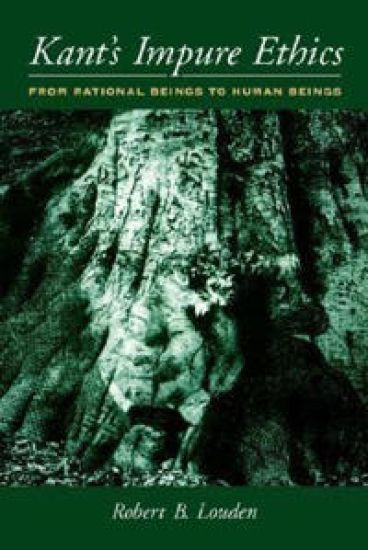
Kant's Impure Ethics

Kant's Impure Ethics

Robert B. Louden

Oxford University Press Inc
2002
nidottu
This is the first book-length study in any language to examine in detail and critically assess the second part of Kant's ethics--an empirical, impure part, which determines how best to apply pure principles to the human situation. Drawing attention to Kant's under-explored impure ethics, this revealing investigation refutes the common and long-standing misperception that Kants ethics advocates empty formalism. Making detailed use of a variety of Kantian texts never before translated into English, author Robert B. Louden reassesses the strengths and weaknesses of Kantian ethics as a whole, once the second part is re-admitted to its rightful place within Kant's practical philosophy.
Kant's Impure Ethics

Kant's Impure Ethics

Robert B. Louden

Oxford University Press Inc
2000
sidottu
This is the first book-length study in any language to examine in detail and critically assess the second part of Kant's ethics--an empirical, impure part, which determines how best to apply pure principles to the human situation. Drawing attention to Kant's under-explored impure ethics, this revealing investigation refutes the common and long-standing misperception that Kant's ethics advocates empty formalism. Making detailed use of a variety of Kantian texts never before translated into English, author Robert B. Louden reassesses the strengths and weaknesses of Kantian ethics as a whole, once the second part is re-admitted to its rightful place within Kant's practical philosophy.
Morality and Moral Theory

Morality and Moral Theory

Robert B. Louden

Oxford University Press Inc
1992
nidottu
Contemporary philosophers have grown increasingly sceptical toward both morality and moral theory. Some argue that moral theory is a radically misguided enterprise which does not illuminate moral practice, while others simply deny the value of morality in human life. In this book, Robert Louden attempts to respond to the arguments of both 'anti-morality' and 'anti-theory' sceptics. In Part One, he develops and defends an alternative conception of morality. On Louden's model, morality is primarily a matter of what one does to oneself, rather than what one does or does not do to others. This model eliminates the gulf that many anti-morality critics say exists between morality's demands and the personal point of view. Louden further argues that morality's primary focus should be on agents and their lives, rather than on right actions, and that it is always better to be morally better - ie it is impossible to be 'too moral'. Part Two presents Louden's alternative conception of moral theory. He reaffirms the necessity and importance of moral theory in human life, and shows that moral theories fulfill a variety of genuine and indispensable human needs.