

Kirjailija
Robert Boyd
Kirjat ja teokset yhdessä paikassa: 40 kirjaa, julkaisuja vuosilta 1988-2025, suosituimpien joukossa People of the Dalles. Vertaile teosten hintoja ja tarkista saatavuus suomalaisista kirjakaupoista.
40 kirjaa
Kirjojen julkaisuhaarukka 1988-2025.




Glad Tidings, or Believe And Live
Robert Boyd
Createspace Independent Publishing Platform
2015
nidottu

First Words to Young Christians
Robert Boyd
Createspace Independent Publishing Platform
2015
nidottu

How to Repair Your Credit in 180 Days: A Self-Help Guide to Restoring Your Credit
Robert Boyd
Midnight Express Books
2014
nidottu



Mathematical Models of Social Evolution – A Guide for the Perplexed
Richard Mcelreath; Robert Boyd
University of Chicago Press
2007
nidottu
Over the last several decades, mathematical models have become central to the study of social evolution, both in biology and the social sciences. But students in these disciplines often seriously lack the tools to understand them. A primer on behavioral modeling that includes both mathematics and evolutionary theory, "Mathematical Models of Social Evolution" aims to make the student and professional researcher in biology and the social sciences fully conversant in the language of the field. Teaching biological concepts from which models can be developed, Richard McElreath and Robert Boyd introduce readers to many of the typical mathematical tools that are used to analyze evolutionary models and end each chapter with a set of problems that draw upon these techniques. "Mathematical Models of Social Evolution" equips behaviorists and evolutionary biologists with the mathematical knowledge to truly understand the models on which their research depends. Ultimately, McElreath and Boyd's goal is to impart the fundamental concepts that underlie modern biological understandings of the evolution of behavior so that readers will be able to more fully appreciate journal articles and scientific literature and start building models of their own.

Mathematical Models of Social Evolution – A Guide for the Perplexed
Richard Mcelreath; Robert Boyd
University of Chicago Press
2007
sidottu
Over the last several decades, mathematical models have become central to the study of social evolution, both in biology and the social sciences. But students in these disciplines often seriously lack the tools to understand them. A primer on behavioral modeling that includes both mathematics and evolutionary theory, "Mathematical Models of Social Evolution" aims to make the student and professional researcher in biology and the social sciences fully conversant in the language of the field. Teaching biological concepts from which models can be developed, Richard McElreath and Robert Boyd introduce readers to many of the typical mathematical tools that are used to analyze evolutionary models and end each chapter with a set of problems that draw upon these techniques. "Mathematical Models of Social Evolution" equips behaviorists and evolutionary biologists with the mathematical knowledge to truly understand the models on which their research depends. Ultimately, McElreath and Boyd's goal is to impart the fundamental concepts that underlie modern biological understandings of the evolution of behavior so that readers will be able to more fully appreciate journal articles and scientific literature and start building models of their own.
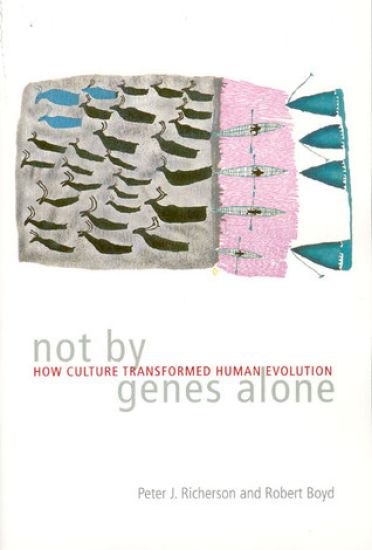
Humans are a striking anomaly in the natural world. While we are similar to other mammals in many ways, our behavior sets us apart. Our unparalleled ability to adapt has allowed us to occupy virtually every habitat on earth, and our societies are larger, more complex, and more cooperative than any other mammal's. In "Not by Genes Alone", Peter J. Richerson and Robert Boyd argue that only a Darwinian theory of cultural evolution can explain these unique characteristics. "Not by Genes Alone" offers a radical interpretation of human evolution, arguing that our ecological dominance and our singular social systems stem from a psychology uniquely adapted to create complex culture. Richerson and Boyd consider culture to be essential to human adaptation, as much a part of human biology as bipedal locomotion. Drawing on work in the fields of anthropology, political science, sociology, and economics - and building their case with such fascinating examples as kayaks, clever knots, and yams that require twelve men to carry them - Richerson and Boyd convincingly demonstrate that culture and biology are inextricably linked. In abandoning the nature-versus-nurture debate as fundamentally misconceived, "Not by Genes Alone" is a truly original and groundbreaking theory of the role of culture in evolution and a book to be reckoned with for generations to come.


World War I stereoview sets remained popular for many years after the war ended. In the United States, the most commonly encountered World War I stereographs were produced by four companies: Keystone View Company, Underwood & Underwood, and W.E. Troutman of this country, and Realistic Travels of England. Of those four, Keystone was the largest and in business the longest time. It produced over 800 war stereographs, most a part of one or more of the seven principle war sets. The Great War Through Keystone Stereographs describes these sets from the first one in 1915 to the last one in 1932. It includes photos of over 120 stereoviews and complete title lists for each set. While Keystone stereoviews are the most common in this country, not all Keystone cards are common. . The Great War Through Keystone Stereographs provides for the first time a sound basis for estimating their market value. Anyone who looks at Keystone war stereographs card on eBay will find that dealers and collectors alike betray considerable ignorance of their scarcity, with common cards being offered (and purchased) at $25.00 and rare cards and sets going for a song. As we approach the centennial of the Great War, stereocards about it are likely to become increasingly popular. The collector who owns this book will avoid overpaying and will be able to find bargains. . The Great War Through Keystone Stereographs is far more than a catalog. The chapters on each set offer serious students of the war and photography insight into Keystone's editorial decisions as they continually tried to improve the quality of their coverage of the Great War. It also establishes previous unknown links among producers of stereographs of the period and makes sense of the baffling number patterns apparent in any group of cards. It is an indispensable a reference to historians and dealers.

Written for the practicing electronics professional, Tolerance Analysis of Electronic Circuits Using MATHCADä offers a comprehensive, step-by-step treatment of methods used to perform analyses essential to the design process of circuit cards and systems of cards, including:worst-case analysis, limits for production testing, component stress analysis, determining if a design meets specification limits, and manufacturing yield analysis Using a practical approach that allows engineers and technicians to put the techniques directly into practice, the author presents the mathematical procedures used to determine performance limits. The topics and techniques discussed include extreme value and root-sum-square analysis using symmetric and asymmetric tolerance, Monte Carlo analysis using normal and uniform distributions, sensitivity formulas, tolerance analyses of opamp offsets, and anomalies of high-Q ac circuits.

Written for the practicing electronics professional, Tolerance Analysis of Electronic Circuits Using MATLAB offers a comprehensive, step-by-step treatment of methods used to perform analyses essential to the design process of circuit cards and systems of cards, including:worst-case analysis, limits for production testing, component stress analysis, determining if a design meets specification limits, and manufacturing yield analysis Using a practical approach that allows engineers and technicians to put the techniques directly into practice, the author presents the mathematical procedures used to determine performance limits. The topics and techniques discussed include extreme value and root-sum-square analysis using symmetric and asymmetric tolerance, Monte Carlo analysis using normal and uniform distributions, sensitivity formulas, tolerance analyses of opamp offsets, and anomalies of high-Q ac circuits.

Tax planning can lead to considerable efficiencies, but few GPs have been trained as businessmen. This book in "The Business Side of General Practice" series, provides a guide to the regulations, identifies the pitfalls and opportunities and shows how to maximize the income retained by the practice. John Dean is known for his writing on financial management in general practice and has also written "Making Sense of Practice Finance" (Radcliff).

Paediatric Problems in General Practice
Michael Modell; Zulf Mughal; Robert Boyd
Oxford University Press
1996
nidottu
This tremendously popular guide to caring for children's health in the primary care setting has been completely revised and updated for the new edition. It includes guidance on the implications of the Children Act and child protection, Health for All Children, screening in pregnancy, asthma management, and other recent changes in practice and in the law. This is the most reliable and up-to-date book available for the primary health care team.

Culture and the Evolutionary Process
Robert Boyd; Peter J. Richerson
University of Chicago Press
1988
nidottu
How do biological, psychological, sociological, and cultural factors combine to change societies over the long run? Boyd and Richerson explore how genetic and cultural factors interact, under the influence of evolutionary forces, to produce the diversity we see in human cultures. Using methods developed by population biologists, they propose a theory of cultural evolution that is an original and fair-minded alternative to the sociobiology debate.