Kirjojen hintavertailu. Mukana 12 595 353 kirjaa ja 12 kauppaa.

Kirjailija

Robert Cassanello

Kirjat ja teokset yhdessä paikassa: 2 kirjaa, julkaisuja vuosilta 2013-2016, suosituimpien joukossa To Render Invisible. Vertaile teosten hintoja ja tarkista saatavuus suomalaisista kirjakaupoista.

2 kirjaa

Kirjojen julkaisuhaarukka 2013-2016.

To Render Invisible

To Render Invisible

Robert Cassanello

University Press of Florida
2016
nidottu
What defines a city’s public space? Who designates such areas, who determines their uses, and who gets to use them? Robert Cassanello uses rough-and-tumble nineteenth-century Jacksonville as both backdrop and springboard to explore social transformation in Florida and the South. When free black men in the city were first given the right to vote, conservative lawmakers made concerted efforts to drive them out of white public spaces. They attempted to make the public sphere a white domain by rendering blacks voiceless—invisible—in the public square. In response, a black counterpublic developed, flourishing clandestinely at times and openly challenging racism in the public sphere at others.Fortified by the theories of Henri Lefebvre, David Harvey, and Jürgen Habermas, To Render Invisible is the first book to focus on the tumultuous emergence of African American public life in Jacksonville between Reconstruction and the 1920s. Robert Cassanello brings to light many of the reasons Jacksonville, like Birmingham, Alabama, and other cities throughout the South, continues to struggle with its contentious racial past.
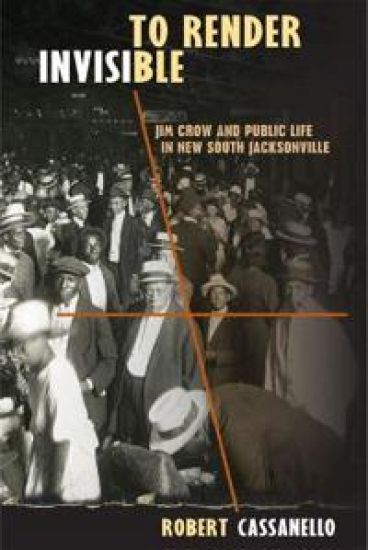
To Render Invisible

To Render Invisible

Robert Cassanello

University Press of Florida
2013
sidottu
What defines a city’s public space? Who designates such areas, who determines their uses, and who gets to use them? Today’s “Occupy” movement has brought widespread attention to these issues, but Robert Cassanello demonstrates that such questions have been part of urban life for more than a century.Rough-and-tumble nineteenth-century Jacksonville serves as a springboard to his exploration of social transformation in Florida and the South. When free black men in the city first began to vote, conservative lawmakers pushed blacks from white public spaces in order to make blacks voiceless—invisible—in the public square and thus making the public sphere a white domain. The response was a black counter public that at times flourished clandestinely and at other times challenged racism in the public sphere. Fortified by the theories of Henri Lefebvre, David Harvey, and Jürgen Habermas, this is the first book to focus on the tumultuous emergence of the African American working class in Jacksonville between Reconstruction and the 1920s. Cassanello brings to light many of the reasons Jacksonville, like Birmingham, Alabama, and other cities throughout the South, continues to struggle with its contentious racial past.