Kirjojen hintavertailu. Mukana 12 595 353 kirjaa ja 12 kauppaa.

Kirjailija

Robert Chambers

Kirjat ja teokset yhdessä paikassa: 428 kirjaa, julkaisuja vuosilta 1983-2026, suosituimpien joukossa The Songs of Scotland. Vertaile teosten hintoja ja tarkista saatavuus suomalaisista kirjakaupoista.

428 kirjaa

Kirjojen julkaisuhaarukka 1983-2026.

Settlement Schemes in Tropical Africa

Settlement Schemes in Tropical Africa

Robert Chambers

Routledge
1998
sidottu
First published in 1998. This is Volume XIII of eighteen in the Sociology of Development series. Originally published in 1969, this book is a study of organizations and development of two rural development projects by the author whilst working in the Administration in Kenya: a grazing control programme and the Mwea Irrigation Settlement.
Whose Reality Counts?

Whose Reality Counts?

Robert Chambers

ITDG Publishing
1997
nidottu
In this sequel to Rural Development: Putting the last first Robert Chambers argues that central issues in development have been overlooked, and that many past errors have flowed from domination by those with power. Development professionals now need new approaches and methods for interacting, learning and knowing. Through analysing experience - of past mistakes and myths, and of the continuing methodological revolution of PRA (participatory rural appraisal) - the author points towards solutions. In many countries, urban and rural people alike have shown an astonishing ability to express and analyse their local, complex and diverse realities which are often at odds with the top-down realities imposed by professionals. The author argues that personal, professional and institutional change is essential if the realities of the poor are to receive greater recognition. Self-critical awareness and changes in concepts, values, methods and behaviour must be developed to explore the new high ground of participation and empowerment. Whose Reality Counts? presents a radical challenge to all concerned with development, whether practitioners, researchers or policy-makers, in all organizations and disciplines, and at all levels from fieldworkers to the heads of agencies. With its thrust of putting the first last it presents a new, exciting and above all practical agenda for future development which cannot be ignored. BAI Catalogue: The methods and approaches of Participatory Rural Appraisal (PRA) comprise the core of this book. But PRA has evolved and spread in many directions and into many areas. The author argues that PRA has come to affect much development practice, professionalism, research, education, training, management and many institutions. The PRA experience has led into wider questions about development and about the human condition. It has pointed towards a gap in the writing about development - the lack of analysis of how error, professionalism, power and personal interaction interlink - a gap which the author tries to fill with this book. The argument runs that reflective and self-critical PRA practitioners are evolving a philosophy and behaviour which seem to promise better performance. This new approach combined with other trends are part of a deep shift in ways of thinking, seeing, acting and being in the world. So the book is about more than PRA and more than just development. The author contends that, as a term, participatory rural appraisal no longer describes what is happening. Participatory fits but rural is wrong because of innumerable applications in urban areas, organisations, adult literacy, policy and so on; and appraisal implies only finding out and assessment, when many want PRA to describe a much longer process. PRA has become fashionable but the author contends that bad practice is widespread and asks whether PRA can be self-improving as it spreads. This is a thought-provoking book and it would interest all those concerned with the realities of the poor in the developing world.
Resulting Trusts

Resulting Trusts

Robert Chambers

Clarendon Press
1997
sidottu
The resulting trust has received little attention in recent years and this may be because, until relatively recently, the law relating to resulting trusts was thought to be settled and uncontroversial. Most of the current academic writing about resulting trusts is found in the established textbooks on equity and trusts, but these tend to provide little more than catalogues of the situations in which resulting trusts arise. There is, however, very little consensus on the principle by which the resulting trust operates, including the fundamental question whether it arises by opertaion of law or depends on the presumed intention to create a trust. This book examines the true nature of the resulting trust and the question whether the trusts brought into being to reverse unjust enrichment should not include resulting trusts. It then considers whether, when resulting trusts are properly understood, it does turn out that it is through the resulting trust that equity makes its principle contribution to reversing unjust enrichment. This book examines principally the case law of the UK, Canada and Australia, and it also makes reference to the views of academic commentators as found in the standard texts and law journals.
Challenging the Professions

Challenging the Professions

Robert Chambers

ITDG Publishing
1993
nidottu
Questioning the dominant approaches taken by many professionals concerned with rural development the theme of this book is that 'we' - the professionals - are much of the problem. New frontiers could be opened by reversing many ideas and practices.
To the Hands of the Poor

To the Hands of the Poor

Robert Chambers; N Saxena; Tushaar Shah

Practical Action Publishing
1989
nidottu
Confronts the paradox of mass poverty coexisting with vast resource potentials in rural India, such as the potentials from groundwater and trees, previously underestimated. Combines empirical research with practical political economy.
Managing Canal Irrigation

Managing Canal Irrigation

Robert Chambers

Cambridge University Press
1989
pokkari
The many billions of dollars invested in canal irrigation in recent decades have had disappointing results. Rarely have projected benefits in well-being or production been achieved. In consequence, in the mid-1980s, further vast sums are being spent throughout the Third World on programmes for rehabilitation, canal lining, on farm development, and farmers’ organisation. In this book, Robert Chambers shows that much of this policy and practice is based on misleading research and misdiagnosis. When applied to the complexity and uniqueness of canal irrigation systems, the normal professionalism of civil and agricultural engineers, agronomists, economists, and sociologists, leaves gaps which are keys to better performance. In successive chapters, five such gaps are analysed and presented: main system management, including the scheduling and delivery of water, and communications; canal irrigation at night; management of canal systems jointly by farmers and officials; professional conditions and incentives for irrigation managers; and methods for diagnostic analysis to identify cost-effective actions for improvement. Managing Canal Irrigation has been written for policy-makers, irrigation managers, consultants, researchers, trainers and teachers. It challenges all concerned with improving the performance and anti-poverty impact of canal irrigation, whether in government departments, aid agencies, consultancy firms, training and research institutes or universities, to re-examine their beliefs, biases and actions. By going beyond the limits of normal professionalism, the book presents a new syllabus for training, a new agenda for research and development, and points to new policies and to practical action to be taken in the field.
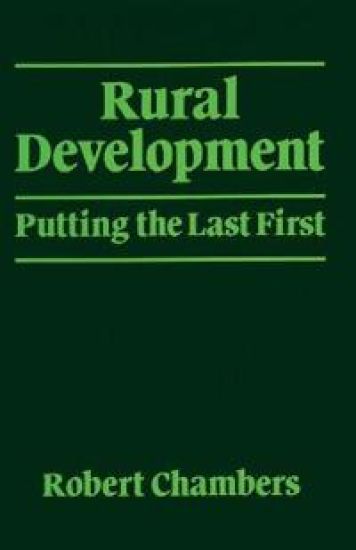
Rural Development

Rural Development

Robert Chambers

Prentice-Hall
1983
nidottu
Rural poverty is often unseen or misperceived by outsiders. Dr Chambers contends that researchers, scientists, administrators and fieldworkers rarely appreciate the richness and validity of rural people's knowledge or the hidden nature of rural poverty. This is a challenging book for all concerned with rural development, as practitioners, academics, students or researchers.