Kirjojen hintavertailu. Mukana 12 585 136 kirjaa ja 12 kauppaa.

Kirjailija

Robert Chazan

Kirjat ja teokset yhdessä paikassa: 15 kirjaa, julkaisuja vuosilta 1992-2020, suosituimpien joukossa Cultures and Contexts of Jewish Education. Vertaile teosten hintoja ja tarkista saatavuus suomalaisista kirjakaupoista.

15 kirjaa

Kirjojen julkaisuhaarukka 1992-2020.

Medieval Jewry in Northern France

Medieval Jewry in Northern France

Robert Chazan

Johns Hopkins University Press
2020
pokkari
Originally published in 1974. Focusing on a set of Jewish communities, Robert Chazan tells how, by the eleventh century, French Jews had created for themselves a role as local merchants and moneylenders in adapting to the political, economic, and social limits imposed on them. French society, striving to become more powerful and civilized, was willing to extend aid and protection to the Jews in return for general stimulation of trade and urban life and for the immediate profit realized from taxation. While the authorities were relatively successful in protecting the Jews from others, there was no power to impose itself between the Jews and their protectors. The political and social well-being of the Jews was, therefore, dependent on the will of the governing authorities who taxed their holdings and regulated their activities. During the twelfth and thirteenth centuries, the position of the Jews was constantly under attack by reform elements in the church concerned with Jewish moneylending and blasphemous materials in Jewish books; these reformers were eventually devoted to a serious missionizing effort within the Jewish community. The Jews' situation was further complicated by deep popular animosity, expressing itself in a damaging set of slanders and occasionally in physical violence. Despite the impressive achievements of the Jews in medieval northern France, by the thirteenth century their community was increasingly constricted; and in 1306, they were expelled from royal France by Philip IV. Overcoming the handicap of a lack of copious source material, Chazan analyzes the Jews' political status, their relations with key elements of Christian society, their demographic development, their economic outlets, their internal organization, and their attitudes toward the Christian environment. As it highlights aspects of French society from an unusual perspective, Medieval Jewry in Northern France should be of special interest to the historian of medieval France as well as to the student of Jewish history. This story is also significant for all who are fascinated by the capacity of human groups to respond and adapt creatively to a hostile and limiting environment.
Cultures and Contexts of Jewish Education

Cultures and Contexts of Jewish Education

Barry Chazan; Robert Chazan; Benjamin M. Jacobs

Springer International Publishing AG
2018
nidottu
This book examines the history of Jewish education from the Biblical period to the present. It traces how Jews have formally and informally transmitted their culture and worldview over the years, with particular attention to the shift from premodernity to modernity and to the unique opportunities and challenges of contemporary American Jewish education. Its authors combine historical background and insight with educational expertise to provide a robust portrait of the cultures and contexts of Jewish education and address possibilities for the future.
From Anti-Judaism to Anti-Semitism

From Anti-Judaism to Anti-Semitism

Robert Chazan

Cambridge University Press
2016
sidottu
From its earliest days, Christianity has viewed Judaism and Jews ambiguously. Given its roots within the Jewish community of first-century Palestine, there was much in Judaism that demanded Church admiration and praise; however, as Jews continued to resist Christian truth, there was also much that had to be condemned. Major Christian thinkers of antiquity - while disparaging their Jewish contemporaries for rejecting Christian truth - depicted the Jewish past and future in balanced terms, identifying both positives and negatives. Beginning at the end of the first millennium, an increasingly large Jewish community started to coalesce across rapidly developing northern Europe, becoming the object of intense popular animosity and radically negative popular imagery. The portrayals of the broad trajectory of Jewish history offered by major medieval European intellectual leaders became increasingly negative as well. The popular animosity and the negative intellectual formulations were bequeathed to the modern West, which had tragic consequences in the twentieth century. In this book, Robert Chazan traces the path that began as anti-Judaism, evolved into heightened medieval hatred and fear of Jews, and culminated in modern anti-Semitism.
Reassessing Jewish Life in Medieval Europe

Reassessing Jewish Life in Medieval Europe

Robert Chazan

Cambridge University Press
2010
sidottu
This book re-evaluates the prevailing notion that Jews in medieval Christian Europe lived under an appalling regime of ecclesiastical limitation, governmental exploitation and expropriation, and unceasing popular violence. Robert Chazan argues that, while Jewish life in medieval Western Christendom was indeed beset with grave difficulties, it was nevertheless an environment rich in opportunities; the Jews of medieval Europe overcame obstacles, grew in number, explored innovative economic options, and fashioned enduring new forms of Jewish living. His research also provides a reconsideration of the legacy of medieval Jewish life, which is often depicted as equally destructive and projected as the underpinning of the twentieth-century catastrophes of antisemitism and the Holocaust. Dr Chazan's research proves that, although Jewish life in the medieval West laid the foundation for much Jewish suffering in the post-medieval world, it also stimulated considerable Jewish ingenuity, which lies at the root of impressive Jewish successes in the modern West.
Reassessing Jewish Life in Medieval Europe

Reassessing Jewish Life in Medieval Europe

Robert Chazan

Cambridge University Press
2010
pokkari
This book re-evaluates the prevailing notion that Jews in medieval Christian Europe lived under an appalling regime of ecclesiastical limitation, governmental exploitation and expropriation, and unceasing popular violence. Robert Chazan argues that, while Jewish life in medieval Western Christendom was indeed beset with grave difficulties, it was nevertheless an environment rich in opportunities; the Jews of medieval Europe overcame obstacles, grew in number, explored innovative economic options, and fashioned enduring new forms of Jewish living. His research also provides a reconsideration of the legacy of medieval Jewish life, which is often depicted as equally destructive and projected as the underpinning of the twentieth-century catastrophes of antisemitism and the Holocaust. Dr Chazan's research proves that, although Jewish life in the medieval West laid the foundation for much Jewish suffering in the post-medieval world, it also stimulated considerable Jewish ingenuity, which lies at the root of impressive Jewish successes in the modern West.
Fashioning Jewish Identity in Medieval Western Christendom

Fashioning Jewish Identity in Medieval Western Christendom

Robert Chazan

Cambridge University Press
2009
pokkari
During the course of the twelfth century, increasing numbers of Jews migrated into dynamically developing western Christendom from Islamic lands. The vitality that attracted them also presented a challenge: Christianity - from early in its history - had proclaimed itself heir to a failed Jewish community and thus the vitality of western Christendom was both appealing and threatening to the Jewish immigrants. Indeed, western Christendom was entering a phase of intense missionising activity, some of which was directed at the long-term Jewish residents of Europe and the Jewish newcomers. This 2003 study examines the techniques of persuasion adopted by the Jewish polemicists in order to reassure their Jewish readers of the truth of Judaism and the error of Christianity. At the very deepest level, these Jewish authors sketched out for their fellow Jews a comparative portrait of Christian and Jewish societies - the former powerful but irrational and morally debased, the latter the weak but reasonable and morally elevated - urging that the obvious and sensible choice was Judaism.
The Jews of Medieval Western Christendom

The Jews of Medieval Western Christendom

Robert Chazan

Cambridge University Press
2006
sidottu
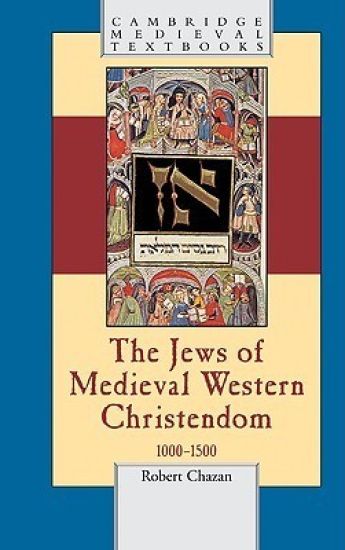
Between the years AD 1000 and 1500, western Christendom absorbed by conquest and attracted through immigration a growing number of Jews. This community was to make a valuable contribution to rapidly developing European civilisation but was also to suffer some terrible setbacks, culminating in a series of expulsions from the more advanced westerly areas of Europe. At the same time, vigorous new branches of world Jewry emerged and a rich new Jewish cultural legacy was created. In this important historical synthesis, Robert Chazan discusses the Jewish experience over a 500 year period across the entire continent of Europe. As well as being the story of medieval Jewry, the book simultaneously illuminates important aspects of majority life in Europe during this period. This book is essential reading for all students of medieval Jewish history and an important reference for any scholar of medieval Europe.
The Jews of Medieval Western Christendom

The Jews of Medieval Western Christendom

Robert Chazan

Cambridge University Press
2006
pokkari
Between the years AD 1000 and 1500, western Christendom absorbed by conquest and attracted through immigration a growing number of Jews. This community was to make a valuable contribution to rapidly developing European civilisation but was also to suffer some terrible setbacks, culminating in a series of expulsions from the more advanced westerly areas of Europe. At the same time, vigorous new branches of world Jewry emerged and a rich new Jewish cultural legacy was created. In this important historical synthesis, Robert Chazan discusses the Jewish experience over a 500 year period across the entire continent of Europe. As well as being the story of medieval Jewry, the book simultaneously illuminates important aspects of majority life in Europe during this period. This book is essential reading for all students of medieval Jewish history and an important reference for any scholar of medieval Europe.
Fashioning Jewish Identity in Medieval Western Christendom

Fashioning Jewish Identity in Medieval Western Christendom

Robert Chazan

Cambridge University Press
2003
sidottu
During the course of the twelfth century, increasing numbers of Jews migrated into western Christendom from Islamic lands. But western Christendom was both appealing and threatening to the Jewish immigrants. Indeed, western Christendom was entering a phase of intense missionizing activity, some of which was directed at the long-term Jewish residents of Europe and the Jewish newcomers. The writings of twelfth- and thirteenth-century leaders from southern France and northern Spain constitute the first evidence of Jewish anti-Christian polemics from within western Christendom. These leaders were fully cognizant of the core Christian thrusts, described them in detail for their co-religionists, and rebutted them carefully. This study recreates some of the clarification and rebuttal, and examines the techniques of persuasion adopted by the Jewish polemicists in order to reassure their Jewish readers of the truth of Judaism and the error of Christianity.
God, Humanity, and History

God, Humanity, and History

Robert Chazan

University of California Press
2000
sidottu
Although closely focused on the remarkable Hebrew First-Crusade narratives, Robert Chazan's new interpretation of these texts is anything but narrow, as his title, "God, Humanity, and History", strongly suggests. The three surviving Hebrew accounts of the crusaders' devastating assaults on Rhineland Jewish communities during the spring of 1096 have been examined at length, but only now can we appreciate the extent to which they represent their turbulent times. After a close analysis of the texts themselves, Chazan addresses the objectives of the three narratives. He compares these accounts with earlier Jewish history writing and with contemporary crusade historiography. It is in their disjuncture with past forms of Jewish historical narration and their amazing parallels with Latin crusade narratives that the Hebrew narratives are most revealing. We see how they reflect the embeddedness of early Ashkenazic Jewry in the vibrant atmosphere of late-eleventh- and early-twelfth-century northern Europe.
Jewish Suffering

Jewish Suffering

Robert Chazan

Medieval Institute Publications
1998
nidottu
Early Christianity understood the destruction of the Second Temple (70 C.E.) as the immediate outcome of the Jewish rejection of Jesus, a view later reinforced by the perception of permanent Jewish degradation evident in the continued exile and inferior status of Jews in the societies that hosted them. Aware of this view, Jews of Western Christendom interpreted their suffering in more triumphal ways. Hebrew narratives of the First Crusade (1096) depict the Christian understanding of Crusader attacks on Jewish communities as part of the ongoing degradation of Jews and evidence that they ought to convert to Christianity. Two important Hebrew sources, the Mainz Anonymous and the Solomon bar Simson Chronicle, counter this view with the perspective of a glorification of Jewish martyrdom found in the same events. By the mid-thirteenth century, the argument that Jewish suffering was a result of God's rejection of the Jews was paramount to Christian efforts to win over Jews in forced debates and forced sermons - instruments employed by such converts as Friar Paul and Alfonso of Valladolid. Jewish authors, such as Nahmanides (in his famous debate with Friar Paul) and Rabbi Mordechai ben Joseph of Avignon, asserted that Christian claims of divine favor were erroneous, and that God's promise of redemption for Jews was still valid. These methods to resist Christian assertions of superiority and affirm the grandeur of Jewish experience were essential for the continuity of Jewish life in the Middle Ages.
Medieval Stereotypes and Modern Antisemitism

Medieval Stereotypes and Modern Antisemitism

Robert Chazan

University of California Press
1997
sidottu
The twelfth century in Europe, hailed by historians as a time of intellectual and spiritual vitality, had a dark side. As Robert Chazan points out, the marginalization of minorities emerged during the "twelfth-century renaissance" as part of a growing pattern of persecution, and among those stigmatized the Jews figured prominently. The migration of Jews to northern Europe in the late tenth century led to the development of a new set of Jewish communities. This northern Jewry prospered, only to decline sharply two centuries later. Chazan locates the cause of the decline primarily in the creation of new, negative images of Jews. He shows how these damaging twelfth-century stereotypes developed and goes on to chart the powerful, lasting role of the new anti-Jewish imagery in the historical development of antisemitism. This coupling of the twelfth century's notable intellectual bequests to the growth of Western civilization with its legacy of virulent anti-Jewish motifs offers an important new key to understanding modern antisemitism.
In the Year 1096

In the Year 1096

Robert Chazan

Jewish Publication Society
1996
pokkari
In the Year 1096 presents a clear, highly readable chronicle of the events of 1096. Noted teacher and historian Robert Chazan brings readers to critical moments in Jewish history, illuminating the events themselves, their antecedents, and their far-reaching consequences. Equally important, his book assesses the significance of the events of 1096 within the larger framework of Jewish history, including both the scope of persecution and the record of Jewish resistance.
European Jewry and the First Crusade

European Jewry and the First Crusade

Robert Chazan

University of California Press
1996
pokkari
One of the unanticipated results of the First Crusade in 1095 was a series of violent assaults on major Jewish communities in the Rhineland. Robert Chazan offers the first detailed analysis of these events, illuminating the attitudes that triggered the assaults as well as the beliefs that informed Jewish reactions to them.
Barcelona and Beyond

Barcelona and Beyond

Robert Chazan

University of California Press
1992
sidottu
In late July 1263 a public disputation was convened by King James I of Aragon, pitting Friar Paul Christian against the distinguished rabbi of Gerona, Moses ben Nahman. Organized by leading figures in the Dominican Order to give Friar Paul an opportunity to test his innovative missionizing argumentation against a worthy opponent, the spectacle in Barcelona was colorful, impressive, surely somewhat frightening to the Jews, and ultimately indecisive. Both sides claimed victory, and their documented claims have given rise to substantial disagreement among historians over the tone and outcome of this important event. Robert Chazan's masterly analysis reconstructs the Barcelona disputation from the conflicting Christian and Jewish sources and sets it in its broad historical context, with particular attention to the post-disputation maneuvers on both sides. His richly detailed account focuses on Rabbi ben Nahman's eloquent efforts to reassure his fellow Jews in the face of new missionizing pressures.