Kirjojen hintavertailu. Mukana 12 595 353 kirjaa ja 12 kauppaa.

Kirjailija

Robert D. Kaplan

Kirjat ja teokset yhdessä paikassa: 28 kirjaa, julkaisuja vuosilta 1995-2026, suosituimpien joukossa Politik och ideologier : perspektiv från Engelbergsseminariet 2011. Vertaile teosten hintoja ja tarkista saatavuus suomalaisista kirjakaupoista.

Mukana myös kirjoitusasut: Robert D Kaplan

28 kirjaa

Kirjojen julkaisuhaarukka 1995-2026.

Politik och ideologier : perspektiv från Engelbergsseminariet 2011

Politik och ideologier : perspektiv från Engelbergsseminariet 2011

Ulrike Ackermann; Scott Atran; James Bartolomew; Michael Bentley; Paul Berman; Vernon Bogdanor; Nick Boles; Robert Cooper; Stephan Eisel; Richard J Evans; Michael Freeden; David Frum; Dick Harrison; Anna Jardfeldt; Oliver Kamm; Robert D Kaplan; John Keane; Johan Lagerkvist; Mark Leonard; John Lloyd; Hisham Melhem; Richard Miles; Kenneth Minogue; Minxin Pei; Malise Ruthven; Roger Scruton; Per Schlingman; Nathan Shachar; Robert J Shapiro; Maria Wetterstrand

Bokförlaget Atlantis
2012
sidottu
Ideologiernas död har förutspåtts ett flertal gånger under åren, men gång på gång har vi också sett gamla ideologier återvända under nya beteckningar. I denna bok behandlar vi både nuet och det förflutna. Vi belyser en del av de politiska idéer och system i historien som fortsätter att utöva inflytande på samtiden. Vi granskar också den auktoritära statskapitalismen, som i fallet Kina, och ställer frågan om den är hållbar. Om så är fallet, hur kommer den att inverka på världen? Kommer den att bli förebilden, precis som liberal demokrati under lång tid har varit det för många människor och nationer? Kommer islamism, främlings- och invandrarfientliga partier och andra rörelser i marginalen av det politiska och ideologiska spektrumet i Europa, USA och den islamiska världen att befästa den rådande ordningen eller undergräva tilltron till den? Vilka är globaliseringens konsekvenser för politik och ideologi? Kommer svaret att bli ett världsparlament, en världsomfattande miljörörelse eller olika strömningar med religion som gemensam nämnare? Eller kommer vi kanske i stället att få se ett annat gammalt spöke återvända: nationalismen? Boken ingår i serien Engelsbergsseminarierna och utges i samarbete med Bokförlaget Atlantis och Axel och Margaret Ax:son Johnsons stiftelse för almännyttiga ändamål.

China Whisperers: The Voices That Have Shaped America's Views of Its Chief Geopolitical Rival
From one of the most prominent post-Cold War geopolitics experts and "a grand strategist to whom the Pentagon turns" (The Wall Street Journal), a probing and insight-filled look at the China experts who have influenced--and continue to influence--America's policy toward its greatest rival. No country or civilization is as big or as old as China. And in the minds of Americans whose job it is to contemplate international affairs, China has always been more than just the "ultimate place" quite simply, it is the essential foreign policy challenge--one frequently thought incapable of being solved. Enter the China Whisperers: American missionaries, travelers, journalists, linguists, and foreign service officers who, going back a hundred years, have been on the ground, fluent in Mandarin, and enamored of the culture. In the early and mid-20th century, these were the true China experts of the Western world. Some proved unwitting dupes, others showed their brilliance. What lured them to that distant nation? With its deep history and unstable present, China was something Americans could use both to fill their dreams and measure their own young nation directly against. To this cohort of Americans, it seemed possible for outsiders like themselves to shape China and its destiny. And over a period of a few transformative decades they had front-row seats to the formation of both the Nationalist and Communist parties; crossed the Gobi Desert; searched out the young Mao Zedong in the wilds of Yen'an province; provided visionary analysis on the American predicament in Asia; bore witness to China's World War II; and made invaluable contributions to journalism and diplomacy. But the China Whisperers may have gotten too close to the story. Washington rejected their counsel when they contradicted reigning ideology, and, tragically, these ground-level experts offered advice that was often ignored. The ranks of China Whisperers have been filled in recent years not so much by nomadic journalists and explorers as by multi-lingual policy experts who've had the ear of the person occupying the Oval Office. Often, their voices have proved critical, counseling engagement over precipitous moves. China Whisperers is the story of how Americans both have succeeded and failed to interpret China over the past century. It paints a full-bodied portrait of the drama of trying to understand a radically different and age-old culture--one whose rivalry with America constitutes the most dangerous element of geopolitics.
Waste Land

Waste Land

Robert D. Kaplan

C HURST CO PUBLISHERS LTD
2026
nidottu
One of the Financial Times' Books to Read in 2025 One of Foreign Policy's Most Anticipated Books of 2025 A darkly brilliant, wide-angled vision of our chaotic, globalised world, where present crises resonate with past tyrannies—from a bestselling geopolitical expert. We are entering a new era of global cataclysm; a deadly mix of war, climate change, great-power rivalry, rapid technological advancement, and the end of empire. In Waste Land, renowned world affairs author Robert D. Kaplan explains incisively how we got here and where we are going. Kaplan’s trademark sweep of history, literature, politics and philosophy draws parallels between today’s challenges and those of Germany’s interwar Weimar Republic. Today, too, every national disaster could spread across the world, given this century’s singular dilemmas—pandemics, recessions; urbanisation, mass migration; destabilisation under large-scale democracy and great-power conflict; and the intimate bonds forged by digital media. Could stability and historic liberalism, rather than mass democracy per se, save world populations from anarchic breakdown? Waste Land is a bracing glimpse into a future defined by twenty-first–century technology, but remarkably resonant with the past. The situation may be spiralling out of our control—unless our leaders act first.
Waste Land

Waste Land

Robert D. Kaplan

C HURST CO PUBLISHERS LTD
2025
sidottu
One of the Financial Times' Books to Read in 2025 One of Foreign Policy's Most Anticipated Books of 2025 A darkly brilliant, wide-angled vision of our chaotic, globalised world, where present crises resonate with past tyrannies—from a bestselling geopolitical expert. We are entering a new era of global cataclysm; a deadly mix of war, climate change, great-power rivalry, rapid technological advancement, and the end of empire. In Waste Land, renowned world affairs author Robert D. Kaplan explains incisively how we got here and where we are going. Kaplan’s trademark sweep of history, literature, politics and philosophy draws parallels between today’s challenges and those of Germany’s interwar Weimar Republic. Today, too, every national disaster could spread across the world, given this century’s singular dilemmas—pandemics, recessions; urbanisation, mass migration; destabilisation under large-scale democracy and great-power conflict; and the intimate bonds forged by digital media. Could stability and historic liberalism, rather than mass democracy per se, save world populations from anarchic breakdown? Waste Land is a bracing glimpse into a future defined by twenty-first–century technology, but remarkably resonant with the past. The situation may be spiralling out of our control—unless our leaders act first.
Waste Land: A World in Permanent Crisis

Waste Land: A World in Permanent Crisis

Robert D. Kaplan

Random House
2025
sidottu
An urgent exploration of a world in constant crisis, where every regional disaster threatens to become a global conflict, with lessons from history that can stop the spiral--from the New York Times bestselling author of The Revenge of Geography "Compelling and helpful . . . Kaplan's analysis has enormous implications for U.S. strategy abroad. . . . His conclusion is the only right one."--John Bolton, The Wall Street Journal One of Financial Times' Most Important Books to Read This Year - One of Foreign Policy's Most Anticipated Books of the Year We are entering a new era of global cataclysm in which the world faces a deadly mix of war, climate change, great power rivalry, rapid technological advancement, the end of both monarchy and empire, and countless other dangers. In Waste Land, Robert D. Kaplan, geopolitical expert and author of more than twenty books on world affairs, incisively explains how we got here and where we are going. Kaplan makes a novel argument that the current geopolitical landscape must be considered alongside contemporary social phenomena such as urbanization and digital news media, grounding his ideas in foundational modern works of philosophy, politics, and literature, including the poem from which the title is borrowed, and celebrating a canon of traditionally conservative thinkers, including Alexander Solzhenitsyn, Jeane Kirkpatrick, and many others. As in many of his books, Kaplan looks to history and literature to inform the present, drawing particular comparisons between today's challenges and the Weimar Republic, the post-World War I democratic German government that fell to Nazism in the 1930s. Just as in Weimar, which faced myriad crises inextricably bound up with global systems, the singular dilemmas of the twenty-first century--pandemic disease, recession, mass migration, the destabilizing effects of large-scale democracy and great power conflicts, and the intimate bonds created by technology--mean that every disaster in one country has the potential to become a global crisis, too. According to Kaplan, the solutions lie in prioritizing order in governing systems, arguing that stability and historic liberalism rather than mass democracy per se will save global populations from an anarchic future. Waste Land is a bracing glimpse into a future defined by the connections afforded by technology but with remarkable parallels to the past. Just as it did in Weimar, Kaplan fears the situation may be spiraling out of our control--unless our leaders act first.
The Tragic Mind

The Tragic Mind

Robert D. Kaplan

YALE UNIVERSITY PRESS
2024
pokkari
A moving meditation on recent geopolitical crises, viewed through the lens of ancient and modern tragedy “Spare, elegant and poignant. . . . If there is a single contemporary book that should be pressed into the hands of those who decide issues of war and peace, this is it.”—John Gray, New Statesman “It is tragic that Robert D. Kaplan’s luminous The Tragic Mind is so urgently needed.”—George F. Will Some books emerge from a lifetime of hard-won knowledge. Robert D. Kaplan has learned, from a career spent reporting on wars, revolutions, and international politics in Europe, the Middle East, and East Asia, that the essence of geopolitics is tragedy. In The Tragic Mind, he employs the works of ancient Greek dramatists, Shakespeare, German philosophers, and the modern classics to explore the central subjects of international politics: order, disorder, rebellion, ambition, loyalty to family and state, violence, and the mistakes of power. The great dilemmas of international politics, he argues, are not posed by good versus evil—a clear and easy choice—but by contests of good versus good, where the choices are often searing, incompatible, and fraught with consequences. A deeply learned and deeply felt meditation on the importance of lived experience in conducting international relations, this is a book for everyone who wants a profound understanding of the tragic politics of our time.
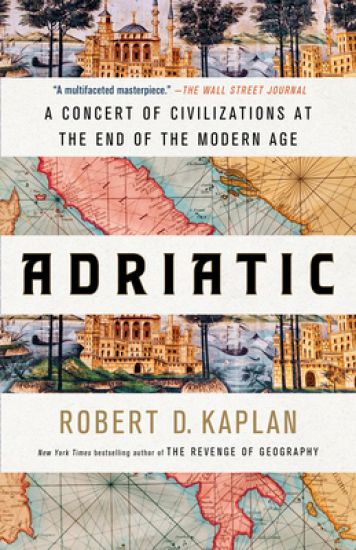
Adriatic

Adriatic

Robert D. Kaplan

RANDOM HOUSE USA INC
2023
nidottu
" An] elegantly layered exploration of Europe's past and future . . . a multifaceted masterpiece."--The Wall Street Journal "A lovely, personal journey around the Adriatic, in which Robert Kaplan revisits places and peoples he first encountered decades ago."--Peter Frankopan, author of The Silk Roads ONE OF THE BEST BOOKS OF THE YEAR: The New Yorker In this insightful travelogue, Robert D. Kaplan, geopolitical expert and bestselling author of Balkan Ghosts and The Revenge of Geography, turns his perceptive eye to a region that for centuries has been a meeting point of cultures, trade, and ideas. He undertakes a journey around the Adriatic Sea, through Italy, Slovenia, Croatia, Montenegro, Albania, and Greece, to reveal that far more is happening in the region than most news stories let on. Often overlooked, the Adriatic is in fact at the center of the most significant challenges of our time, including the rise of populist politics, the refugee crisis, and battles over the control of energy resources. And it is once again becoming a global trading hub that will determine Europe's relationship with the rest of the world as China and Russia compete for dominance in its ports. Kaplan explores how the region has changed over his three decades of observing it as a journalist. He finds that to understand both the historical and contemporary Adriatic is to gain a window on the future of Europe as a whole, and he unearths a stark truth: The era of populism is an epiphenomenon--a symptom of the age of nationalism coming to an end. Instead, the continent is returning to alignments of the early modern era as distinctions between East and West meet and break down within the Adriatic countries and ultimately throughout Europe. With a brilliant cross-pollination of history, literature, art, architecture, and current events, in Adriatic, Kaplan demonstrates that this unique region that exists at the intersection of civilizations holds revelatory truths for the future of global affairs.
Adriatic

Adriatic

Robert D. Kaplan

RANDOM HOUSE USA INC
2022
sidottu
A vital and deeply personal exploration of a historically volatile region that is once again a global crossroads--the Adriatic Sea, including Italy, Croatia, Albania, and Greece--and what that says about the future, from the bestselling author of Balkan Ghosts and The Revenge of Geography. In this insightful travelogue, geopolitical expert Robert D. Kaplan turns his perceptive eye to the Adriatic Sea, a region that has always been a crossroads in trade, culture, and ideas. Kaplan undertakes a journey through Italy and the Balkan countries lining the Adriatic to reveal much more to the region than news stories about resurgent populism or the refugee crisis let on. As he travels, the stark truth emerges that the age of populism is merely an epiphenomenon--a swan song for the age of nationalism itself--and that the future of Europe lies in a different direction entirely as he observes a breaking down of the distinctions between East and West, a return to alignments of an earlier era. Traveling the coastline from Italy to Slovenia and Croatia, to Montenegro to Albania and to Greece, he engages in perceptive cultural criticism and an urgent study of Europe as a whole with a close reading of his personal library and examination of his own career, contrasting his visits to the Adriatic region through the years. He finds clues to what the future may hold in history as he reflects on contemporary issues like the refugee crisis, the return of populist nationalism, battles over the control of fossil fuel resources, and how the Adriatic will once again be a global trading hub. With a cross-pollination of history, literature, art, architecture, and current events, Kaplan demonstrates how Europe is distilled within the geography of the Adriatic, an often-overlooked region rich with answers and insights about the fate of the continent.
Surrender Or Starve

Surrender Or Starve

Robert D Kaplan

Routledge
2021
nidottu
Famine in the Horn is both a tool and an aspect of ethnic conflict, with the Ethiopian Amharas of the central highlands pitted against the Eritreans and Tigreans of the north. The overwhelming majority of U.S. journalists have reported on Ethiopia from one side only-that of the Amharas in Addis Ababa. The author wants to show the story from the other side, in order to redress a grievous imbalance in news coverage. To get people excited, you sometimes have to light a fire, and that was the author’s intention. This book covers the period from late 1984 to the early part of 1987. In late 1987, the famine returned, mainly for the very reasons cited inside.
Surrender Or Starve

Surrender Or Starve

Robert D Kaplan

Routledge
2019
sidottu
Famine in the Horn is both a tool and an aspect of ethnic conflict, with the Ethiopian Amharas of the central highlands pitted against the Eritreans and Tigreans of the north. The overwhelming majority of U.S. journalists have reported on Ethiopia from one side only-that of the Amharas in Addis Ababa. The author wants to show the story from the other side, in order to redress a grievous imbalance in news coverage. To get people excited, you sometimes have to light a fire, and that was the author’s intention. This book covers the period from late 1984 to the early part of 1987. In late 1987, the famine returned, mainly for the very reasons cited inside.
Earning the Rockies

Earning the Rockies

Robert D. Kaplan

Random House Trade Paperbacks
2017
pokkari
An incisive portrait of the American landscape that shows how geography continues to determine America's role in the world Book Club Pick for Now Read This, from PBS NewsHour and The New York Times - "There is more insight here into the Age of Trump than in bushels of political-horse-race journalism."--The New York Times Book Review (Editors' Choice) At a time when there is little consensus about who we are and what we should be doing with our power overseas, a return to the elemental truths of the American landscape is urgently needed. In Earning the Rockies, New York Times bestselling author Robert D. Kaplan undertakes a cross-country journey, traversing a rich and varied landscape that still remains the primary source of American power. Traveling west, in the same direction as the pioneers, Kaplan witnesses both prosperity and decline, and reexamines the history of westward expansion in a new light: as a story not just of genocide and individualism but also of communalism and a respect for the limits of a water-starved terrain. Concluding at the edge of the Pacific Ocean with a gripping description of an anarchic world, Earning the Rockies shows how America's foreign policy response ought to be rooted in its own geographical situation. Praise for Earning the Rockies "Unflinchingly honest . . . a lens-changing vision of America's role in the world . . . a jewel of a book that lights the path ahead."--Secretary of Defense James Mattis "A sui generis writer . . . America's East Coast establishment has only one Robert Kaplan, someone as fluently knowledgeable about the Balkans, Iraq, Central Asia and West Africa as he is about Ohio and Wyoming."--Financial Times "Kaplan has pursued stories in places as remote as Yemen and Outer Mongolia. In Earning the Rockies, he visits a place almost as remote to many Americans: these United States. . . . The author's point is a good one: America is formed, in part, by a geographic setting that is both sanctuary and watchtower."--The Wall Street Journal "A brilliant reminder of the impact of America's geography on its strategy. . . . Kaplan's latest contribution should be required reading."--Henry A. Kissinger "A text both evocative and provocative for readers who like to think ... In his final sections, Kaplan discusses in scholarly but accessible detail the significant role that America has played and must play in this shuddering world."--Kirkus Reviews
In Europe's Shadow

In Europe's Shadow

Robert D. Kaplan

Random House Inc
2016
pokkari
obert Kaplan first visited Romania in the 1970s, when he was a young journalist and the country was a bleak Communist backwater. It was one of the darkest corners of Europe, but few Westerners were paying attention. What ensued was a lifelong obsession with a critical, often overlooked country?a country that, today, is key to understanding the current threat that Russia poses to Europe.In Europe?s Shadow is a vivid blend of memoir, travelogue, journalism, and history, a masterly work thirty years in the making?the story of a journalist coming of age, and a country struggling to do the same. Through the lens of one country, Kaplan examines larger questions of geography, imperialism, the role of fate in international relations, the Cold War, the Holocaust, and more. Here Kaplan illuminates the fusion of the Latin West and the Greek East that created Romania, the country that gave rise to Ion Antonescu, Hitler?s chief foreign accomplice during World War II, and the country that was home to the most brutal strain of Communism under Nicolae Ceau?escu. Romania past and present are rendered in cinematic prose: the ashen faces of citizens waiting in bread lines in Cold War?era Bucharest; the Baragan Steppe, laid bare by centuries of foreign invasion; the grim labor camps of the Black Sea Canal; the majestic Gothic church spires of Transylvania and Maramures. Kaplan finds himself in dialogue with the great thinkers of the past, and with the Romanians of today, the philosophers, priests, and politicians?those who struggle to keep the flame of humanism alive in the era of a resurgent Russia. Upon his return to Romania in 2013 and 2014, Kaplan found the country transformed yet again?now a traveler?s destination shaped by Western tastes, yet still emerging from the long shadows of Hitler and Stalin.In Europe?s Shadow is the story of an ideological and geographic frontier?and the book you must read in order to truly understand the crisis with Russia, and within Europe itself.
Asia's Cauldron

Asia's Cauldron

Robert D. Kaplan

Random House Inc
2015
pokkari
NAMED ONE OF THE BEST BOOKS OF THE YEAR BY FINANCIAL TIMESFrom Robert D. Kaplan, named one of the world's Top 100 Global Thinkers by Foreign Policy magazine, comes a penetrating look at the volatile region that will dominate the future of geopolitical conflict. Over the last decade, the center of world power has been quietly shifting from Europe to Asia. With oil reserves of several billion barrels, an estimated nine hundred trillion cubic feet of natural gas, and several centuries' worth of competing territorial claims, the South China Sea in particular is a simmering pot of potential conflict. The underreported military buildup in the area where the Western Pacific meets the Indian Ocean means that it will likely be a hinge point for global war and peace for the foreseeable future. In Asia's Cauldron, Robert D. Kaplan offers up a vivid snapshot of the nations surrounding the South China Sea, the conflicts brewing in the region at the dawn of the twenty-first century, and their implications for global peace and stability. One of the world's most perceptive foreign policy experts, Kaplan interprets America's interests in Asia in the context of an increasingly assertive China. He explains how the region's unique geography fosters the growth of navies but also impedes aggression. And he draws a striking parallel between China's quest for hegemony in the South China Sea and the United States' imperial adventure in the Caribbean more than a century ago. To understand the future of conflict in East Asia, Kaplan argues, one must understand the goals and motivations of its leaders and its people. Part travelogue, part geopolitical primer, Asia's Cauldron takes us on a journey through the region's boom cities and ramshackle slums: from Vietnam, where the superfueled capitalism of the erstwhile colonial capital, Saigon, inspires the geostrategic pretensions of the official seat of government in Hanoi, to Malaysia, where a unique mix of authoritarian Islam and Western-style consumerism creates quite possibly the ultimate postmodern society; and from Singapore, whose "benevolent autocracy" helped foster an economic miracle, to the Philippines, where a different brand of authoritarianism under Ferdinand Marcos led not to economic growth but to decades of corruption and crime. At a time when every day's news seems to contain some new story--large or small--that directly relates to conflicts over the South China Sea, Asia's Cauldron is an indispensable guide to a corner of the globe that will affect all of our lives for years to come. Praise for Asia's Cauldron "Asia's Cauldron is a short book with a powerful thesis, and it stands out for its clarity and good sense. . . . If you are doing business in China, traveling in Southeast Asia or just obsessing about geopolitics, you will want to read it."--The New York Times Book Review "Kaplan has established himself as one of our most consequential geopolitical thinkers. . . . Asia's Cauldron] is part treatise on geopolitics, part travel narrative. Indeed, he writes in the tradition of the great travel writers."--The Weekly Standard "Kaplan's fascinating book is a welcome challenge to the pessimists who see only trouble in China's rise and the hawks who view it as malign."--The Economist "Muscular, deeply knowledgeable . . . Kaplan is an ultra-realist who] takes a non-moralistic stance on questions of power and diplomacy."--Financial Times
The Revenge of Geography

The Revenge of Geography

Robert D. Kaplan

Random House Inc
2013
pokkari
NEW YORK TIMES BESTSELLER - In this provocative, startling book, Robert D. Kaplan, the bestselling author of Monsoon and Balkan Ghosts, offers a revelatory new prism through which to view global upheavals and to understand what lies ahead for continents and countries around the world. Bestselling author Robert D. Kaplan builds on the insights, discoveries, and theories of great geographers and geopolitical thinkers of the recent and distant past to look back at critical pivots in history and then to look forward at the evolving global scene. Kaplan traces the history of the world's hot spots by examining their climates, topographies, and proximities to other embattled lands. He then applies the lessons learned to the present crises in Europe, Russia, China, the Indian Subcontinent, Turkey, Iran, and the Arab Middle East. The result is a holistic interpretation of the next cycle of conflict throughout Eurasia, a visionary glimpse into a future that can be understood only in the context of temperature, land allotment, and other physical certainties. A brilliant rebuttal to thinkers who suggest that globalism will trump geography, this indispensable work shows how timeless truths and natural facts can help prevent this century's looming cataclysms.Praise for The Revenge of Geography " An] ambitious and challenging new book . . . The Revenge of Geography] displays a formidable grasp of contemporary world politics and serves as a powerful reminder that it has been the planet's geophysical configurations, as much as the flow of competing religions and ideologies, that have shaped human conflicts, past and present."--Malise Ruthven, The New York Review of Books"Robert D. Kaplan, the world-traveling reporter and intellectual whose fourteen books constitute a bedrock of penetrating exposition and analysis on the post-Cold War world . . . strips away much of the cant that suffuses public discourse these days on global developments and gets to a fundamental reality: that geography remains today, as it has been throughout history, one of the most powerful drivers of world events."--The National Interest "Kaplan plunges into a planetary review that is often thrilling in its sheer scale . . . encyclopedic."--The New Yorker " The Revenge of Geography] serves the facts straight up. . . . Kaplan's realism and willingness to face hard facts make The Revenge of Geography a valuable antidote to the feel-good manifestoes that often masquerade as strategic thought."--The Daily Beast
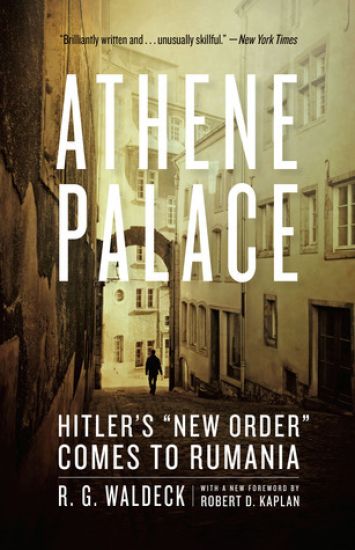
Athene Palace

Athene Palace

R. G. Waldeck; Robert D. Kaplan

University of Chicago Press
2013
nidottu
On the day that Paris fell to the Nazis, R. G. Waldeck was checking into the swankiest hotel in Bucharest, the Athene Palace. A cosmopolitan center during the war, the hotel was populated by Italian and German oilmen hoping to secure new business opportunities in Romania, international spies cloaked in fake identities, and Nazi officers whom Waldeck discovered to be intelligent but utterly bloodless. A German Jew and a reporter for Newsweek, Waldeck became a close observer of the Nazi invasion. As King Carol first tried to placate the Nazis, then abdicated the throne in favor of his son, Waldeck was dressing for dinners with diplomats and cozying up to Nazi officers to gain insight and information. From her unique vantage, she watched as Romania, a country with a pro-totalitarian elite and a deep strain of anti-Semitism, suffered civil unrest, a German invasion, and an earthquake, before turning against the Nazis. A striking combination of social intimacy and distinterested political analysis, Athene Palace evokes the elegance and excitement of the dynamic international community in Bucharest before the world had come to grips with the horrors of war and genocide. Waldeck's account strikingly presents the finely wrought surface of dinner parties, polite discourse, and charisma, while recognizing the undercurrents of violence and greed that ran through the denizens of the Athene Palace.
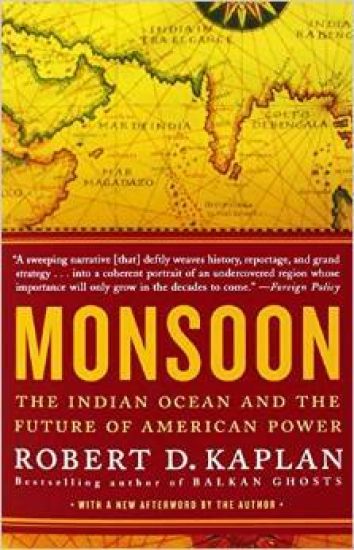
Monsoon

Monsoon

Robert D. Kaplan

Random House Inc
2011
pokkari
On the world maps common in America, the Western Hemisphere lies front and center, while the Indian Ocean region all but disappears. This convention reveals the geopolitical focus of the now-departed twentieth century, but in the twenty-first century that focus will fundamentally change. In this pivotal examination of the countries known as "Monsoon Asia"--which include India, Pakistan, China, Indonesia, Burma, Oman, Sri Lanka, Bangladesh, and Tanzania--bestselling author Robert D. Kaplan shows how crucial this dynamic area has become to American power. It is here that the fight for democracy, energy independence, and religious freedom will be lost or won, and it is here that American foreign policy must concentrate if the United States is to remain relevant in an ever-changing world. From the Horn of Africa to the Indonesian archipelago and beyond, Kaplan exposes the effects of population growth, climate change, and extremist politics on this unstable region, demonstrating why Americans can no longer afford to ignore this important area of the world.