Kirjojen hintavertailu. Mukana 12 317 493 kirjaa ja 12 kauppaa.

Kirjailija

Robert D. Richtmyer

Kirjat ja teokset yhdessä paikassa: 6 kirjaa, julkaisuja vuosilta 1995-2018, suosituimpien joukossa A Non-random Sampling Method, Based on Congruences, for "Monte Carlo" Problems. Vertaile teosten hintoja ja tarkista saatavuus suomalaisista kirjakaupoista.

Mukana myös kirjoitusasut: Robert D Richtmyer

6 kirjaa

Kirjojen julkaisuhaarukka 1995-2018.

A Numerical Method for the Time-dependent Transport Equation
This work has been selected by scholars as being culturally important, and is part of the knowledge base of civilization as we know it. This work was reproduced from the original artifact, and remains as true to the original work as possible. Therefore, you will see the original copyright references, library stamps (as most of these works have been housed in our most important libraries around the world), and other notations in the work.This work is in the public domain in the United States of America, and possibly other nations. Within the United States, you may freely copy and distribute this work, as no entity (individual or corporate) has a copyright on the body of the work.As a reproduction of a historical artifact, this work may contain missing or blurred pages, poor pictures, errant marks, etc. Scholars believe, and we concur, that this work is important enough to be preserved, reproduced, and made generally available to the public. We appreciate your support of the preservation process, and thank you for being an important part of keeping this knowledge alive and relevant.

Difference Methods for Initial Value Problems: Interscience Tracts in Pure and Applied Mathematics, No. 4
Difference Methods for Initial Value Problems is a book written by Robert D. Richtmyer and published as part of the Interscience Tracts in Pure and Applied Mathematics series. The book focuses on the use of difference methods for solving initial value problems in mathematics. It covers topics such as the numerical solution of partial differential equations, the stability of difference schemes, and the accuracy of numerical methods. The book is intended for graduate students and researchers in mathematics and engineering who are interested in numerical methods for solving initial value problems. It provides a comprehensive overview of the subject, including detailed explanations of the underlying theory and practical applications. The book is written in a clear and concise style, making it accessible to readers with a range of mathematical backgrounds. Overall, Difference Methods for Initial Value Problems is an essential resource for anyone interested in numerical methods for solving initial value problems.Additional Editor Is J. J. Stoker.This scarce antiquarian book is a facsimile reprint of the old original and may contain some imperfections such as library marks and notations. Because we believe this work is culturally important, we have made it available as part of our commitment for protecting, preserving, and promoting the world's literature in affordable, high quality, modern editions, that are true to their original work.
Principles of Advanced Mathematical Physics

Principles of Advanced Mathematical Physics

Robert D. Richtmyer

Springer-Verlag Berlin and Heidelberg GmbH Co. K
2012
nidottu
A first consequence of this difference in texture concerns the attitude we must take toward some (or perhaps most) investigations in "applied mathe­ matics," at least when the mathematics is applied to physics. Namely, those investigations have to be regarded as pure mathematics and evaluated as such. For example, some of my mathematical colleagues have worked in recent years on the Hartree-Fock approximate method for determining the structures of many-electron atoms and ions. When the method was intro­ duced, nearly fifty years ago, physicists did the best they could to justify it, using variational principles, intuition, and other techniques within the texture of physical reasoning. By now the method has long since become part of the established structure of physics. The mathematical theorems that can be proved now (mostly for two- and three-electron systems, hence of limited interest for physics), have to be regarded as mathematics. If they are good mathematics (and I believe they are), that is justification enough. If they are not, there is no basis for saying that the work is being done to help the physicists. In that sense, applied mathematics plays no role in today's physics. In today's division of labor, the task of the mathematician is to create mathematics, in whatever area, without being much concerned about how the mathematics is used; that should be decided in the future and by physics.
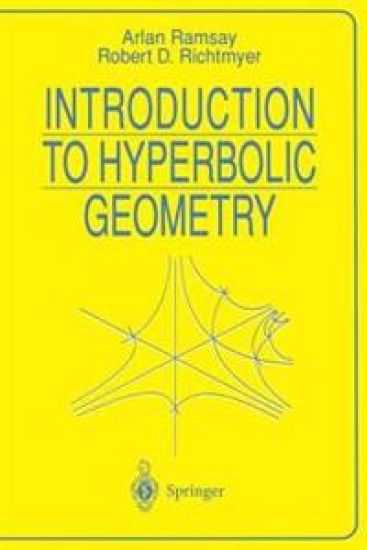
Introduction to Hyperbolic Geometry

Introduction to Hyperbolic Geometry

Arlan Ramsay; Robert D. Richtmyer

Springer-Verlag New York Inc.
1995
nidottu
This book is an introduction to hyperbolic and differential geometry that provides material in the early chapters that can serve as a textbook for a standard upper division course on hyperbolic geometry. For that material, the students need to be familiar with calculus and linear algebra and willing to accept one advanced theorem from analysis without proof. The book goes well beyond the standard course in later chapters, and there is enough material for an honors course, or for supplementary reading. Indeed, parts of the book have been used for both kinds of courses. Even some of what is in the early chapters would surely not be nec­ essary for a standard course. For example, detailed proofs are given of the Jordan Curve Theorem for Polygons and of the decomposability of poly­ gons into triangles, These proofs are included for the sake of completeness, but the results themselves are so believable that most students should skip the proofs on a first reading. The axioms used are modern in character and more "user friendly" than the traditional ones. The familiar real number system is used as an in­ gredient rather than appearing as a result of the axioms. However, it should not be thought that the geometric treatment is in terms of models: this is an axiomatic approach that is just more convenient than the traditional ones.