Kirjojen hintavertailu. Mukana 12 390 323 kirjaa ja 12 kauppaa.

Kirjailija

Robert D. Tollison

Kirjat ja teokset yhdessä paikassa: 8 kirjaa, julkaisuja vuosilta 1981-2017, suosituimpien joukossa Sacred Trust. Vertaile teosten hintoja ja tarkista saatavuus suomalaisista kirjakaupoista.

8 kirjaa

Kirjojen julkaisuhaarukka 1981-2017.

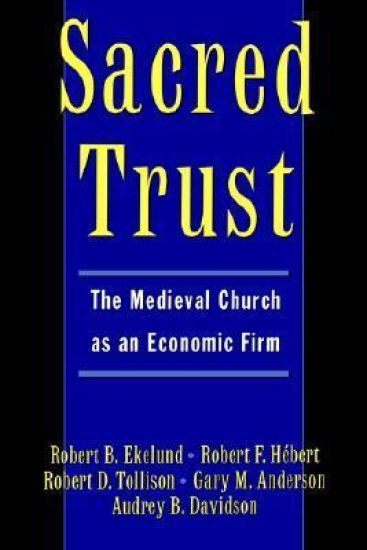
Sacred Trust

Sacred Trust

Robert B. Ekelund; Robert F. Hébert; Robert D. Tollison; Gary M. Anderson; Audrey B. Davidson

Oxford University Press Inc
1997
sidottu
The Church dominated society in the Middle Ages and functioned as a quasi-government, providing public and private goods. This book is the first to examine specific institutions in the Church in the Middle Ages in economic terms. Other books have argued generally that the Church either had a positive or negative effect on economic development. The authors of this book look more closely at the actual Church institutions and practices and describe how each functioned as a part of the larger economy of the time. They focus especially on marriage, usury, heresy, the crusades, and the monasteries. It is not their purpose to reject or impugn religious motives that may be advanced by theologians and historians. Their goal is to bring a fresh perspective to the role of institutions of the medieval Church in economic development.
The Economics of American Art

The Economics of American Art

Robert B. Ekelund; John D. Jackson; Robert D. Tollison

Oxford University Press Inc
2017
sidottu
The rapidly changing and evolving art market might appear to be chaotic to the casual observer, with new highs, potential lows, and tastes and fashions changing season to season. Economists, however, view the actions of buyers and sellers as constituting an identifiable market. They have, for some decades, studied such issues as artistic productivity and "death effects" on prices, investment returns, and on the basis of the behavior and estimated prices in auction markets. The Economics of American Art analyzes the most pervasive economic issues facing the art world, applied to the whole spectrum of American art. The book begins by looking at how a market for American art developed, how the politics of the post-war era shaped, at least in large part, the direction of American art, and how this legacy continues into contemporary art today. The book then tackles several salient, integral questions animating the American art world: Are age and "type" of artist (i.e. traditional or "innovative") related and, if so, how might they be related to productivity? Is investment in American art a remunerative endeavor compared to other investment possibilities? Do economic insights provide understanding of fakes, fraud and theft of art, particularly American art, and is it possible to prevent art crime? Is there is a boom (or a bust) in the market for contemporary American art as might be found in other markets? The ongoing evolution of American art is attended by a massive number of influences, and the economic concepts employed in this volume will complement other critical and important cultural studies of art. Both practical and accessible, The Economics of American Art will be essential for collectors, auction houses, American art experts of all kinds, museums, gallery owners and, not least, by economists with continuing scholarly interests in these matters.
The Economics of Smoking

The Economics of Smoking

Robert D. Tollison; Richard E. Wagner

Springer
2012
nidottu
Cigarettes are under political attack at all_levels of government in the United States. From Washington, D. C. to state capitals to local govern­ ments, proposals abound to increase the cigarette excise tax, to impose smoking bans, to prevent cigarette advertising, to restrict the sale of cigarettes through vending machines, to cut off the export of cigarettes, to earmark the cigarette excise tax for health programs, to divest the stock of cigarette companies, and so on. And all of these are purportedly being advocated in the name of health. Undergirding and abetting the health argument is an economic argument that claims to place a value of up to $100 billion per year on the alleged health costs of smoking to the American economy, which is more than $3 per pack of cigarettes smoked. As our title suggests, our interest lies in the economics of smoking and not in the health issues surrounding smoking. We are professional economists and not medical scientists. We will focus on what, if any, economic consequences arise for nonsmokers when smokers smoke. For purposes of our discussion, we simply accept the premise that smoking damages health and proceed with our analysis. Since we have not studied the issue ourselves, we have no way of knowing whether such a premise is true. But it really does not matter for getting the economics of smoking right. The important point resides in who pays for whatever to smoking.
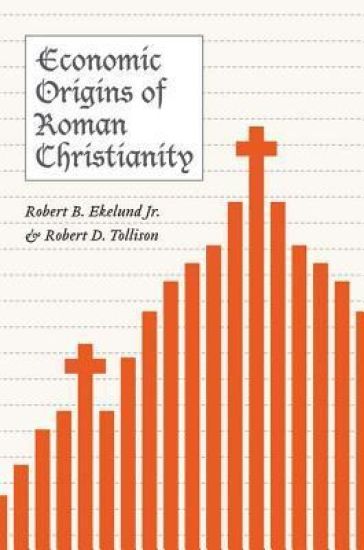
Economic Origins of Roman Christianity

Economic Origins of Roman Christianity

Robert B. Ekelund Jr.; Robert D. Tollison

University of Chicago Press
2011
sidottu
In the global marketplace of ideas, few realms spark as much conflict as religion. For millions of people, it is an integral part of everyday life as reflected by a widely divergent supply of practices and philosophical perspectives. Yet, historically, the marketplace has not always been competitive. While the early Common Era saw competition between Christianity, Judaism, and the many pagan cults, Roman Christianity eventually came to dominate Western Europe. Using basic concepts of economic theory, Robert B. Ekelund Jr. and Robert D. Tollison explain the origin and subsequent spread of Roman Christianity, showing first how the standard concepts of risk, cost, and benefit can account for the demand for religion. Then, drawing on the economics of networking, entrepreneurship, and industrial organization, the book explains Christianity's rapid ascent. Like a business, the church developed sound business strategies that increased its market share to a near monopoly in the medieval period. This book offers a fascinating look at the dynamics of Christianity's rise, as well as how aspects of the church's structure - developed over the first millennium - illuminate a number of critical problems faced by the church today.
The Economics of Smoking

The Economics of Smoking

Robert D. Tollison; Richard E. Wagner

Springer
1991
sidottu
Cigarettes are under political attack at all_levels of government in the United States. From Washington, D. C. to state capitals to local govern­ ments, proposals abound to increase the cigarette excise tax, to impose smoking bans, to prevent cigarette advertising, to restrict the sale of cigarettes through vending machines, to cut off the export of cigarettes, to earmark the cigarette excise tax for health programs, to divest the stock of cigarette companies, and so on. And all of these are purportedly being advocated in the name of health. Undergirding and abetting the health argument is an economic argument that claims to place a value of up to $100 billion per year on the alleged health costs of smoking to the American economy, which is more than $3 per pack of cigarettes smoked. As our title suggests, our interest lies in the economics of smoking and not in the health issues surrounding smoking. We are professional economists and not medical scientists. We will focus on what, if any, economic consequences arise for nonsmokers when smokers smoke. For purposes of our discussion, we simply accept the premise that smoking damages health and proceed with our analysis. Since we have not studied the issue ourselves, we have no way of knowing whether such a premise is true. But it really does not matter for getting the economics of smoking right. The important point resides in who pays for whatever to smoking.
Predicting Politics

Predicting Politics

W. Crain; Robert D. Tollison

The University of Michigan Press
1990
nidottu
Predicting Politics: Essays in Empirical Public Choice explores politics in an empirical spirit. The topics covered are novel and important, including the impact of campaign finance on the size of government, the economics of gerrymandering, constitutional change, and budgetary politics. The approach is to formulate and to test interesting hypotheses about political behavior. The essential idea is to illustrate the power of public choice theory in explaining actual politics. The volume brings together the work of Crain and Tollison and other scholars who have worked in this public choice tradition, and shows the power of empirical approaches in explaining the origin and inner working of political institutions and processes.