Kirjojen hintavertailu. Mukana 12 595 353 kirjaa ja 12 kauppaa.

Kirjailija

Robert E. Goodin

Kirjat ja teokset yhdessä paikassa: 30 kirjaa, julkaisuja vuosilta 1983-2024, suosituimpien joukossa Protecting the Vulnerable. Vertaile teosten hintoja ja tarkista saatavuus suomalaisista kirjakaupoista.

30 kirjaa

Kirjojen julkaisuhaarukka 1983-2024.

Consent Matters

Consent Matters

Robert E. Goodin

Oxford University Press
2024
sidottu
Consent works moral magic. Things that would otherwise be wrong to do to someone are, with that person's consent, made morally permissible. But what is consent, and how does it work? What can be taken for consent (perhaps wrongly) and with what consequences? How does consent come into being and pass out of it? How can consent be conferred, invoked and revoked? What is the role of social and legal norms in governing consent? How contextually sensitive should those norms be in applying to diverse settings, ranging from sexual encounters to prison hospitals to the poll booth? Those are the sorts of broad questions animating this book. It aspires to provide a comprehensive account of the social practice of consent, informed by deep reading in the history of ideas, philosophy, law, political science and sociology. Consent Matters thus serves, at one and the same time, as a guide for the perplexed social practitioner of consent and as a touchstone for philosophical attempts to theorize and to refine those existing practices.
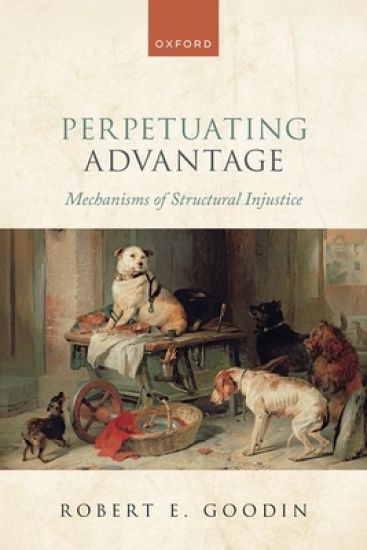
Perpetuating Advantage

Perpetuating Advantage

Robert E. Goodin

Oxford University Press
2023
sidottu
Injustices are, in the first instance, brute acts of identifiable individuals. But they are typically perpetuated, more subtly, through seemingly innocent workings of innocuous social structures. Critics of structural injustice are quick to call out that ruse. They say much about all the sites where such structural injustices reside - but without saying much, as yet, about how exactly structural injustice actually works. By what specific mechanisms are unfair advantages and disadvantages perpetuated? What, specifically, can we do to interrupt them? That is the focus of this book, in which Robert Goodin identifies several fundamental mechanisms of structural injustice: social position, networks, language, social expectations and norms, reputation, and organization. His discussion is deeply informed by a wide range of social sciences, mined with a philosopher's sharp eye to what matters and lucidly explained with a deft turn of phrase. Having exposed each of those specific mechanisms of structural injustice, Goodin proceeds to explore what they all have in common. The underlying drivers, he shows, are a combination of scale effects and attention scarcities. That combination limits - but also informs - what can reasonably be done to overcome the various, nefarious mechanisms that perpetuate unfair social advantage and disadvantage.
Political Theory Without Borders

Political Theory Without Borders

Robert E. Goodin; James S. Fishkin

JOHN WILEY AND SONS LTD
2022
nidottu
POLITICAL THEORY WITHOUT BORDERS Political theory has traditionally focused on governance within the confines of a specific polity, but with the recent proliferation of environmental realities and national decisions that have global repercussions, political theory must now be re-imagined to confront globalization head-on. Political Theory Without Borders presents a collection scholarship that does just that. Each chapter focuses on answering specific questions that have arisen from issues of global spillover – like climate change and pollution – and the increasingly unrestricted flow of people, products, and financial capital across borders. With contributions from emerging scholars alongside key texts from some of the most well-known theorists of previous generations, this collection illustrates how the classic concerns of political theory – justice and equality, liberty and oppression – have re-emerged with a renewed significance at the global level.
An Epistemic Theory of Democracy

An Epistemic Theory of Democracy

Robert E. Goodin; Kai Spiekermann

Oxford University Press
2018
sidottu
Democracy has many attractive features. Among them is its tendency to track the truth, at least under certain idealized assumptions. That basic result has been known since 1785, when Condorcet published his famous jury theorem. But that theorem has typically been dismissed as little more than a mathematical curiosity, with assumptions too restrictive for it to apply to the real world. In An Epistemic Theory of Democracy, Goodin and Spiekermann propose different ways of interpreting voter independence and competence to make jury theorems more generally applicable. They go on to assess a wide range of familiar political practices and alternative institutional arrangements, to determine what constellation of them might most fully exploit the truth-tracking potential of majoritarian democracy. The book closes with a discussion of how epistemic democracy might be undermined, using as case studies the Trump and Brexit campaigns.
Free Movement

Free Movement

Barry Barry; Robert E. Goodin

Routledge
2017
sidottu
The articles which comprise this book were written for a conference organized at Mont Saint Michel, France in September, 1989 by The Ethikon Institute in collaboration with The California Institute of Technology. The closing years of the twentieth century seem likely to be dominated by issues involving borders. There are strong forces making for the breaking up of states, as we have seen in the Balkans, the former Soviet Union and many other parts of the world. At the same time, there are also strong forces making for the transcending of state boundaries as finance and production become increasingly international. The moves towards integration within the European Economic Community are one institutional response to a phenomenon experienced by almost every country. This book focuses on the crossing of state boundaries by people and by money.
On Settling

On Settling

Robert E. Goodin

Princeton University Press
2016
pokkari
In a culture that worships ceaseless striving, "settling" seems like giving up. But is it? On Settling defends the positive value of settling, explaining why this disdained practice is not only more realistic but more useful than an excessive ideal of striving. In fact, the book makes the case that we'd all be lost without settling--and that even to strive, one must first settle. We may admire strivers and love the ideal of striving, but who of us could get through a day without settling? Real people, confronted with a complex problem, simply make do, settling for some resolution that, while almost certainly not the best that one could find by devoting limitless time and attention to the problem, is nonetheless good enough. Robert Goodin explores the dynamics of this process. These involve taking as fixed, for now, things that we reserve the right to reopen later (nothing is fixed for good, although events might always overtake us). We settle on some things in order to concentrate better on others. At the same time we realize we may need to come back later and reconsider those decisions. From settling on and settling for, to settling down and settling in, On Settling explains why settling is useful for planning, creating trust, and strengthening the social fabric--and why settling is different from compromise and resignation. So, the next time you're faced with a thorny problem, just settle. It's no failure.
Explaining Norms

Explaining Norms

Geoffrey Brennan; Lina Eriksson; Robert E. Goodin; Nicholas Southwood

Oxford University Press
2016
nidottu
Norms are a pervasive yet mysterious feature of social life. In Explaining Norms, four philosophers and social scientists team up to grapple with some of the many mysteries, offering a comprehensive account of norms: what they are; how and why they emerge, persist and change; and how they work. Norms, they argue, should be understood in non-reductive terms as clusters of normative attitudes that serve the function of making us accountable to one another--with the different kinds of norms (legal, moral, and social norms) differing in virtue of being constituted by different kinds of normative attitudes that serve to make us accountable in different ways. Explanations of and by norms should be seen as thoroughly pluralist in character. Explanations of norms should appeal to the ways that norms help us to pursue projects and goals, individually and collectively, as well as to enable us to constitute social meanings. Explanations by norms should recognise the multiplicity of ways in which norms may bear upon the actions we perform, the attitudes we form and the modes of deliberation in which we engage: following, merely conforming with, and even breaching norms. While advancing novel and distinctive positions on all of these topics, Explaining Norms will also serve as a sourcebook with a rich array of arguments and illustrations for others to reassemble in ways of their own choosing.
Political Theory Without Borders

Political Theory Without Borders

Robert E. Goodin; James S. Fishkin

John Wiley Sons Inc
2015
sidottu
POLITICAL THEORY WITHOUT BORDERS Political theory has traditionally focused on governance within the confines of a specific polity, but with the recent proliferation of environmental realities and national decisions that have global repercussions, political theory must now be re-imagined to confront globalization head-on. Political Theory Without Borders presents a collection scholarship that does just that. Each chapter focuses on answering specific questions that have arisen from issues of global spillover – like climate change and pollution – and the increasingly unrestricted flow of people, products, and financial capital across borders. With contributions from emerging scholars alongside key texts from some of the most well-known theorists of previous generations, this collection illustrates how the classic concerns of political theory – justice and equality, liberty and oppression – have re-emerged with a renewed significance at the global level.
On Complicity and Compromise

On Complicity and Compromise

Chiara Lepora; Robert E. Goodin

Oxford University Press
2015
nidottu
'Taxpayers are complicit in the illegal wars waged by their governments.' 'Corporations are complicit in human rights abuses perpetrated by their suppliers.' 'Aid workers who compromise with militias are complicit in their reign of terror.' We hear such allegations all the time. Yet there are many ways of being mixed up with the wrongdoing of others. They are not all on a par, morally; some are worse than others. Furthermore, complicitly contributing to wrongdoing, while still wrong in itself, might nonetheless be the right thing to do if that is the only way to achieve some greater good. Drawing on philosophy, law and political science, and on a wealth of practical experience delivering emergency medical services in conflict-ridden settings, Lepora and Goodin untangle the complexities surrounding compromise and complicity: carefully cataloguing their many varieties; identifying the dimensions along which those differ; and explaining why some are morally more worrying than others. Lepora and Goodin summarize their analysis in a formula that can be used as a decision heuristic for assessing any given act of complicity. They go on to illustrate its practical usefulness by applying it first to some stylized philosophical examples and then, in a more sustained way, to two vexing cases of complicity in the real world: the complicity of humanitarian aid organizations with genocidaires controlling Rwandan refugee camps; and the complicity of physicians treating patients who are being subjected to torture. Both rigorous and rooted, this is a book for philosophers and practitioners alike.
Explaining Norms

Explaining Norms

Geoffrey Brennan; Lina Eriksson; Robert E. Goodin; Nicholas Southwood

Oxford University Press
2013
sidottu
Norms are a pervasive yet mysterious feature of social life. In Explaining Norms, four philosophers and social scientists team up to grapple with some of the many mysteries, offering a comprehensive account of norms: what they are; how and why they emerge, persist and change; and how they work. Norms, they argue, should be understood in non-reductive terms as clusters of normative attitudes that serve the function of making us accountable to one another--with the different kinds of norms (legal, moral, and social norms) differing in virtue of being constituted by different kinds of normative attitudes that serve to make us accountable in different ways. Explanations of and by norms should be seen as thoroughly pluralist in character. Explanations of norms should appeal to the ways that norms help us to pursue projects and goals, individually and collectively, as well as to enable us to constitute social meanings. Explanations by norms should recognise the multiplicity of ways in which norms may bear upon the actions we perform, the attitudes we form and the modes of deliberation in which we engage: following, merely conforming with, and even breaching norms. While advancing novel and distinctive positions on all of these topics, Explaining Norms will also serve as a sourcebook with a rich array of arguments and illustrations for others to reassemble in ways of their own choosing.
On Complicity and Compromise

On Complicity and Compromise

Chiara Lepora; Robert E. Goodin

Oxford University Press
2013
sidottu
'Taxpayers are complicit in the illegal wars waged by their governments.' 'Corporations are complicit in human rights abuses perpetrated by their suppliers.' 'Aid workers who compromise with militias are complicit in their reign of terror.' We hear such allegations all the time. Yet there are many ways of being mixed up with the wrongdoing of others. They are not all on a par, morally; some are worse than others. Furthermore, complicitly contributing to wrongdoing, while still wrong in itself, might nonetheless be the right thing to do if that is the only way to achieve some greater good. Drawing on philosophy, law and political science, and on a wealth of practical experience delivering emergency medical services in conflict-ridden settings, Lepora and Goodin untangle the complexities surrounding compromise and complicity: carefully cataloguing their many varieties; identifying the dimensions along which those differ; and explaining why some are morally more worrying than others. Lepora and Goodin summarize their analysis in a formula that can be used as a decision heuristic for assessing any given act of complicity. They go on to illustrate its practical usefulness by applying it first to some stylized philosophical examples and then, in a more sustained way, to two vexing cases of complicity in the real world: the complicity of humanitarian aid organizations with genocidaires controlling Rwandan refugee camps; and the complicity of physicians treating patients who are being subjected to torture. Both rigorous and rooted, this is a book for philosophers and practitioners alike.
On Settling

On Settling

Robert E. Goodin

Princeton University Press
2012
sidottu
In a culture that worships ceaseless striving, "settling" seems like giving up. But is it? On Settling defends the positive value of settling, explaining why this disdained practice is not only more realistic but more useful than an excessive ideal of striving. In fact, the book makes the case that we'd all be lost without settling--and that even to strive, one must first settle. We may admire strivers and love the ideal of striving, but who of us could get through a day without settling? Real people, confronted with a complex problem, simply make do, settling for some resolution that, while almost certainly not the best that one could find by devoting limitless time and attention to the problem, is nonetheless good enough. Robert Goodin explores the dynamics of this process. These involve taking as fixed, for now, things that we reserve the right to reopen later (nothing is fixed for good, although events might always overtake us). We settle on some things in order to concentrate better on others. At the same time we realize we may need to come back later and reconsider those decisions. From settling on and settling for, to settling down and settling in, On Settling explains why settling is useful for planning, creating trust, and strengthening the social fabric--and why settling is different from compromise and resignation. So, the next time you're faced with a thorny problem, just settle. It's no failure.
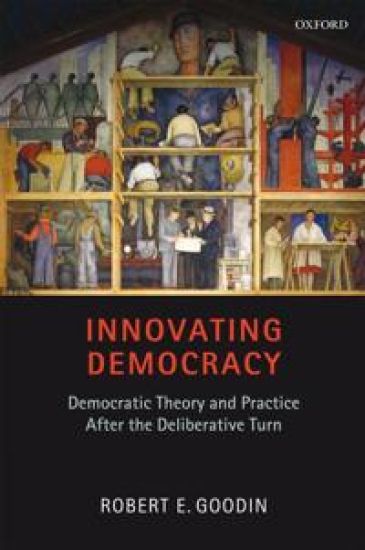
Innovating Democracy

Innovating Democracy

Robert E. Goodin

Oxford University Press
2012
nidottu
In recent years democratic theory has taken a deliberative turn. Instead of merely casting the occasional ballot, deliberative democrats want citizens to reason together. They embrace 'talk as a decision procedure'. But of course thousands or millions of people cannot realistically talk to one another all at once. When putting their theories into practice, deliberative democrats therefore tend to focus on 'mini-publics', usually of a couple dozen to a couple hundred people. The central question then is how to connect micro-deliberations in mini-publics to the political decision-making processes of the larger society. In Innovating Democracy, Robert Goodin surveys these new deliberative mechanisms, asking how they work and what we can properly expect of them. Much though they have to offer, they cannot deliver all that deliberative democrats hope. Talk, Goodin concludes, is good as a discovery procedure but not as a decision procedure. His slogan is, 'First talk, then vote'. Micro-deliberative mechanisms should supplement, not supplant, representative democracy. Goodin goes on to show how to adapt our thinking about those familiar institutions to take full advantage of deliberative inputs. That involves rethinking who should get a say, how we hold people accountable, how we sequence deliberative moments and what the roles of parties and legislatures can be in that. Revisioning macro-democratic processes in light of the processes and promise of micro-deliberation, Innovating Democracy provides an integrated perspective on democratic theory and practice after the deliberative turn.
Innovating Democracy

Innovating Democracy

Robert E. Goodin

Oxford University Press
2008
sidottu
In recent years democratic theory has taken a deliberative turn. Instead of merely casting the occasional ballot, deliberative democrats want citizens to reason together. They embrace 'talk as a decision procedure'. But of course thousands or millions of people cannot realistically talk to one another all at once. When putting their theories into practice, deliberative democrats therefore tend to focus on 'mini-publics', usually of a couple dozen to a couple hundred people. The central question then is how to connect micro-deliberations in mini-publics to the political decision-making processes of the larger society. In Innovating Democracy, Robert Goodin surveys these new deliberative mechanisms, asking how they work and what we can properly expect of them. Much though they have to offer, they cannot deliver all that deliberative democrats hope. Talk, Goodin concludes, is good as discovery procedure but not as a decision procedure. His slogan is, 'First talk, then vote'. Micro-deliberative mechanisms should supplement, not supplant, representative democracy. Goodin goes on to show how to adapt our thinking about those familiar institutions to take full advantage of deliberative inputs. That involves rethinking who should get a say, how we hold people accountable, how we sequence deliberative moments and what the roles of parties and legislatures can be in that. Revisioning macro-democratic processes in light of the processes and promise of micro-deliberation, Innovating Democracy provides an integrated perspective on democratic theory and practice after the deliberative turn.
Discretionary Time

Discretionary Time

Robert E. Goodin; James Mahmud Rice; Antti Parpo; Lina Eriksson

Cambridge University Press
2008
sidottu
A healthy work-life balance has become increasingly important to people trying to cope with the pressures of contemporary society. This trend highlights the fallacy of assessing well-being in terms of finance alone; how much time we have matters just as much as how much money. The authors of this book have developed a novel way to measure 'discretionary time': time which is free to spend as one pleases. Exploring data from the US, Australia, Germany, France, Sweden and Finland, they show that temporal autonomy varies substantially across different countries and under different living conditions. By calibrating how much control people have over their time, and how much they could have under alternative welfare, gender or household arrangements, this book offers a new perspective for comparative cross-national enquiries into the temporal aspects of human welfare.
What's Wrong With Terrorism?

What's Wrong With Terrorism?

Robert E. Goodin

Polity Press
2006
nidottu
Terrorists perform terrible acts. They maim, mutilate and kill in pursuit of their goals. The horrifying events of 9/11 and the regular suicide bombings around the world have made terrorism one of the central preoccupations of the twenty-first century. But what is the distinctive wrong of terrorism? Criminal acts such as murder and hijacking are already on the moral statute books, so why is it that we regard terrorists as different from and morally worse than ordinary killers and kidnappers? Some see terrorism is an ideology, others claim it is a deep-seated social or psychological failing, others that it is a form of fighting unfairly judged by just-war standards. In this provocative new book, Robert Goodin puts forward the view that terrorism is, in fact, a deliberate tactic of frightening people for socio-political gain. Fear affects peoples ability to reason clearly and undermines their capacity for autonomous self-government. In this way, Goodin contends that terror is not only the weapon of organizations such as al-Qaeda; it also benefits democratic politicians who profit from the climate of insecurity induced by terrorist threats and violence. Political figures conducting a campaign of fear as part of their war on terrorism may therefore be committing wrongs akin to those of terrorists themselves. This, Goodin argues, is what is distinctively wrong with terrorism in the contemporary world.
What's Wrong With Terrorism?

What's Wrong With Terrorism?

Robert E. Goodin

Polity Press
2006
sidottu
Terrorists perform terrible acts. They maim, mutilate and kill in pursuit of their goals. The horrifying events of 9/11 and the regular suicide bombings around the world have made terrorism one of the central preoccupations of the twenty-first century. But what is the distinctive wrong of terrorism? Criminal acts such as murder and hijacking are already on the moral statute books, so why is it that we regard terrorists as different from and morally worse than ordinary killers and kidnappers? Some see terrorism is an ideology, others claim it is a deep-seated social or psychological failing, others that it is a form of fighting unfairly judged by just-war standards. In this provocative new book, Robert Goodin puts forward the view that terrorism is, in fact, a deliberate tactic of frightening people for socio-political gain. Fear affects peoples ability to reason clearly and undermines their capacity for autonomous self-government. In this way, Goodin contends that terror is not only the weapon of organizations such as al-Qaeda; it also benefits democratic politicians who profit from the climate of insecurity induced by terrorist threats and violence. Political figures conducting a campaign of fear as part of their war on terrorism may therefore be committing wrongs akin to those of terrorists themselves. This, Goodin argues, is what is distinctively wrong with terrorism in the contemporary world.
Reflective Democracy

Reflective Democracy

Robert E. Goodin

Oxford University Press
2005
nidottu
Democracy used to be seen as a relatively mechanical matter of merely adding up everyone's votes in free and fair elections. That mechanistic model has many virtues, among them allowing democracy to 'track the truth', where purely factual issues are all that is at stake. Political disputes invariably mix facts with values, however, and then it is essential to listen to what people are saying rather than merely note how they are voting. The great challenge is how to implement that deliberative ideal among millions of people at once. In this strikingly original book, Goodin offers a solution: 'democratic deliberation within'. Building on models of ordinary conversational dynamics, he suggests that people simply imagine themselves in the position of various other people they have heard or read about and ask, 'What would they say about this proposal?' Informing the democratic imaginary then becomes the key to making deliberations more reflective - more empathetic, more considered, more expansive across time and distance. Oxford Political Theory presents the best new work in contemporary political theory. It is intended to be broad in scope, including original contributions to political philosophy, and also work in applied political theory. The series contains works of outstanding quality with no restriction as to approach or subject matter.
Reflective Democracy

Reflective Democracy

Robert E. Goodin

Oxford University Press
2003
sidottu
Democracy used to be seen as a relatively mechanical matter of merely adding up everyone's votes in free and fair elections. That mechanistic model has many virtues, among them allowing democracy to 'track the truth', where purely factual issues are all that is at stake. Political disputes invariably mix facts with values, however, and then it is essential to listen to what people are saying rather than merely note how they are voting. The great challenge is how to implement that deliberative ideal among millions of people at once. In this strikingly original book, Goodin offers a solution: 'democratic deliberation within'. Building on models of ordinary conversational dynamics, he suggests that people simply imagine themselves in the position of various other people they have heard or read about and ask, 'What would they say about this proposal?' Informing the democratic imaginary then becomes the key to making deliberations more reflective - more empathetic, more considered, more expansive across time and distance.
The Real Worlds of Welfare Capitalism

The Real Worlds of Welfare Capitalism

Robert E. Goodin; Bruce Headey; Ruud Muffels; Henk-Jan Dirven

Cambridge University Press
1999
pokkari
The Real Worlds of Welfare Capitalism traces how individuals fare over time in each of the three principal types of welfare state. Through a unique analysis of panel data from Germany, the Netherlands and the US, tracking individuals’ socio-economic fate over fully ten years, Goodin, Headey, Muffels and Dirven explore issues of economic growth and efficiency, of poverty and inequality, of social integration and social autonomy. It is common to talk of the inevitability of tradeoffs between these goals. But in this book the authors contend that the social democratic welfare regime, represented here by the Netherlands, equals or exceeds the performance of the corporatist German regime and the liberal US regime across all these social and economic objectives. They thus argue that, whatever one’s priorities, the social democratic welfare regime is uniquely well-suited to realizing them.