Kirjojen hintavertailu. Mukana 12 390 323 kirjaa ja 12 kauppaa.

Kirjailija

Robert Forsyth

Kirjat ja teokset yhdessä paikassa: 39 kirjaa, julkaisuja vuosilta 2008-2026, suosituimpien joukossa Ju 52/3m Bomber and Transport Units 1936-41. Vertaile teosten hintoja ja tarkista saatavuus suomalaisista kirjakaupoista.

39 kirjaa

Kirjojen julkaisuhaarukka 2008-2026.

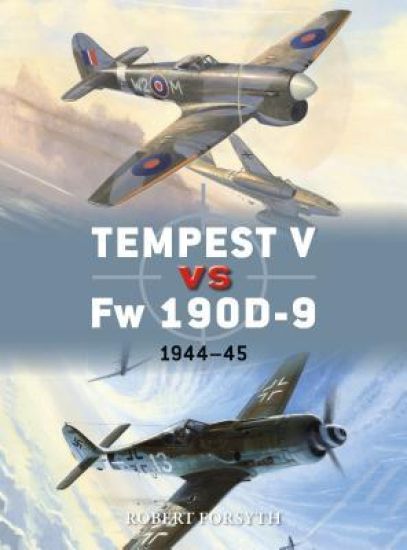
Tempest V vs Fw 190D-9

Tempest V vs Fw 190D-9

Robert Forsyth

Osprey Publishing
2019
nidottu
Arguably two of the finest piston-engined fighters ever built, the Tempest V and Fw 190D-9 raised the bar in terms of aircraft design and operational capability during World War II. The long-nosed ‘Dora 9’, designed by Kurt Tank, first appeared in the skies over the Western and Eastern Fronts in the late summer of 1944. Fast, and with an exceptional rate of climb, it quickly bettered almost every fighter that the RAF, USAAF and Soviet Red Air Force could field. The Hawker Tempest V entered service in early 1944, initially proving itself a stalwart performer when it was deployed to intercept V1 flying bombs over southern England. From the autumn of 1944, the Tempest V also equipped squadrons of the 2nd Tactical Air Force, operating in support of the Allied armies advancing across north-west Europe. It became a potent ground-attack aircraft, armed with underwing rockets, but also a first-class interceptor when pitted against the Luftwaffe’s advanced Fw 190D-9 and Me 262.Featuring full colour artwork, this book describes in fascinating detail combats between the Tempest Vs of No 274 Sqn and the Fw 190D-9s of I. and III./JG 26 between February and April 1945.
Dornier Do 335

Dornier Do 335

Robert Forsyth

Osprey Publishing
2018
nidottu
The Dornier Do 335 was conceived as a high-speed, all-weather fighter, and represented the pinnacle of piston-engined aircraft design. The Do 335 was a big aircraft, weighing just over 10,000kg when laden with fuel, equipment, and pilot, yet powered by two Daimler-Benz DB 603 engines, it was capable of reaching a maximum speed of 750km/h at 6400 meters, making it the fastest piston engine aircraft produced in Germany during World War II.Some forty aircraft were built between late 1943 and the end of the war, and it was intended to deploy the type as a day fighter, bomber, night fighter, bad weather interceptor, and reconnaissance aircraft, all of which were intended to incorporate the latest armament, bomb sights, communications, and radar equipment, as well as an ejector seat. Featuring archive photography and specially commissioned artwork, this is the full story of the aircraft that the Luftwaffe hoped would turn the tide of the war.
Heinkel He 177 Units of World War 2

Heinkel He 177 Units of World War 2

Robert Forsyth

Osprey Publishing
2018
nidottu
In many ways, the Heinkel He 177 'Greif' (Griffon) was Nazi Germany's 'lost' strategic bomber. With some fundamental creases ironed out, and built in large numbers, the He 177 would have offered the Luftwaffe the means with which to carry out long-range, mass bombing attacks against targets of a strategic nature. Although competing interests and personalities served to prevent this from happening, from mid-1943 the aircraft nevertheless saw service over England, the Atlantic, the Mediterranean and in Russia. The He 177 flew to the end of the war, with some machines undertaking extremely hazardous low-level missions against Soviet armour in Poland in late 1944-45. This fascinating book, filled with detailed artwork and contemporary photographs, tells the story of this aircraft, including the political infighting at the top of the Luftwaffe’s hierarchy that stymied its development, its radical technical design and its state-of-the-art weaponry.
Bachem Ba 349 Natter

Bachem Ba 349 Natter

Robert Forsyth

Osprey Publishing
2018
nidottu
A fascinating look at Nazi Germany's radical development of a manned missile to shoot down Allied bombers.The Bachem Ba 349 Natter was a secretive, vertical take-off, single-seat rocket interceptor intended to offer high-speed defence of key targets. This radical aircraft offered Luftwaffe an inexpensive means with which to intercept and attack Allied heavy bombers using a vertically-launched, semi-expendable machine built of wood and armed with a nose-mounted ‘honeycomb’ battery of spin-stabilised air-to-air rockets as well as cannon armament. Launched vertically at 36,000ft per minute, the pilot was expected to fly within range of the enemy bombers, fire his rockets at them, ram another bomber, eject and parachute to the ground.Illustrated with contemporary photographs and stunning commissioned artwork, this study examines this inventive yet ultimately unsuccessful attempt by the Luftwaffe to defend against the tide of Allied aircraft that was bombing German cities into the ground.
Jagdgeschwader 1 ‘Oesau’ Aces 1939-45

Jagdgeschwader 1 ‘Oesau’ Aces 1939-45

Robert Forsyth

Osprey Publishing
2017
nidottu
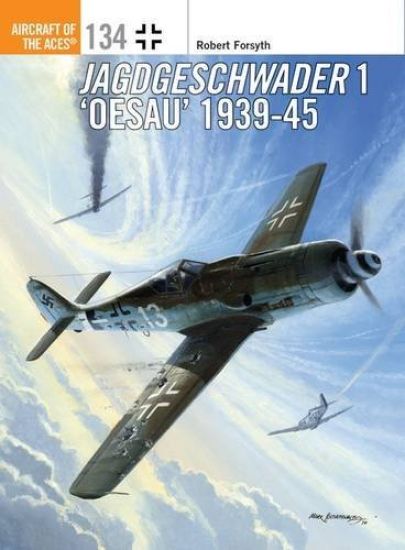
Formed shortly after the outbreak of World War 2, and equipped with Messerschmitt Bf 109Es, Jagdgeschwader 1 was initially tasked to defend the regional North Sea and Baltic coastal areas and Germany’s main port cities and naval bases. The greatest task for JG 1 though came after 1942 in its defence of the Reich against the US Eighth Air Force’s B-17s and B-24s, bearing the brunt of defence against increasingly regular, larger and deep penetrating USAAF daylight bomber raids with fighter escort. Levels of attrition subsequently grew, but so did experience among the leading aces, who were often the subject of propaganda films and literature. Many of Germany’s most famous World War 2 aces flew with JG 1 including Herbert Ihlefeld (132 victories), Heinz Bär (220) and Walter Oesau (127), piloting Bf 109Es, Fw 190s and the Heinkel 162 jet fighter. Packed with photographs and profile artwork and revealing first-hand accounts, this is the compelling story of the Luftwaffe fighter pilots who battled to defend the skies of Germany.
Shadow over the Atlantic

Shadow over the Atlantic

Robert Forsyth

Osprey Publishing
2017
sidottu
A unique insight into the U-boat war in World War II, focusing on FAGr 5, the Luftwaffe's only long-range maritime reconnaissance and U-boat cooperation unit.German U-boats were the scourge of Allied merchant and military shipping in the Atlantic during World War II, threatening to isolate and then starve the UK out of the War. As Germany’s war against the Allied convoys intensified in late 1943, German Admiral Karl Dönitz called upon the Luftwaffe to provide a long-range spotting and shadowing unit to act as ‘eyes’ for his U-boats.Equipped with big, four-engined Junkers Ju 290s fitted out with advanced search radar and other maritime ‘ELINT’ (electronic intelligence) devices, Fernaufklärungsgruppe (FAGr) 5 'Atlantik' undertook a distant, isolated campaign far out into the Atlantic and thousands of miles away from its home base in western France. The information generated and reported back to Dönitz’s headquarters was vital to the efforts of the U-boats, and FAGr 5’s ‘shadowing’ missions were assigned priority in terms of skilled crews, supplies and equipment.Shadow over the Atlantic book tells for the first time the fascinating story of the formation and operations of FAGr 5 'Atlantik', drawing on never-before-published historical records of the unit that accounted for the reporting and destruction of thousands of tons of Allied shipping.
Luftwaffe Emergency Fighters

Luftwaffe Emergency Fighters

Robert Forsyth

Osprey Publishing
2017
nidottu
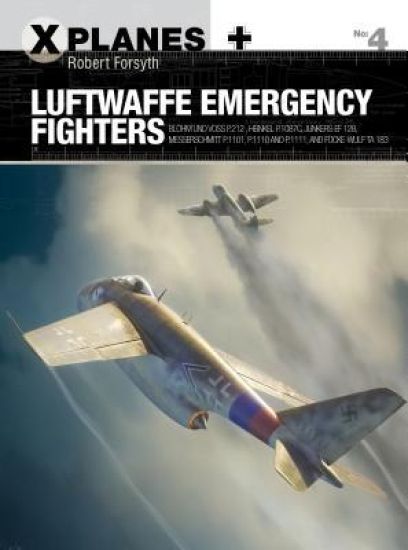
In late 1944, the German Air Ministry organised what it called an ‘Emergency Fighter Competition’ intended to produce designs for quick-to-build yet technically and tactically effective jet fighter aircraft capable of tackling the anticipated arrival of the B-29 Superfortress over Europe, as well as the British Mosquito and US P-38 Lightning which were appearing in ever greater numbers.Thus was born a cutting-edge, highly sophisticated series of aircraft including the futuristic and elegant Focke-Wulf Ta 183; the extraordinary Blohm und Voss P.212, and the state-of-the-art Messerschmitt P.1101 series. Armed with heavy cannon and the latest air-to-air rockets and missiles, these were designed to inflict carnage on American bomber formations at high speed. Using stunning three-view illustrations of each prototype along with full colour artwork, aviation expert Robert Forsyth traces the history of the extraordinary aircraft of the ‘Emergency Fighter Competition’, Hitler’s last throw of the dice in the air war against the Allies.
He 162 Volksjäger Units

He 162 Volksjäger Units

Robert Forsyth

Osprey Publishing
2016
nidottu
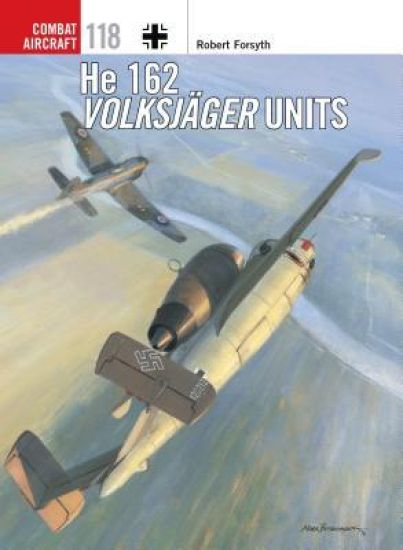
With the Third Reich on the brink of defeat Hitler's instructions to his designers were clear. He wanted a Volksjäger – a People's Fighter that was quick to produce and used minimal quantities of strategic materials.Heinkel rose to the challenge with the He 162, a fighter constructed of wood and metal that was designed, built and flown in the staggeringly short time of ten weeks. Professional pilots were in short supply, and so the Luftwaffe was ordered to man the He 162 with hastily trained members of the Hitler Youth – a flawed plan that fortunately never came to fruition.Detailed aircraft profiles and never before seen photographs perfectly complement the analysis of the revolutionary Heinkel He 162 as author Robert Forsyth traces its entire history, from the early design and production through to its limited combat experience.
Messerschmitt Me 264 Amerika Bomber

Messerschmitt Me 264 Amerika Bomber

Robert Forsyth

Osprey Publishing
2016
nidottu
Launching Osprey's 'X-Planes' series is a fascinating examination of Hitler's secret weapon. This title is a must-have for modellers, aviation historians and enthusiasts of Germany's super-hi-tech aircraft programme.As Europe plunged into World War II, Hitler ordered the development of a hi-tech weapon capable of taking the war across the Atlantic – the Messerschmitt Me 264. Chosen from designs for an 'Amerika Bomber' tendered by Messerschmitt, Junkers and Focke-Wulf, this ultra-long-range aircraft would be capable of attacking cities in the United States. Just one month before the attack on Pearl Harbor and the American entry into World War II Hitler was promising, privately, to wage a 'new war' against the USA after his victories in Europe.Dazzling digital artwork and 50 rare archive photographs perfectly complement the detailed analysis offered by Robert Forsyth as he examines the development, intended role and influence of the aircraft that Hitler planned to use to bomb New York City.
Luftwaffe Mistel Composite Bomber Units

Luftwaffe Mistel Composite Bomber Units

Robert Forsyth

Osprey Publishing
2015
nidottu
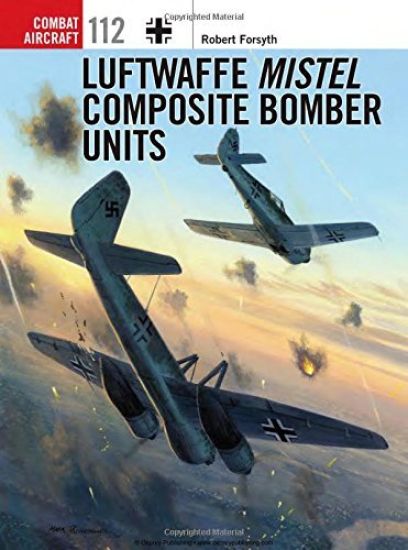
The striking appearance of Luftwaffe’s Mistel Composite attack aircraft might seem ridiculous to modern eyes, but employed correctly, these original ‘fire and forget’ weapons were devastatingly effective, as Allied sources testify.This book draws on a wealth of first-hand reports and revealing contemporary photographs to tell the full, strange story of the Mistel units. They were the product of a remarkable mix of desperation and innovation, and were actually grounded in a pre-war, non-military practise – the mounting of one aircraft atop another was initially conceived to extend the ranges of passenger and mail-carrying aircraft. But as early as 1942, German planners saw the potential for use as a guided missile, and by the end of the war, the sight of a Ju-88 lashed to a BF 109 or FW 190 fighter bearing down on an Allied target was not as rare as one might expect.This is a comprehensive account of the Mistel units, from their design and development, through the first deployments at D-Day, to the last, desperate missions against key bridges on the Oder and the Neisse in the final weeks of the war.
Me 262 Bomber and Reconnaissance Units

Me 262 Bomber and Reconnaissance Units

Robert Forsyth; Eddie Creek

Osprey Publishing
2012
nidottu
When the revolutionary Messerschmitt Me 262 jet first appeared as a bomber in the skies over north-west Europe in late 1944, it represented both a new dawn in aeronautical development and a great shock to the Allied air forces and armies. In mid-1944, Adolf Hitler, having seen the impressive and formidable performance of Me 262 prototypes, stated his firm desire to see the aircraft enter service as a bomber. There was nothing which the Allies had in their air forces which could touch the Me 262. Although, due mainly to problems associated with delays in engine deliveries, its debut was too late to contest the Allied landings in Normandy, when it finally did enter service in the autumn of 1944, the bomb-carrying Me 262s conducted several hit-and-run raids against RAF airfields in Belgium and Holland. From then until the end of the war the Me 262 remained one of the most feared weapons in the Axis arsenal. This book covers the complete history of the Me 262 bomber and reconnaissance units during World War 2.
Luftwaffe Viermot Aces 1942–45

Luftwaffe Viermot Aces 1942–45

Robert Forsyth

Osprey Publishing
2011
nidottu
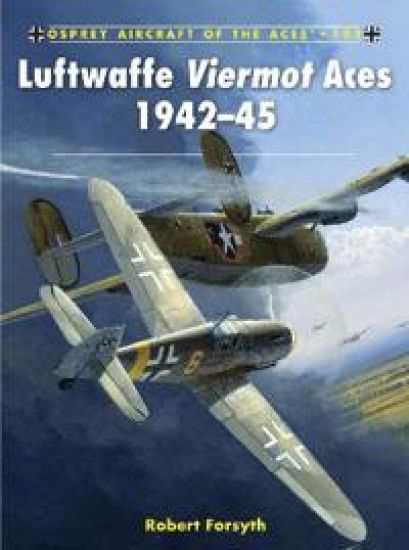
A full account of the German airmen who achieved ace status by destroying Allied bombers.Viermot Aces' were pilots who shot down five or more USAAF and RAF bombers during the daylight Defence of the Reich missions from May 1942 through to VE Day. This book tells the complete story of the men and the planes that challenged the great bomber offensive. Flying a number of different aircraft including the Bf 110G, Me 210 and the Me 410, they fought their desperate battles against the numerous machine guns of B-17s and Lancasters. This book also covers the 'jet aces' that flew the Me 262 jet-powered interceptors in the closing days of the war to wage a desperate last-ditch fight against the endless Allied bomber fleets.
Aces of the Legion Condor

Aces of the Legion Condor

Robert Forsyth

Osprey Publishing
2011
nidottu
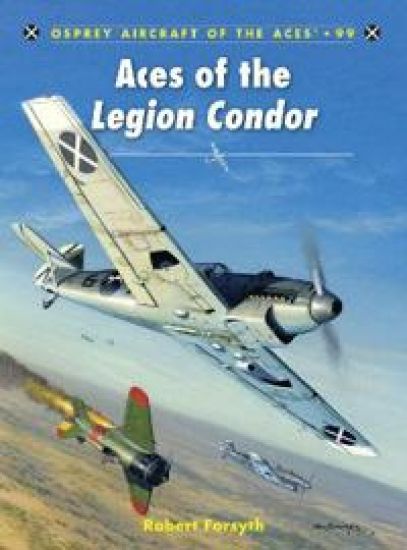
The story of the 29 fighter pilot aces of the Legion Condor who became aces flying Messerschmitt Bf 109 C-Es, Heinkel He 51s, Henschel Hs 123s, Arado Ar 68 E-1s and Heinkel He 112s during the Spanish Civil War.For Germany, the Spanish Civil War proved a perfect testing ground for new technologies and tactics. During the war, some 19,000 German 'volunteers' formed an aviation group called the Legion Condor in support of the fascists. Originally flying He-51s, they were soon upgraded to 109s. These fighters proved dominant in the Spanish skies, and many members of the legion scored five or more kills during the fighting.This compact, illustrated volume tells the story of the first German aces and charts the evolution of aerial tactics kick-started by this 'baptism of fire'.
The principles of Moral Science.

The principles of Moral Science.

Robert Forsyth

British Library, Historical Print Editions
2011
pokkari
Title: The principles of Moral Science.Publisher: British Library, Historical Print EditionsThe British Library is the national library of the United Kingdom. It is one of the world's largest research libraries holding over 150 million items in all known languages and formats: books, journals, newspapers, sound recordings, patents, maps, stamps, prints and much more. Its collections include around 14 million books, along with substantial additional collections of manuscripts and historical items dating back as far as 300 BC.The GENERAL HISTORICAL collection includes books from the British Library digitised by Microsoft. This varied collection includes material that gives readers a 19th century view of the world. Topics include health, education, economics, agriculture, environment, technology, culture, politics, labour and industry, mining, penal policy, and social order. ++++The below data was compiled from various identification fields in the bibliographic record of this title. This data is provided as an additional tool in helping to insure edition identification: ++++ British Library Forsyth, Robert; 1805. Vol. 1.; 8 . 526.i.13.
Fw 190 Sturmböcke vs B-17 Flying Fortress

Fw 190 Sturmböcke vs B-17 Flying Fortress

Robert Forsyth

Osprey Publishing
2009
nidottu
For the first time in the best-selling "Duel" series, Osprey Publishing presents the horrifying aerial clash between a fighter and a bomber. The Fw 190 was one of the best air superiority aircraft of World War II, and when it first appeared over the Channel in 1941 it sent shockwaves through the Allied air commands. By 1944, these fighters had been up-gunned to serve as the front line of defence against the Allied bombing campaign. Although the Fw 190s were responsible for shooting down hundreds of Allied bombers, they met their match against the USAAF B-17 'Flying Fortress'. Capable of carry 4,000 lbs of bombs and bristling with .50cal machine guns, the B-17 could sow death in every direction. Using brand-new artwork and first-hand accounts, this book recreates the deadly drama in the skies above Germany in the closing stages of the war.
Jagdgeschwader 7 ‘Nowotny’

Jagdgeschwader 7 ‘Nowotny’

Robert Forsyth

Osprey Publishing
2008
nidottu
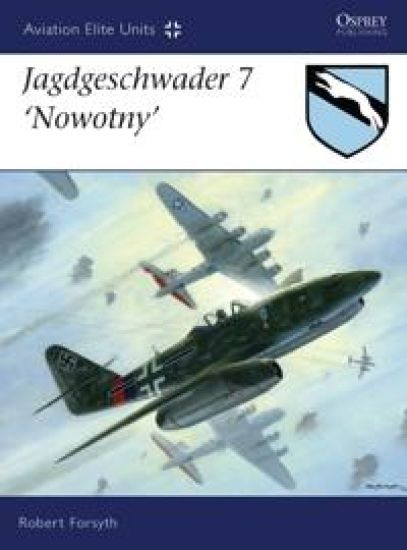
When the revolutionary Messerschmitt Me 262 jet fighter first appeared in the skies over northwest Europe in mid-1944, it represented one of the greatest challenges to Allied air superiority. The first group to solely fly jet fighters, Jagdgeschwader 7 was tasked with wrestling back command of the skies. Put almost immediately into action, despite fuel shortages, poor training and problems with the jet engine, victories quickly followed against both US and British aircraft. By the end of the war, the Jagdgeschwader had claimed nearly 200 enemy aircraft destroyed in daylight bomber raids during 1945. This book follows the history of the JG 7 unit, examining how their courage, determination and the most advanced aircraft in the world were simply not enough to ensure victory. In the final section of the book, Robert Forsyth details how JG 7 were eventually defeated by gradual losses, restricted operating conditions, lack of fuel and overwhelming Allied fighter strength.
Jagdverband 44

Jagdverband 44

Robert Forsyth

Osprey Publishing
2008
nidottu
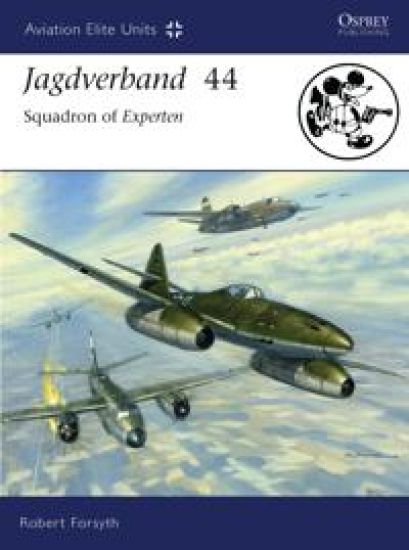
This book provides up-to-date insight into the notorious German unit, JV 44, its numerous aces and its stunning success with the revolutionary Me 262 during the last dramatic months of World War 2.There was no Luftwaffe fighter unit like Jagdverband 44. Formed in February 1945, the unit grew out of Hitler's bizarre decision that the Me 262 jet fighter should be used as a bomber, despite its potential in the daylight defensive battles over the Reich. Seen as a grave mistake by Göring, a small fighter unit was formed in southern Germany to 'prove' the Me 262's ability as an interceptor. Formed with some of Germany's most experienced fighter pilots, Jagdverband 44 numbered a disproportionately high number of leading aces in its ranks, to the extent that it was said that the Knights' Cross was the unofficial badge of the unit.With numerous first-hand accounts from pilots and detailed colour profiles, this book is a fascinating account of the dramatic birth of the jet fighter and the impact it had during the bitter struggles of 1944-45.