Kirjojen hintavertailu. Mukana 12 595 353 kirjaa ja 12 kauppaa.

Kirjailija

Robert G. Sutter

Kirjat ja teokset yhdessä paikassa: 28 kirjaa, julkaisuja vuosilta 1998-2024, suosituimpien joukossa Foreign Relations of the PRC. Vertaile teosten hintoja ja tarkista saatavuus suomalaisista kirjakaupoista.

Mukana myös kirjoitusasut: Robert G Sutter

28 kirjaa

Kirjojen julkaisuhaarukka 1998-2024.

Foreign Relations of the PRC

Foreign Relations of the PRC

Robert G. Sutter

Rowman Littlefield
2018
nidottu
Now in a fully updated edition, this cogent but comprehensive book examines the international relations of the People’s Republic of China since its founding in 1949. Noted scholar Robert G. Sutter provides a balanced assessment of the country’s recent successes and advances as well as the important legacies and constraints that hamper it, especially in nearby Asia—long the focus of China’s foreign policy attention. Sutter demonstrates how Beijing has carefully created an image of a China that follows consistent policies based on morally correct principles, but its record shows repeated episodes of sometime surprising change and frequent use of violence, intimidation, and coercion. China’s leaders, he argues, still fail to manage the desire for productive foreign relations with their aspirations to build Chinese security and sovereignty interests. Image-building efforts condition Chinese public and elite opinion to be extraordinarily sensitive, self-righteous, and often alarmist in dealing with the many disputes China has with its Asian neighbors and the United States. Advances that the PRC has made in other parts of the world focus mainly on commercial interests, limiting its actual impact on world affairs. Sutter shows readers how to use China’s rise in nearby Asia as a reliable barometer of how important and effective the country will actually become internationally.
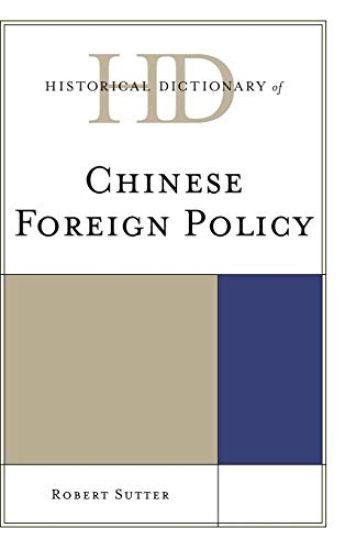
Historical Dictionary of Chinese Foreign Policy

Historical Dictionary of Chinese Foreign Policy

Robert G. Sutter

Scarecrow Press
2011
sidottu
The foreign relations of the People's Republic of China have gone through dramatic change since 1949. The strong-man rule of Mao Zedong and the Chinese Communist Party leader's dominance of Chinese foreign policy decision making for three decades witnessed dramatic swings in alignment, repeated and strong commitments to revolutionary goals and ideals, and spasms of destructive mass campaigns within China that spilled over to impact Chinese foreign relations. Contrastingly, as China emerged in the 21st century as an economic and military power second only to the United States, the new generations of Chinese leaders followed collaborative and consultative patterns of foreign policy making at home and abroad, seeking to sustain into the coming decades the generally favorable recent international circumstances seen as providing a prolonged period of "strategic opportunity" for China's economic and broader national development. Historical Dictionary of Chinese Foreign Policy covers the more than 60 years of the foreign policy of the People's Republic of China. It provides reliable and comprehensive information and assessments about the major actors, developments, and other aspects of the foreign policy and foreign relations of the People's Republic of China. This is done through a chronology, an introductory essay, and over 500 cross-referenced dictionary entries dealing with important individuals, events, and other aspects of the foreign policy of this important country. It is an excellent access point for students, researchers, and anyone wanting to know more about Chinese foreign policy.
The A to Z of United States-China Relations

The A to Z of United States-China Relations

Robert G. Sutter

Scarecrow Press
2010
nidottu
The relationship between the United States of America and the People's Republic of China is traced in this dictionary containing hundreds of cross-referenced entries on the presidents and prime ministers, the secretaries of state and foreign ministers, other key players, and the more significant institutions and events. Everything from the Boxer Uprising in the late 19th Century to Nixon's historic visit to China in 1972, from the crisis over U.S. arms sales to Taiwan in 1982 to the U.S. bombing of the Chinese Embassy at Belgrade in 1999 is covered in this highly accessible scholarly work. The A to Z of United States-China Relations introduction and chronology delineate the many differences in political, military, and ideological issues between the two countries. Two appendixes list all the United States Presidents and Secretaries of State, as well as all the Republic of China Presidents and Prime Ministers and the People's Republic of China Presidents and Prime Ministers, respectively. Supplementing the material is an extremely detailed bibliography of related materials.
Historical Dictionary of United States-China Relations
The relationship between the United States of America and the People's Republic of China is traced in this dictionary containing hundreds of cross-referenced entries on the presidents and prime ministers, the secretaries of state and foreign ministers, other key players, and the more significant institutions and events. Everything from the Boxer Uprising in the late 19th Century to Nixon's historic visit to China in 1972, from the crisis over U.S. arms sales to Taiwan in 1982 to the U.S. bombing of the Chinese Embassy at Belgrade in 1999 is covered in this highly accessible scholarly work. The book's introduction and chronology delineate the many differences in political, military, and ideological issues between the two countries. Two appendixes list all the United States Presidents and Secretaries of State, as well as all the Republic of China Presidents and Prime Ministers and the People's Republic of China Presidents and Prime Ministers, respectively. Supplementing the material is an extremely detailed bibliography of related materials.
China's Rise in Asia

China's Rise in Asia

Robert G. Sutter

Rowman Littlefield Publishers
2005
sidottu
China's rapid military and economic growth has fuelled a steady stream of analysis and debate about the PRC's motivations and objectives regarding the United States. Yet until now, there has not been a sustained, single-authored assessment in English of China's expanding influence in Asia in the post-Cold War period. Respected analyst Robert G. Sutter draws on his extensive experience in the region to explore the current debate on China's rise and its meaning for U.S. interests by examining in detail China's current and historical relations with the key countries of Asia. He finds a range of motivations underlying China's recent initiatives. Some incline Chinese policy to be cooperative with the United States, others to be competitive and confrontational. Sutter's nuanced study shows that U.S. power and influence continue to dominate Asia and play a critical role in determining China's cooperative or confrontational approach. He argues that the Bush administration's policies of firmness and cooperation have encouraged China to stay on a generally constructive track in the region.
China's Rise in Asia

China's Rise in Asia

Robert G. Sutter

Rowman Littlefield Publishers
2005
nidottu
China's rapid military and economic growth has fuelled a steady stream of analysis and debate about the PRC's motivations and objectives regarding the United States. Yet until now, there has not been a sustained, single-authored assessment in English of China's expanding influence in Asia in the post-Cold War period. Respected analyst Robert G. Sutter draws on his extensive experience in the region to explore the current debate on China's rise and its meaning for U.S. interests by examining in detail China's current and historical relations with the key countries of Asia. He finds a range of motivations underlying China's recent initiatives. Some incline Chinese policy to be cooperative with the United States, others to be competitive and confrontational. Sutter's nuanced study shows that U.S. power and influence continue to dominate Asia and play a critical role in determining China's cooperative or confrontational approach. He argues that the Bush administration's policies of firmness and cooperation have encouraged China to stay on a generally constructive track in the region.
Chinese Policy Priorities and Their Implications for the United States
How the West responds to China's emergence as a great power will go far toward determining the course of world politics in the years ahead. Yet, as Robert Sutter shows in this timely book, U.S. foreign policy in this vital arena remains remarkably unfocused and uninformed. Preoccupied with domestic imperatives and a persistent and intractable debate over China, the U.S. government, media, and public have all but ignored the interests and motivations of China's leaders. The author argues that the course of U.S.–China relations will be determined by Beijing as well as Washington, and a balanced understanding of Chinese leaders' priorities will lead to more informed and effective U.S. policy. Toward that goal, this pragmatic study examines current Chinese concerns and behavior in areas of crucial importance to the United States. Assessing the many economic, social, and political problems that continue to preoccupy China's leaders, Sutter concludes that Chinese internal difficulties and aspirations are so wide-ranging and protracted that China's leaders will remain focused on promoting economic development and reforms and maintaining social-political stability well into the twenty-first century. This analysis sets the stage for more extensive treatment of China's role in world affairs—areas where Chinese and U.S. interests interact most directly. The author contends that a balanced view of common ground and differences will temper the excessive swings seen in recent U.S. China policy and lay the groundwork for a more realistic relationship as we move into a new century.
U.S. Policy Toward China

U.S. Policy Toward China

Robert G. Sutter

Rowman Littlefield
1998
nidottu
Increased fluidity and pluralism in U.S. policy toward China in the postDCold War period have led to growing non-governmental influence as both the administration and Congress have become the target of intense lobbying by organized groups concerned with human rights, trade opportunities, relations with Taiwan, and other hotly debated issues. This balanced study examines the central role of these organizations, focusing especially on two key cases of policy reversal: President Clinton's 1994 decision to delink human rights concerns from trade access and his 1995 decision to allow Taiwan's president to visit the United States, albeit in a private capacity. The recent movement toward a more consistent and coherent administration policy on China remains tentative and has been under mounting attack, especially in the wake of Asian campaign contributions. Although recognizing that U.S. policymakers must consider a wider range of interests than was the case during the Cold War, Sutter argues that following the prevailing consensus among organized interests may lead to bad policy. Instead, he contends that U.S. foreign policy must strike a balance between satisfying domestic concerns while buttressing interests abroad.