Kirjojen hintavertailu. Mukana 12 657 676 kirjaa ja 12 kauppaa.

Kirjailija

Robert G. Wallace

Kirjat ja teokset yhdessä paikassa: 4 kirjaa, julkaisuja vuosilta 2009-2019, suosituimpien joukossa Clear-Cutting Disease Control. Vertaile teosten hintoja ja tarkista saatavuus suomalaisista kirjakaupoista.

4 kirjaa

Kirjojen julkaisuhaarukka 2009-2019.

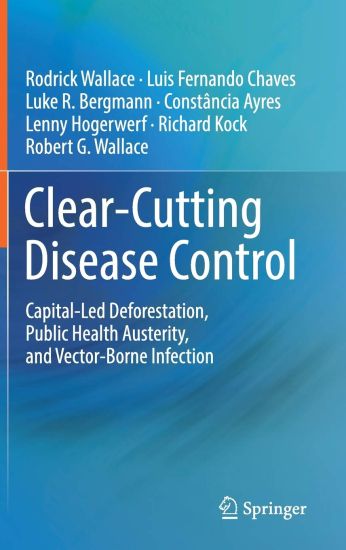
Clear-Cutting Disease Control

Clear-Cutting Disease Control

Rodrick Wallace; Luis Fernando Chaves; Luke R. Bergmann; Constância Ayres; Lenny Hogerwerf; Richard Kock; Robert G. Wallace

Springer Nature Switzerland AG
2019
nidottu
The vector-borne Zika virus joins avian influenza, Ebola, and yellow fever as recent public health crises threatening pandemicity.By a combination of stochastic modeling and economic geography, this book proposes two key causes together explain the explosive spread of the worst of the vector-borne outbreaks.Ecosystems in which such pathogens are largely controlled by environmental stochasticity are being drastically streamlined by both agribusiness-led deforestation and deficits in public health and environmental sanitation.Consequently, a subset of infections that once burned out relatively quickly in local forests are now propagating across susceptible human populations whose vulnerability to infection is often exacerbated in structurally adjusted cities. The resulting outbreaks are characterized by greater global extent, duration, and momentum.As infectious diseases in an age of nation states and global health programs cannot, as much of the present modeling literature presumes, be described by interacting populations of host, vector, and pathogen alone, a series of control theory models is also introduced here. These models, useful to researchers and health officials alike, explicitly address interactions between government ministries and the pathogens they aim to control.
Clear-Cutting Disease Control

Clear-Cutting Disease Control

Rodrick Wallace; Luis Fernando Chaves; Luke R. Bergmann; Constância Ayres; Lenny Hogerwerf; Richard Kock; Robert G. Wallace

Springer International Publishing AG
2018
sidottu
The vector-borne Zika virus joins avian influenza, Ebola, and yellow fever as recent public health crises threatening pandemicity.By a combination of stochastic modeling and economic geography, this book proposes two key causes together explain the explosive spread of the worst of the vector-borne outbreaks.Ecosystems in which such pathogens are largely controlled by environmental stochasticity are being drastically streamlined by both agribusiness-led deforestation and deficits in public health and environmental sanitation.Consequently, a subset of infections that once burned out relatively quickly in local forests are now propagating across susceptible human populations whose vulnerability to infection is often exacerbated in structurally adjusted cities. The resulting outbreaks are characterized by greater global extent, duration, and momentum.As infectious diseases in an age of nation states and global health programs cannot, as much of the present modeling literature presumes, be described by interacting populations of host, vector, and pathogen alone, a series of control theory models is also introduced here. These models, useful to researchers and health officials alike, explicitly address interactions between government ministries and the pathogens they aim to control.
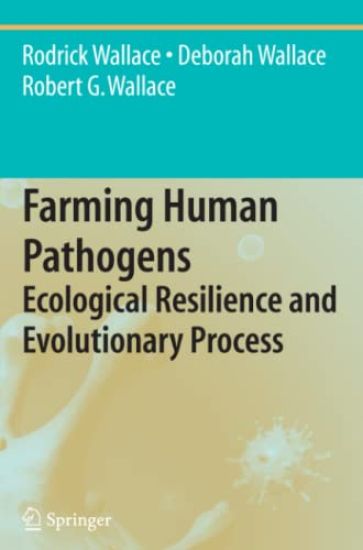
Farming Human Pathogens

Farming Human Pathogens

Rodrick Wallace; Deborah Wallace; Robert G. Wallace

Springer-Verlag New York Inc.
2010
nidottu
Farming Human Pathogens: Ecological Resilience and Evolutionary Process introduces a cutting-edge mathematical formalism based on the asymptotic limit theorems of information theory to describe how punctuated shifts in mesoscale ecosystems can entrain patterns of gene expression and organismal evolution. The authors apply the new formalism toward characterizing a number of infectious diseases that have evolved in response to the world as humans have made it. Many of the human pathogens that are emerging out from underneath epidemiological control are 'farmed' in the metaphorical sense, as the evolution of drug-resistant HIV makes clear, but also quite literally, as demonstrated by avian influenza's emergence from poultry farms in southern China. The most successful pathogens appear able to integrate selection pressures humans have imposed upon them from a variety of socioecological scales. The book also presents a related treatment of Eigen's Paradox and the RNA 'error catastrophe' that bedevils models of the origins of viruses and of biological life itself.
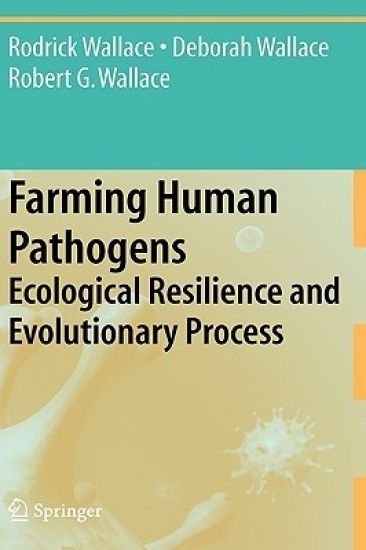
Farming Human Pathogens

Farming Human Pathogens

Rodrick Wallace; Deborah Wallace; Robert G. Wallace

Springer-Verlag New York Inc.
2009
sidottu
Farming Human Pathogens: Ecological Resilience and Evolutionary Process introduces a cutting-edge mathematical formalism based on the asymptotic limit theorems of information theory to describe how punctuated shifts in mesoscale ecosystems can entrain patterns of gene expression and organismal evolution. The authors apply the new formalism toward characterizing a number of infectious diseases that have evolved in response to the world as humans have made it. Many of the human pathogens that are emerging out from underneath epidemiological control are 'farmed' in the metaphorical sense, as the evolution of drug-resistant HIV makes clear, but also quite literally, as demonstrated by avian influenza's emergence from poultry farms in southern China. The most successful pathogens appear able to integrate selection pressures humans have imposed upon them from a variety of socioecological scales. The book also presents a related treatment of Eigen's Paradox and the RNA 'error catastrophe' that bedevils models of the origins of viruses and of biological life itself.