
Kirjailija
Robert Hanna
Kirjat ja teokset yhdessä paikassa: 15 kirjaa, julkaisuja vuosilta 2001-2025, suosituimpien joukossa Science for Humans. Vertaile teosten hintoja ja tarkista saatavuus suomalaisista kirjakaupoista.
15 kirjaa
Kirjojen julkaisuhaarukka 2001-2025.
Digital ethics and AI ethics are of fundamental importance for humankind and its future. Hanna shows how specifically Kantian moral principles can be applied to the design, production, and implementation of digital technology, with a special focus on how these principles flow from the concept and fact of human dignity. His core thesis is that digital technology is nothing more and nothing less than a tool created by humankind for the betterment of humankind, whose use should be constrained by Kantian moral principles grounded in human dignity. This thesis promises to stimulate new research on Kantian approaches to digital ethics and AI ethics. It also has important political implications, including a clarion call for us to engage in the self-conscious, self-disciplined, and free exercise of our own innate cognitive, affective, and practical capacities, in the face of new and exceptionally powerful forms of digital technology—e.g., chatbots—that threaten to undermine our ability to think, feel, and act for ourselves.
This book presents and defends an original and paradigm-shifting conception of formal science, natural science, and the natural universe alike, that’s fully pro-science, but at the same time neither theological or God-centered, nor solipsistic or self-centered, nor communitarian or social-institution-centered, nor scientistic or science-valorizing, nor materialist/physicalist or reductive, nor—above all—mechanistic. It does this by presenting and defending what Robert Hanna calls the neo-organicist turn, including manifest realism and the three sub-parts of metaphysical organicism: liberal naturalism, mind-life continuity, and explanatory inversion, whereby mechanical systems are explained by grounding them in organic systems, and not the other way around. Or more briefly and simply put, the purpose of this book is to present and defend science for humans. As such, it will be highly interesting and profoundly relevant to graduate students and specialist researchers in philosophy and the formal-&-natural sciences.
Building on contemporary research in embodied cognition, enactivism, and the extended mind, this book explores how social institutions in contemporary neoliberal nation-states systematically affect our thoughts, feelings, and agency. Human beings are, necessarily, social animals who create and belong to social institutions. But social institutions take on a life of their own, and literally shape the minds of all those who belong to them, for better or worse, usually without their being self-consciously aware of it. Indeed, in contemporary neoliberal societies, it is generally for the worse. In The Mind-Body Politic, Michelle Maiese and Robert Hanna work out a new critique of contemporary social institutions by deploying the special standpoint of the philosophy of mind—in particular, the special standpoint of the philosophy of what they call essentially embodied minds—and make a set of concrete, positive proposals for radically changing both these social institutions and also our essentially embodied lives for the better.
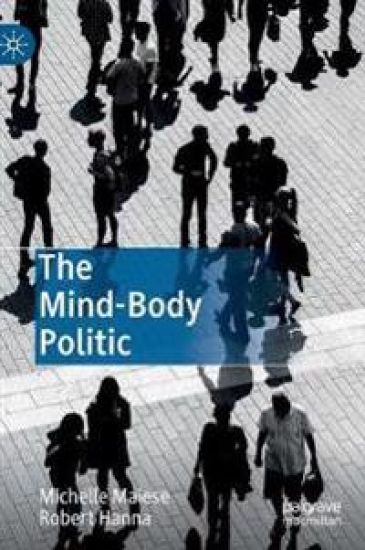
Building on contemporary research in embodied cognition, enactivism, and the extended mind, this book explores how social institutions in contemporary neoliberal nation-states systematically affect our thoughts, feelings, and agency. Human beings are, necessarily, social animals who create and belong to social institutions. But social institutions take on a life of their own, and literally shape the minds of all those who belong to them, for better or worse, usually without their being self-consciously aware of it. Indeed, in contemporary neoliberal societies, it is generally for the worse. In The Mind-Body Politic, Michelle Maiese and Robert Hanna work out a new critique of contemporary social institutions by deploying the special standpoint of the philosophy of mind—in particular, the special standpoint of the philosophy of what they call essentially embodied minds—and make a set of concrete, positive proposals for radically changing both these social institutions and also our essentially embodied lives for the better.
Preface and General Introduction, Supplementary Essays, and General Bibliography
Robert Hanna
Nova Science Pub Inc
2018
sidottu
Deep Freedom and Real Persons - a Study in Metaphysics
Robert Hanna
Nova Science Pub Inc
2018
sidottu

In Cognition, Content, and the A Priori, Robert Hanna works out a unified contemporary Kantian theory of rational human cognition and knowledge. Along the way, he provides accounts of (i) intentionality and its contents, including non-conceptual content and conceptual content, (ii) sense perception and perceptual knowledge, including perceptual self-knowledge, (iii) the analytic-synthetic distinction, (iv) the nature of logic, and (v) a priori truth and knowledge in mathematics, logic, and philosophy. This book is specifically intended to reach out to two very different audiences: contemporary analytic philosophers of mind and knowledge on the one hand, and contemporary Kantian philosophers or Kant-scholars on the other. At the same time, it is also riding the crest of a wave of exciting and even revolutionary emerging new trends and new work in the philosophy of mind and epistemology, with a special concentration on the philosophy of perception. What is revolutionary in this new wave are its strong emphases on action, on cognitive phenomenology, on disjunctivist direct realism, on embodiment, and on sense perception as a primitive and proto-rational capacity for cognizing the world. Cognition, Content, and the A Priori makes a fundamental contribution to this philosophical revolution by giving it a specifically contemporary Kantian twist, and by pushing these new lines of investigation radically further.

Take Your Idea to the Marketplace: What Every Aspiring Entrepreneur Should Know to Avoid Costly Mistakes
Robert Hanna
Createspace Independent Publishing Platform
2013
nidottu
In Embodied Minds in Action, Robert Hanna and Michelle Maiese work out a unified treatment of three fundamental philosophical problems: the mind-body problem, the problem of mental causation, and the problem of action. This unified treatment rests on two basic claims. The first is that conscious, intentional minds like ours are essentially embodied. This entails that our minds are necessarily spread throughout our living, organismic bodies and belong to their complete neurobiological constitution. So minds like ours are necessarily alive. The second claim is that essentially embodied minds are self-organizing thermodynamic systems. This entails that our mental lives consist in the possibility and actuality of moving our own living organismic bodies through space and time, by means of our conscious desires. The upshot is that we are essentially minded animals who help to create the natural world through our own agency. This doctrine--the Essential Embodiment Theory--is a truly radical idea which subverts the traditionally opposed and seemingly exhaustive categories of Dualism and Materialism, and offers a new paradigm for contemporary mainstream research in the philosophy of mind and cognitive neuroscience.
Robert Hanna argues for the importance of Kant's theories of the epistemological, metaphysical, and practical foundations of the 'exact sciences'--- relegated to the dustbin of the history of philosophy for most of the 20th century. Hanna's earlier book Kant and the Foundations of Analytic Philosophy (OUP 2001), explores basic conceptual and historical connections between Immanuel Kant's 18th-century Critical Philosophy and the tradition of mainstream analytic philosophy from Frege to Quine. The central topics of the analytic tradition in its early and middle periods were meaning and necessity. But the central theme of mainstream analytic philosophy after 1950 is scientific naturalism, which holds---to use Wilfrid Sellars's apt phrase---that 'science is the measure of all things'. This type of naturalism is explicitly reductive. Kant, Science, and Human Nature has two aims, one negative and one positive. Its negative aim is to develop a Kantian critique of scientific naturalism. But its positive and more fundamental aim is to work out the elements of a humane, realistic, and nonreductive Kantian account of the foundations of the exact sciences. According to this account, the essential properties of the natural world are directly knowable through human sense perception (empirical realism), and practical reason is both explanatorily and ontologically prior to theoretical reason (the primacy of the practical).

Robert Hanna presents a fresh view of the Kantian and analytic traditions that have dominated continental European and Anglo-American philosophy over the last two centuries, and of the relation between them. The rise of analytic philosophy decisively marked the end of the hundred-year dominance of Kant's philosophy in Europe. But Hanna shows that the analytic tradition also emerged from Kant's philosophy in the sense that its members were able to define and legitimate their ideas only by means of an intensive, extended engagement with, and a partial or complete rejection of, the Critical Philosophy. Hanna's book therefore comprises both an interpretative study of Kant's massive and seminal Critique of Pure Reason, and a critical essay on the historical foundations of analytic philosophy from Frege to Quine. Hanna considers Kant's key doctrines in the Critique in the light of their reception and transmission by the leading figures of the analytic tradition--Frege, Moore, Russell, Wittgenstein, Carnap, and Quine. But this is not just a study in the history of philosophy, for out of this emerges Hanna's original approach to two much-contested theories that remain at the heart of contemporary philosophy. Hanna puts forward a new 'cognitive-semantic' interpretation of transcendental idealism, and a vigorous defence of Kant's theory of analytic and synthetic necessary truth. These will make Kant and the Foundations of Analytic Philosophy compelling reading not just for specialists in the history of philosophy, but for all who are interested in these fundamental philosophical issues.

Robert Hanna presents a fresh view of the Kantian and analytic traditions that have dominated continental European and Anglo-American philosophy over the last two centuries, and of the relation between them. The rise of analytic philosophy decisively marked the end of the hundred-year dominance of Kant's philosophy in Europe. But Hanna shows that the analytic tradition also emerged from Kant's philosophy in the sense that its members were able to define and legitimate their ideas only by means of an intensive, extended engagement with, and a partial or complete rejection of, the Critical Philosophy. Hanna's book therefore comprises both an interpretative study of Kant's massive and seminal Critique of Pure Reason, and a critical essay on the historical foundations of analytic philosophy from Frege to Quine. Hanna considers Kant's key doctrines in the Critique in the light of their reception and transmission by the leading figures of the analytic tradition--Frege, Moore, Russell, Wittgenstein, Carnap, and Quine. But this is not just a study in the history of philosophy, for out of this emerges Hanna's original approach to two much-contested theories that remain at the heart of contemporary philosophy. Hanna puts forward a new 'cognitive-semantic' interpretation of transcendental idealism, and a vigorous defence of Kant's theory of analytic and synthetic necessary truth. These will make Kant and the Foundations of Analytic Philosophy compelling reading not just for specialists in the history of philosophy, but for all who are interested in these fundamental philosophical issues.