Kirjojen hintavertailu. Mukana 12 595 353 kirjaa ja 12 kauppaa.

Kirjailija

Robert Hendry

Kirjat ja teokset yhdessä paikassa: 7 kirjaa, julkaisuja vuosilta 2022-2027, suosituimpien joukossa The South West Main Line From London Waterloo to Eastleigh. Vertaile teosten hintoja ja tarkista saatavuus suomalaisista kirjakaupoista.

7 kirjaa

Kirjojen julkaisuhaarukka 2022-2027.

The South West Main Line From London Waterloo to Eastleigh
The South West Main Line to connect London with the port of Southampton and on to Weymouth was built by the London & South Western Railway (LSWR), with the first stages opening in the 1830s and 1840s. By the time the terminus at Waterloo opened in 1848 the line was complete to the old Terminus station at Southampton by the docks. This station has since closed but the line serves passengers today from London, through Surrey, Hampshire and Dorset. Over the years it has seen changes of ownership from the LSWR, to the Southern Railway in the 1923 Grouping, British Railways after Nationalisation in 1948, until privatisation in the 1990s. During this time rolling stock changed markedly too, from steam to modern traction, the line electrified and infrastructure and signalling steadily modernised. This photographic survey of the South West Main Line from London Waterloo to the major junction of Eastleigh, with photographs and other illustrations from the early days of the line under London & South Western Railway ownership to Network SouthEast and the end of BR, will appeal to all those with an interest in the history of railways in this area and in the changes in Britain’s railways in general over the years.
The GWR's Forgotten Main Line to the North

The GWR's Forgotten Main Line to the North

Robert Hendry

AMBERLEY PUBLISHING
2025
nidottu
A key part of the Great Western Railway’s network was the main line to the North through Birmingham. From London, this route including the Princes Risborough cut-off joined Didcot, Oxford, Banbury and Birmingham, and then Wolverhampton, Chester and Shrewsbury, opening up destinations in the North and North West. The GWR also ran services on its joint lines with the London & North Western Railway and the Great Central Railway, to reach Birkenhead and York. In this book author, modeller and railway historian Robert Hendry draws on his extensive collection of historical images to present a photographic portrait of this significant part of the Great Western Railway through the years.
Euston to Birmingham

Euston to Birmingham

Robert Hendry

AMBERLEY PUBLISHING
2025
nidottu
The London & Birmingham Railway was the first intercity line in Britain to travel from London. Superbly engineered by Robert Stephenson, this pioneering early achievement of the railway age in Britain linked England’s second city Birmingham to the capital at Euston station and became part of what later came to be known as the West Coast Main Line. En route, the line travelled through Rugby and Coventry and terminated at Curzon Street station in Birmingham but by 1854 passenger services stopped at Birmingham New Street instead. The route soon became part of the London & North Western Railway, later absorbed into the London, Midland & Scottish Railway at the Grouping in 1923, before becoming part of British Railways in Nationalisation in 1948. In this book author, modeller and railway historian Robert Hendry draws on his extensive collection of historical images to present a photographic portrait of the Euston to Birmingham route through the years up to the Rail Blue era of British Rail which ended in the 1980s.
Traditional Signalling on British Railways

Traditional Signalling on British Railways

Robert Hendry

AMBERLEY PUBLISHING
2025
nidottu
Signalling on British Railways underwent massive change from Nationalisation in 1948 to privatisation in the 1990s, but throughout this period much of the network’s infrastructure dated from the era of the Big Four and the pre-Grouping companies. The variety of traditional signalling in use in the BR era, from the pre-Grouping infrastructure and mechanical signalling up to BR-built signal boxes prior to the conversion to colour-light signalling, is explored here. The principles of signalling operation are also explained. In this book author Robert Hendry presents a fascinating insight into traditional signalling on British railways through a wealth of rare and previously unpublished images.
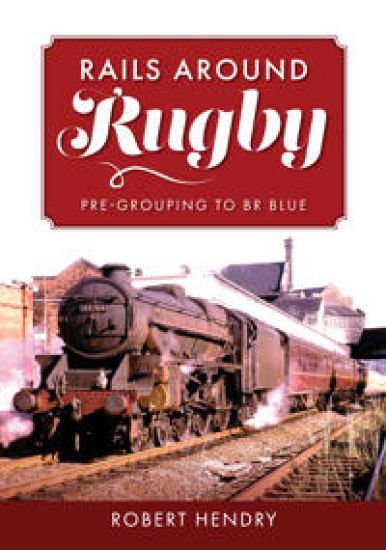
Rails Around Rugby

Rails Around Rugby

Robert Hendry

AMBERLEY PUBLISHING
2023
nidottu
Railways Around Rugby: Pre-Grouping to Rail Blue tells the story of change on the railway network in the Rugby area, covering a period spanning from before the Grouping of the Railways in 1923 to the BR Rail Blue era of the 1960s, 1970s and 1980s. During the late nineteenth and early twentieth century, The London & North Western Railway, The Great Central Railway and the Midland Railway all operated in and around Rugby. Rugby was served by two stations, Rugby and Rugby Central. The latter closed in 1969 and was an important railway junction on what became the West Coast Main Line, with routes to Birmingham and the North West and Scotland in one direction and to London Euston and Northampton in the other. The Great Central route from Sheffield and the East Midlands ran to London at Marylebone. By the 1960s, the West Coast Main Line was electrified around Rugby and the Great Central closed in the same decade, as well as the lines to Leamington, Leicester and Peterborough and the engine sheds at Rugby. In this book author Robert Hendry portrays the changing face of the railways around Rugby, utilising a wealth of rare and previously unpublished images.