Kirjojen hintavertailu. Mukana 12 390 323 kirjaa ja 12 kauppaa.
Kirjailija
Robert I. Sutton
Kirjat ja teokset yhdessä paikassa: 19 kirjaa, julkaisuja vuosilta 1999-2025, suosituimpien joukossa HBR's 10 Must Reads 2025. Vertaile teosten hintoja ja tarkista saatavuus suomalaisista kirjakaupoista.
‘If every leader took the ideas in this book seriously, the world would be a less miserable, more productive place.’ Adam Grant, author of Think AgainEvery organisation is plagued by destructive friction. Lengthy and convoluted emails, inefficient processes, and antiquated procedures can all be obstacles to excellence at work.Yet some forms of friction are incredibly useful. Often teams need to slow down, struggle and develop some bad ideas to find that rare good one. And leaders who attempt to improve workplace efficiency often make things even worse.Drawing from seven years of hands-on research, The Friction Project by bestselling authors Robert I. Sutton and Huggy Rao teaches readers how to become “friction fixers.”Sutton and Rao will help you to:identify where to avert and repair bad organisational frictionacknowledge where to maintain and inject good frictionreframe friction troubles that can’t be immediately fixed, so they feel less threateningrepair failing organisationsThe Friction Project is the ultimate guide to making the right things easier and the wrong things harder.‘Hard to put down and easy to like, this is a business book to savour.’ Tim Harford, author of The Data Detective
A year's worth of management wisdom, all in one place. We've reviewed the ideas, insights, and best practices from the past year of Harvard Business Review to keep you up to date on the most cutting-edge, influential thinking driving business today. With authors from Ginni Rometty to Robert I. Sutton and company examples from Maersk to Nvidia, this volume brings the most current and important management conversations right to your fingertips. This book will inspire you to: Reskill your organization in the age of AI Rid your company of the obstacles that infuriate everyone Understand what today's rainmakers do differently Market sustainable products effectively Choose the right sources of demand to grow your company at the right speed Use strategic thinking to create the life you want This collection of articles includes "Reskilling in the Age of AI," by Jorge Tamayo, Leila Doumi, Sagar Goel, Orsolya Kovacs-Ondrejkovic, and Raffaella Sadun; "How Fast Should Your Company Really Grow?," by Gary P. Pisano; "How to Sustain Your Empathy in Difficult Times," by Jamil Zaki; "The New-Collar Workforce," by Colleen Ammerman, Boris Groysberg, and Ginni Rometty; "Rid Your Organization of Obstacles That Infuriate Everyone," by Robert I. Sutton and Huggy Rao; "Where Does DEI Go from Here?," by Laura Morgan Roberts; "What Today's Rainmakers Do Differently," by Matthew Dixon, Ted McKenna, Rory Channer, and Karen Freeman; "The New Era of Industrial Policy Is Here," by Willy C. Shih; "How to Market Sustainable Products," by Frederic Dalsace and Goutam Challagalla; "What Does 'Stakeholder Capitalism' Mean to You?," by Lynn S. Paine; and "Use Strategic Thinking to Create the Life You Want," by Rainer Strack, Susanne Dyrchs, and Allison Bailey. HBR's 10 Must Reads paperback series is the definitive collection of books for new and experienced leaders alike. Leaders looking for the inspiration that big ideas provide, both to accelerate their own growth and that of their companies, should look no further. HBR's 10 Must Reads series focuses on the core topics that every ambitious manager needs to know: leadership, strategy, change, managing people, and managing yourself. Harvard Business Review has sorted through hundreds of articles and selected only the most essential reading on each topic. Each title includes timeless advice that will be relevant regardless of an ever-changing business environment.
Featured in Financial Times 'Best Business Books of 2024'The definitive guide to eliminating the forces that make it harder, more complicated, or downright impossible to get things done in organizations. Find out why Adam Grant says "If every leader took the ideas in this book seriously, the world would be a less miserable, more productive place."Every organization is plagued by destructive friction. Yet some forms of friction are incredibly useful, and leaders who attempt to improve workplace efficiency often make things even worse. Drawing from seven years of hands-on research, The Friction Project by bestselling authors Robert I. Sutton and Huggy Rao teaches readers how to become “friction fixers.”Sutton and Rao kick off the book by unpacking how skilled friction fixers think and act like trustees of others’ time. They provide friction forensics to help readers identify where to avert and repair bad organizational friction and where to maintain and inject good friction. Then their help pyramid shows how friction fixers do their work, from reframing friction troubles they can’t fix right now, so they feel less threatening, to designing and repairing organizations. The heart of the book digs into the causes and solutions for five of the most common and damaging friction troubles: oblivious leaders, addition sickness, broken connections, jargon monoxide, and fast and frenzied people and teams.Sound familiar? Sutton and Rao are here to help. They wrap things up with lessons for leading your own friction project, including linking little things to big things; the power of civility, caring, and love for propelling designs and repairs; and embracing the mess that is an inevitable part of the process (while still trying to clean it up). 'Entertaining and eminently practical' - Financial Times
The definitive guide to eliminating the forces that make it harder, more complicated, or downright impossible to get things done in organizations. Find out why Adam Grant says "If every leader took the ideas in this book seriously, the world would be a less miserable, more productive place."Every organization is plagued by destructive friction. Yet some forms of friction are incredibly useful, and leaders who attempt to improve workplace efficiency often make things even worse. Drawing from seven years of hands-on research, The Friction Project by bestselling authors Robert I. Sutton and Huggy Rao teaches readers how to become "friction fixers." Sutton and Rao kick off the book by unpacking how skilled friction fixers think and act like trustees of others' time. They provide friction forensics to help readers identify where to avert and repair bad organizational friction and where to maintain and inject good friction. Then their help pyramid shows how friction fixers do their work, from reframing friction troubles they can't fix right now, so they feel less threatening, to designing and repairing organizations. The heart of the book digs into the causes and solutions for five of the most common and damaging friction troubles: oblivious leaders, addition sickness, broken connections, jargon monoxide, and fast and frenzied people and teams. Sound familiar? Sutton and Rao are here to help. They wrap things up with lessons for leading your own friction project, including linking little things to big things; the power of civility, caring, and love for propelling designs and repairs; and embracing the mess that is an inevitable part of the process (while still trying to clean it up).
How do the most resilient companies survive—and even thrive—during a slowdown?If you read nothing else on surviving a tough economy and coming back stronger, read these 15 articles. We've combed through hundreds of Harvard Business Review articles and selected the most important ones to help your company persevere through economic challenges and continue to grow while your competitors stumble.This book will inspire you to:Harness your resources to pull through a pandemicLearn the right lessons from previous recessionsMinimize pain while cutting costs and managing riskFoster a healthy culture during anxious timesMake smart moves to protect your own jobSeize the opportunity to innovate and reinvent your businessThis collection of articles includes "Seize Advantage in a Downturn" by David Rhodes and Daniel Stelter; "How to Survive a Recession and Thrive Afterward: A Research Roundup" by Walter Frick; "How to Bounce Back from Adversity" by Joshua D. Margolis and Paul G. Stoltz; "Rohm and Haas's Former CEO on Pulling off a Sweet Deal in a Down Market" by Raj Gupta; "How to Be a Good Boss in a Bad Economy" by Robert I. Sutton; "Layoffs That Don't Break Your Company" by Sandra J. Sucher and Shalene Gupta; "Getting Reorgs Right" by Stephen Heidari-Robinson and Suzanne Heywood; "Reigniting Growth" by Chris Zook and James Allen; "Reinvent Your Business Model Before It's Too Late" by Paul Nunes and Tim Breene; "How to Protect Your Job in a Recession" by Janet Banks and Diane Coutu; "Learning from the Future" by J. Peter Scoblic; "5 Ways to Stimulate Cash Flow in a Downturn" by Eddie Yoon and Christopher Lochhead; "The Case for M&A in a Downturn" by Brian Salsberg; "Include Your Employees in Cost-Cutting Decisions" by Patrick Daoust and Paul Simon; and "Preparing Your Business for a Post-Pandemic World" by Carsten Lund Pedersen and Thomas Ritter.HBR's 10 Must Reads paperback series is the definitive collection of books for new and experienced leaders alike. Leaders looking for the inspiration that big ideas provide, both to accelerate their own growth and that of their companies, should look no further. HBR's 10 Must Reads series focuses on the core topics that every ambitious manager needs to know: leadership, strategy, change, managing people, and managing yourself. Harvard Business Review has sorted through hundreds of articles and selected only the most essential reading on each topic. Each title includes timeless advice that will be relevant regardless of an ever-changing business environment.
How do the most resilient companies survive—and even thrive—during a slowdown?If you read nothing else on surviving a tough economy and coming back stronger, read these 15 articles. We've combed through hundreds of Harvard Business Review articles and selected the most important ones to help your company persevere through economic challenges and continue to grow while your competitors stumble.This book will inspire you to:Harness your resources to pull through a pandemicLearn the right lessons from previous recessionsMinimize pain while cutting costs and managing riskFoster a healthy culture during anxious timesMake smart moves to protect your own jobSeize the opportunity to innovate and reinvent your businessThis collection of articles includes "Seize Advantage in a Downturn" by David Rhodes and Daniel Stelter; "How to Survive a Recession and Thrive Afterward: A Research Roundup" by Walter Frick; "How to Bounce Back from Adversity" by Joshua D. Margolis and Paul G. Stoltz; "Rohm and Haas's Former CEO on Pulling off a Sweet Deal in a Down Market" by Raj Gupta; "How to Be a Good Boss in a Bad Economy" by Robert I. Sutton; "Layoffs That Don't Break Your Company" by Sandra J. Sucher and Shalene Gupta; "Getting Reorgs Right" by Stephen Heidari-Robinson and Suzanne Heywood; "Reigniting Growth" by Chris Zook and James Allen; "Reinvent Your Business Model Before It's Too Late" by Paul Nunes and Tim Breene; "How to Protect Your Job in a Recession" by Janet Banks and Diane Coutu; "Learning from the Future" by J. Peter Scoblic; "5 Ways to Stimulate Cash Flow in a Downturn" by Eddie Yoon and Christopher Lochhead; "The Case for M&A in a Downturn" by Brian Salsberg; "Include Your Employees in Cost-Cutting Decisions" by Patrick Daoust and Paul Simon; and "Preparing Your Business for a Post-Pandemic World" by Carsten Lund Pedersen and Thomas Ritter.HBR's 10 Must Reads paperback series is the definitive collection of books for new and experienced leaders alike. Leaders looking for the inspiration that big ideas provide, both to accelerate their own growth and that of their companies, should look no further. HBR's 10 Must Reads series focuses on the core topics that every ambitious manager needs to know: leadership, strategy, change, managing people, and managing yourself. Harvard Business Review has sorted through hundreds of articles and selected only the most essential reading on each topic. Each title includes timeless advice that will be relevant regardless of an ever-changing business environment.
"This book is a contemporary classic--a shrewd and spirited guide to protecting ourselves from the jerks, bullies, tyrants, and trolls who seek to demean. We desperately need this antidote to the a-holes in our midst."--Daniel H. Pink, best-selling author of To Sell Is Human and Drive How to avoid, outwit, and disarm assholes, from the author of the classic The No Asshole Rule As entertaining as it is useful, The Asshole Survival Guide delivers a cogent and methodical game plan for anybody who feels plagued by assholes. Sutton starts with diagnosis--what kind of asshole problem, exactly, are you dealing with? From there, he provides field-tested, evidence-based, and often surprising strategies for dealing with assholes--avoiding them, outwitting them, disarming them, sending them packing, and developing protective psychological armor. Sutton even teaches readers how to look inward to stifle their own inner jackass. Ultimately, this survival guide is about developing an outlook and personal plan that will help you preserve the sanity in your work life, and rescue all those perfectly good days from being ruined by some jerk. "Thought-provoking and often hilarious . . . An indispensable resource."--Gretchen Rubin, best-selling author of The Happiness Project and Better Than Before "At last . . . clear steps for rejecting, deflecting, and deflating the jerks who blight our lives . . . Useful, evidence-based, and fun to read."--Robert Cialdini, best-selling author of Influence and Pre-Suasion
Being around assholes, whether at work or elsewhere, can damage performance and affect wellbeing: having one asshole in a team has been shown to reduce performance by 30 to 40%, and research shows that rudeness spreads like a common cold. In The Asshole Survival Guide, Stanford professor Robert Sutton offers practical advice on identifying and tackling any kind of asshole - based on research into groups from uncivil civil servants to French bus drivers, and 8,000 emails that he has received on asshole behaviour.With expertise and humour, he provides a cogent and methodical game-plan to fight back. First, he sets out the asshole audit, to find out what kind of asshole needs dealing with, and asshole detection strategies. Then he reveals field-tested, sometimes surprising techniques, from asshole avoidance and asshole taxes, to mind-tricks and the art of love bombing. Finally, he explains the dangers of asshole blindness - when the problem might be yours truly.Readers will learn how to handle assholes - in the workplace and beyond - once and for all!
Scaling up excellence is the key to creating a great organisation. Scaling Up Excellence is the first management book devoted to what is - or should be - a core priority for every organisation.
Wall Street Journal Bestseller "The pick of 2014's management books." -Andrew Hill, Financial Times "One of the top business books of the year." -Harvey Schacter, The Globe and Mail Bestselling author, Robert Sutton and Stanford colleague, Huggy Rao tackle a challenge that determines every organization's success: how to scale up farther, faster, and more effectively as an organization grows. Sutton and Rao have devoted much of the last decade to uncovering what it takes to build and uncover pockets of exemplary performance, to help spread them, and to keep recharging organizations with ever better work practices. Drawing on inside accounts and case studies and academic research from a wealth of industries-- including start-ups, pharmaceuticals, airlines, retail, financial services, high-tech, education, non-profits, government, and healthcare-- Sutton and Rao identify the key scaling challenges that confront every organization. They tackle the difficult trade-offs that organizations must make between whether to encourage individualized approaches tailored to local needs or to replicate the same practices and customs as an organization or program expands. They reveal how the best leaders and teams develop, spread, and instill the right mindsets in their people-- rather than ruining or watering down the very things that have fueled successful growth in the past. They unpack the principles that help to cascade excellence throughout an organization, as well as show how to eliminate destructive beliefs and behaviors that will hold them back. Scaling Up Excellence is the first major business book devoted to this universal and vexing challenge and it is destined to become the standard bearer in the field.
Now with a new chapter that focuses on what great bosses really do. Dr. Sutton reveals new insights that he's learned since the writing of Good Boss, Bad Boss. Sutton adds revelatory thoughts about such legendary bosses as Ed Catmull, Steve Jobs, A.G. Lafley, and many more, and how you can implement their techniques. If you are a boss who wants to do great work, what can you do about it? Good Boss, Bad Boss is devoted to answering that question. Stanford Professor Robert Sutton weaves together the best psychological and management research with compelling stories and cases to reveal the mindset and moves of the best (and worst) bosses. This book was inspired by the deluge of emails, research, phone calls, and conversations that Dr. Sutton experienced after publishing his blockbuster bestseller The No Asshole Rule. He realized that most of these stories and studies swirled around a central figure in every workplace: THE BOSS. These heart-breaking, inspiring, and sometimes funny stories taught Sutton that most bosses - and their followers - wanted a lot more than just a jerk-free workplace. They aspired to become (or work for) an all-around great boss, somebody with the skill and grit to inspire superior work, commitment, and dignity among their charges. As Dr. Sutton digs into the nitty-gritty of what the best (and worst) bosses do, a theme runs throughout Good Boss, Bad Boss - which brings together the diverse lessons and is a hallmark of great bosses: They work doggedly to stay in tune with how their followers (and superiors, peers, and customers too) react to what they say and do. The best bosses are acutely aware that their success depends on having the self-awareness to control their moods and moves, to accurately interpret their impact on others, and to make adjustments on the fly that continuously spark effort, dignity, and pride among their people.
The definitive guide to working with -- and surviving -- bullies, creeps, jerks, tyrants, tormentors, despots, backstabbers, egomaniacs, and all the other assholes who do their best to destroy you at work. "What an asshole " How many times have you said that about someone at work? You're not alone In this groundbreaking book, Stanford University professor Robert I. Sutton builds on his acclaimed Harvard Business Review article to show you the best ways to deal with assholes...and why they can be so destructive to your company. Practical, compassionate, and in places downright funny, this guide offers: Strategies on how to pinpoint and eliminate negative influences for good Illuminating case histories from major organizations A self-diagnostic test and a program to identify and keep your own "inner jerk" from coming outThe No Asshole Rule is a New York Times, Wall Street Journal, USA Today and Business Week bestseller.
Monatelang auf allen Wirtschafts-Bestsellerlisten! Wir alle kennen sie: die Wichtigtuer, Intriganten, Tyrannen und Egomanen im Berufsleben - und wir haben eine sehr einprägsame Bezeichnung für diese Spezies. Robert Sutton liefert den Beweis: Arschlöcher sind nicht nur eine unerträgliche Zumutung für ihre Mitmenschen, sondern schaden auch dem Unternehmen massiv. Doch wie lassen sie sich eindeutig identifizieren und entschlossen kaltstellen? Ein einzigartiger Leitfaden mit einer Fülle nützlicher Ideen und Überlebensstrategien für den Umgang mit Arschlöchern. "Sein Buch ist ein Leitfaden für den Umgang mit den Egomanen im Betrieb: Sutton zeigt die Strategien fieser Büro-Despoten und gibt Empfehlungen für leidgeplagte Kollegen und Mitarbeiter. Der Professor verliert dabei nie seinen Humor und erzählt auch witzige Anekdoten aus dem Unternehmensalltag." Der Handel "Er gibt ebenso redliche wie realistische Tipps, wie man sich gegen Arschlöcher wappnet und ihnen begegnet. Regel Nummer eins: auf keinen Fall mit gleicher Münze heimzahlen." Financial Times Deutschland "Die Fülle der Beispiele sowie die klare Sprache (vom derben Titel sollte man sich nicht abschrecken lassen) machen Suttons Buch zum unterhaltsamen Ratgeber." manager magazin
A breakthrough in management thinking, "weird ideas" can help every organization achieve a balance between sustaining performance and fostering new ideas. To succeed, you need to be both conventional and counterintuitive. Creativity, new ideas, innovation--in any age they are keys to success. Yet, as Stanford professor Robert Sutton explains, the standard rules of business behavior and management are precisely the opposite of what it takes to build an innovative company. We are told to hire people who will fit in; to train them extensively; and to work to instill a corporate culture in every employee. In fact, in order to foster creativity, we should hire misfits, goad them to fight, and pay them to defy convention and undermine the prevailing culture. Weird Ideas That Work codifies these and other proven counterintuitive ideas to help you turn your workplace from staid and safe to wild and woolly--and creative. In Weird Ideas That Work Sutton draws on extensive research in behavioral psychology to explain how innovation can be fostered in hiring, managing, and motivating people; building teams; making decisions; and interacting with outsiders. Business practices like "hire people who make you uncomfortable" and "reward success and failure, but punish inaction," strike many managers as strange or even downright wrong. Yet Weird Ideas That Work shows how some of the best teams and companies use these and other counterintuitive practices to crank out new ideas, and it demonstrates that every company can reap sales and profits from such creativity. Weird Ideas That Work is filled with examples, drawn from hi- and low-tech industries, manufacturing and services, information and products. More than just a set of bizarre suggestions, it represents a breakthrough in management thinking: Sutton shows that the practices we need to sustain performance are in constant tension with those that foster new ideas. The trick is to choose the right balance between conventional and "weird"--and now, thanks to Robert Sutton's work, we have the tools we need to do so.
The best organizations have the best talent...Financial incentives drive company performance...Firms must change or die. Popular axioms like these drive business decisions every day. Yet too much common management "wisdom" isn't wise at all--but, instead, flawed knowledge based on "best practices" that are actually poor, incomplete, or outright obsolete. Worse, legions of managers use this dubious knowledge to make decisions that are hazardous to organizational health. Jeffrey Pfeffer and Robert I. Sutton show how companies can bolster performance and trump the competition through evidence-based management, an approach to decision-making and action that is driven by hard facts rather than half-truths or hype. This book guides managers in using this approach to dismantle six widely held--but ultimately flawed--management beliefs in core areas including leadership, strategy, change, talent, financial incentives, and work-life balance. The authors show managers how to find and apply the best practices for their companies, rather than blindly copy what seems to have worked elsewhere. This practical and candid book challenges leaders to commit to evidence-based management as a way of organizational life--and shows how to finally turn this common sense into common practice.
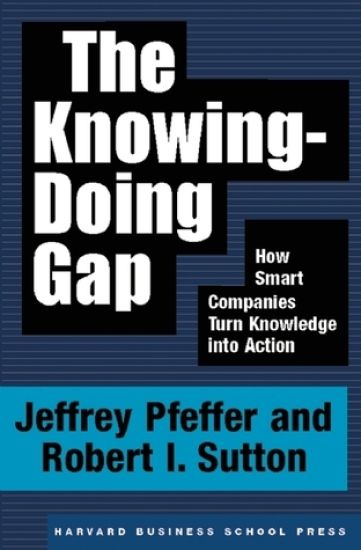
Why are there so many gaps between what firms know they should do and what they actually do? Why do so many companies fail to implement the experience and insight they've worked so hard to acquire? The Knowing-Doing Gap is the first book to confront the challenge of turning knowledge about how to improve performance into actions that produce measurable results. Jeffrey Pfeffer and Robert Sutton, well-known authors and teachers, identify the causes of the knowing-doing gap and explain how to close it. The message is clear--firms that turn knowledge into action avoid the "smart talk trap." Executives must use plans, analysis, meetings, and presentations to inspire deeds, not as substitutes for action. Companies that act on their knowledge also eliminate fear, abolish destructive internal competition, measure what matters, and promote leaders who understand the work people do in their firms. The authors use examples from dozens of firms that show how some overcome the knowing-doing gap, why others try but fail, and how still others avoid the gap in the first place. The Knowing-Doing Gap is sure to resonate with executives everywhere who struggle daily to make their firms both know and do what they know. It is a refreshingly candid, useful, and realistic guide for improving performance in today's business.