
Kirjailija
Robert J Bunker
Kirjat ja teokset yhdessä paikassa: 20 kirjaa, julkaisuja vuosilta 2011-2020, suosituimpien joukossa Islamist Insurgents on the Defensive. Vertaile teosten hintoja ja tarkista saatavuus suomalaisista kirjakaupoista.
Mukana myös kirjoitusasut: Robert J. Bunker
20 kirjaa
Kirjojen julkaisuhaarukka 2011-2020.

China's Securing, Shaping, and Exploitation of Strategic Spaces
Robert J Bunker
Xlibris Us
2019
pokkari
The timing of Dr. Robert J. Bunker's new SWJ pocket book is apropos given the increasing intransigence of the Chinese Communist Party (CCP) in both its domestic 'police state' security policies and foreign 'expansionistic' economic and military activities. This authoritarian regime-bereft of its former Marxist and Maoist ideologies except in name only-under the iron fisted leadership of 'president for life' Xi Jinping is increasingly in the news for the many draconian and predatory behaviors and actions in which it is now engaging. Dave Dilegge Editor-in-Chief Small Wars Journal

Rising Inequality in the United States
Robert J Bunker; Pamela Ligouri Bunker
Xlibris Us
2019
pokkari

This work is the fourth Small Wars Journal anthology focusing on radical Sunni Islamic terrorists and insurgent groups. It covers this professional journals writings for 2016 and is a compliment to the earlier Global Radical Islamist Insurgency anthologies that were produced as Vol. I: 20072011 (published in 2015) and Vol. II: 20122014 (published in 2016) and Jihadi Terrorism, Insurgency, and the Islamic State spanning 2015 (published in 2017). This anthology, which offers well over 600 pages of focused analysis, follows the same general conceptual breakdown as the earlier works and is divided into two major thematic sectionsone focusing on Al Qaeda and Islamic state activities in 2016 and the other focusing on US-Allied policies and counterinsurgent strategies.
This important monograph focuses on the emergence of armed robotic systems on the early 21st- century battlefield and the new strategic realities that their fielding may entail. It utilizes a little known-yet decades old-weapons systems life cycle analytical approach, to place these warfighting technologies in a larger strategic context. This is provided by means of case studies focusing on the developmental progression of the knight from the 9th through the 16th century, the battleship from the 19th through the 20th century, and the tank from the 20th into the 21st century. This progression follows experimental, institutionalized, ritualized, and satirized life cycle phases in which a weapons system is first worked out for battlefield deployment, is then optimized as it matures, later becomes increasingly obsolete as it passes its prime, and finally is suicidal to use as advanced warfighting technologies move beyond it.
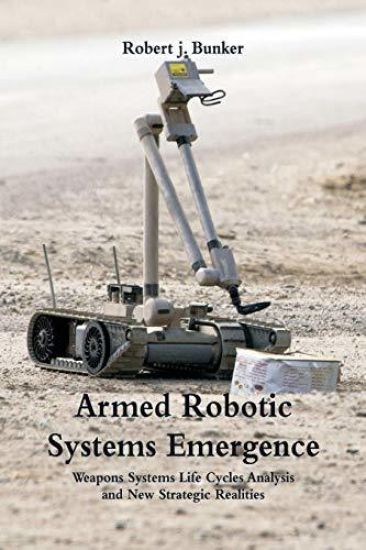
The fielding of armed robotic systems--droids and drones that are teleoperated, semi-autonomous, and even autonomous--has been slowly but surely transitioning from pure science fiction into military reality on the battlefields of the early 21st century. These systems currently have no artificial intelligence (AI) whatsoever and, in most cases, are simply operated by soldiers (and on occasion terrorists and insurgents) utilizing hardline cables and laptop-like controllers, although wireless and satellite systems exist for the more sophisticated national armed drone programs. Near-term future prototypes are likely to have, at best, independent response capabilities similar to a trained animal, due to the incorporation of expert system programming. Projections out even further, however, have raised concerns that these emergent weapons systems, possessing semi-autonomous and autonomous capabilities, could ultimately have the potential to evolve beyond the machine stimulus and response level, eventually incorporating varying degrees of weak AI, and one day possibly even achieving a basic form of self-awareness. ...] In summation, the strategic implications of the robotics revolution upon us cannot be overstated. The robots are not only coming--they are here--and for future U.S. national security requirements, we will need to have a military mastery over them. Hence, our present and future decisions related to armed robotic systems emergence on the battlefield--and the command and control (C2) methodologies directing them--will result in near-term and future force structure end states that will have a fundamental impact on the U.S. conduct of war in the coming decades. These decisions will be a major determinant concerning the ability of the United States to retain dominance as the primary global military power well into the mid-21st century.
This monograph develops a typology of old and new insurgency forms derived from a comprehensive review of the writings of insurgency theorists along with the inclusion of a number of schema offered by terrorism scholars. The work is unique in that no prior military theoretical efforts have been undertaken to analyze and synthesize the post-Cold War insurgency form writings that have emerged over the last 2 decades. It is apropos that these writings were greatly influenced by Strategic Studies Institute efforts dating back to the early-1990s-initially pioneered by Dr. Steven Metz, our present Director of Research-that have now come full circle with their integration in this work. The monograph contains an introduction, sections on defining insurgency, terrorism as insurgency indications and warnings, review of insurgency typologies, a proposed insurgency typology with legacy, contemporary, emergent and potential forms, and the strategic implications for U.S. defense policy...

Terrorist and Insurgent Unmanned Aerial Vehicles: Use, Potentials, and Military Implications
Robert J. Bunker; Strategic Studies Institute; U.S. Army War College
Lulu.com
2015
nidottu
This manuscript focuses on the present threat posed by terrorist and insurgent use of unmanned aerial vehicles (UAVs) as well as the associated future threat potentials identified. The work presents a counterintuitive analysis in the sense that armed drones are typically viewed as a component of America's conventional warfighting prowess-not a technology that would be used against U.S. troops deployed overseas or against civilians back home. Utilizing a red teaming approach, the author, Dr. Robert J. Bunker, a past Minerva Chair at our institution, investigates the emerging threat of such UAV use. His unique analysis and creative approach, especially when related to the threat scenario variants generated, make for very informative reading. The work is divided into an introduction to the topical area, a UAV historical overview and discussion of present use by the U.S. military, a chronological narrative of terrorist and insurgent UAV use...

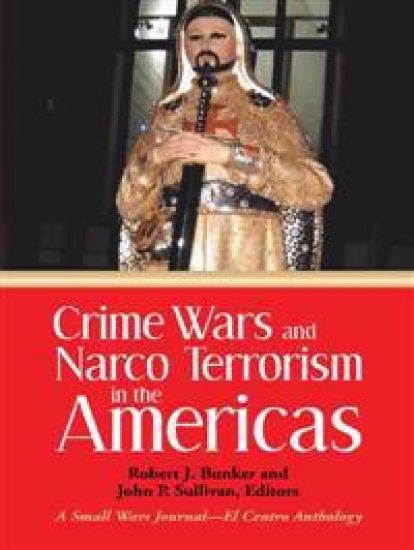
Concerns over the changing nature of gangs and cartels and their relationships to states in the late 20th and early 21st centuries has resulted in the emergence of a scholarly body of work focused on their national security threat potentials. This body of work, utilizing the third generation gangs and third phase cartel typologies, represents an alternative to traditional gang and organized crime research and one that is increasingly influencing the US defense community. Rather than being viewed only as misguided youth and opportunistic criminals or, in their mature forms, as criminal organizations with no broader social or political agendas, more evolved gangs and cartels, are instead seen as developing political, mercenary, and state-challenging capacities. This evolutionary process has emerged due to the growing illicit economy and other unintended consequences of globalization.This important anthology of writings by Robert J. Bunker and John P. Sullivan draws upon a collection of their works from the mid-1990s to the present with the addition of new essays written specifically for this publication. The work will be of great interest to academics and students in the fields of political science and criminal justice and to military, law enforcement, and governmental professionals and policy makers.This book is a collection of new and previously published works from a variety of publications, a full list of which is on the Citation Information page.

Cartel Car Bombings in Mexico
Robert J. Bunker; John P. Sullivan; Strategic Studies Institute; U.S. Army War College
Lulu.com
2014
nidottu
Contemporary Mexican cartel use of car bombs began in mid-July 2010 and has since escalated. Given the proximity to the United States, some literally within miles of the border, the car bombings, with about 20 incidents identified over the last 2 1/2 years, should be of interest to local, state, and federal U.S. law enforcement, the U.S. Army, and other governmental institutions which are providing increasing support to Mexican federal agencies. An historical overview and analysis of cartel car bomb use in Mexico provides context, insights, and lessons learned stemming from the Medellin and Cali cartel car bombing campaigns. In order to generate insights into future cartel car bombings in Mexico, the identification of such potentials offers a glimpse into cartel "enemy intent," a possible form of actionable strategic intelligence. For Mexico, steady and both slowly and quickly increasing car bomb use trajectories may exist.


Concerns over the changing nature of gangs and cartels and their relationships to states in the late 20th and early 21st centuries has resulted in the emergence of a scholarly body of work focused on their national security threat potentials. This body of work, utilizing the third generation gangs and third phase cartel typologies, represents an alternative to traditional gang and organized crime research and one that is increasingly influencing the US defense community. Rather than being viewed only as misguided youth and opportunistic criminals or, in their mature forms, as criminal organizations with no broader social or political agendas, more evolved gangs and cartels, are instead seen as developing political, mercenary, and state-challenging capacities. This evolutionary process has emerged due to the growing illicit economy and other unintended consequences of globalization.This important anthology of writings by Robert J. Bunker and John P. Sullivan draws upon a collection of their works from the mid-1990s to the present with the addition of new essays written specifically for this publication. The work will be of great interest to academics and students in the fields of political science and criminal justice and to military, law enforcement, and governmental professionals and policy makers.This book is a collection of new and previously published works from a variety of publications, a full list of which is on the Citation Information page.

Red Teams and Counterterrorism Training
Stephen Sloan; Robert J. Bunker; David L. Boren
University of Oklahoma Press
2011
nidottu
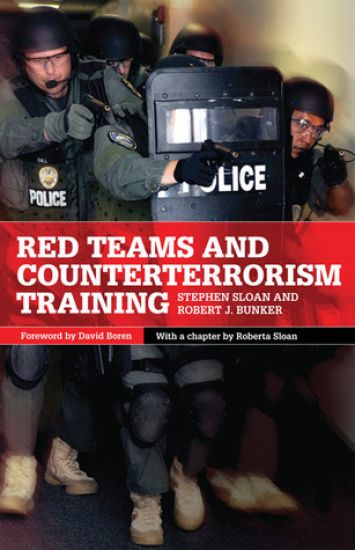
Keeping ahead of terrorists requires innovative, up-to-date training. This follow-up to Stephen Sloan's pioneering 1981 book, Simulating Terrorism, takes stock of twenty-first-century terrorism - then equips readers to effectively counter it. Quickly canvassing the evolution of terrorism - and of counterterrorism efforts - over the past thirty years, co-authors Sloan and Robert J. Bunker draw on examples from the early 2000s, following the World Trade Center and Pentagon attacks, to emphasize the need to prevent or respond quickly to ""active aggressors"" - terrorists who announce their presence and seek credibility through killing. Training for such situations requires realistic simulations - whose effectiveness, the authors show, depends on incorporating red teams; that is, the groups that play the part of active aggressors.In Red Teams and Counterterrorism Training, Sloan and Bunker, developers of simulation-driven counterterrorist training, take readers through the prerequisites for and basic principles of conducting a successful simulation and preparing responders to face threats - whether from teenage shooters or from sophisticated terrorist organizations. The authors clearly explain how to create an effective red team whose members can operate from within the terrorists' mindset. An innovative chapter by theater professional Roberta Sloan demonstrates how to use dramatic techniques to teach red teams believable role-playing.Rounding out this book, a case study of the 2009 shooting at Fort Hood illustrates the cost of failures in intelligence and underscores the still-current need for serious attention to potential threats. First responders - whether civilian or military - will find Red Teams and Counterterrorism Training indispensible as they address and deter terrorism now and in the future.