

Kirjailija
Robert J. Gordon
Kirjat ja teokset yhdessä paikassa: 11 kirjaa, julkaisuja vuosilta 1989-2025, suosituimpien joukossa The Bushman Myth Revisited. Vertaile teosten hintoja ja tarkista saatavuus suomalaisista kirjakaupoista.
Mukana myös kirjoitusasut: Robert J Gordon
11 kirjaa
Kirjojen julkaisuhaarukka 1989-2025.

In the early sixties, South Africa’s colonial policies in Namibia served as a testing ground for many key features of its repressive ‘Grand Apartheid’ infrastructure, including strategies for countering anti-apartheid resistance. Exposing the role that anthropologists played, this book analyses how the knowledge used to justify and implement apartheid was created. Understanding these practices and the ways in which South Africa’s experiences in Namibia influenced later policy at home is also critically evaluated, as is the matter of adjudicating the many South African anthropologists who supported the regime.

In the early sixties, South Africa’s colonial policies in Namibia served as a testing ground for many key features of its repressive ‘Grand Apartheid’ infrastructure, including strategies for countering anti-apartheid resistance. Exposing the role that anthropologists played, this book analyses how the knowledge used to justify and implement apartheid was created. Understanding these practices and the ways in which South Africa’s experiences in Namibia influenced later policy at home is also critically evaluated, as is the matter of adjudicating the many South African anthropologists who supported the regime.

2019 Choice Outstanding Academic TitleThe Enigma of Max Gluckman examines one of the most influential British anthropologists of the twentieth century. South African–born Max Gluckman was the founder of what became known as the Manchester School of social anthropology, a key figure in the anthropology of anticolonialism and conflict theory in southern Africa, and one of the most prolific structuralist and Marxist anthropologists of his generation. From his position at Oxford University as graduate student and lecturer to his career at Manchester, Gluckman was known to be generous and engaged with his closest colleagues but brutish and hostile in his denunciations of their work if it did not contribute to the social justice and activist vision he held for the discipline. Conventional histories of anthropology have treated Gluckman as an outlier from mainstream British social anthropology based on his career at the University of Manchester and his gruff manner. He was certainly not the colonial gentleman typical of his British colleagues in the field. Gluckman was deeply engaged with field research in southern Africa on the Zulus, in Barotseland with the Lozi, and also in connection with his directorship of the Rhodes-Livingstone Institute from 1941 to 1947, which obscured his growing critique of anthropology’s methods and ties to Western colonialism and racial oppression in the subcontinent. Robert J. Gordon’s biography skillfully reexamines the colorful life of Max Gluckman and restores his career in the British anthropological tradition.

In the century after the Civil War, an economic revolution improved the American standard of living in ways previously unimaginable. Electric lighting, indoor plumbing, motor vehicles, air travel, and television transformed households and workplaces. But has that era of unprecedented growth come to an end? Weaving together a vivid narrative, historical anecdotes, and economic analysis, The Rise and Fall of American Growth challenges the view that economic growth will continue unabated, and demonstrates that the life-altering scale of innovations between 1870 and 1970 cannot be repeated. Gordon contends that the nation's productivity growth will be further held back by the headwinds of rising inequality, stagnating education, an aging population, and the rising debt of college students and the federal government, and that we must find new solutions. A critical voice in the most pressing debates of our time, The Rise and Fall of American Growth is at once a tribute to a century of radical change and a harbinger of tougher times to come.

In the century after the Civil War, an economic revolution improved the American standard of living in ways previously unimaginable. Electric lighting, indoor plumbing, motor vehicles, air travel, and television transformed households and workplaces. But has that era of unprecedented growth come to an end? Weaving together a vivid narrative, historical anecdotes, and economic analysis, The Rise and Fall of American Growth challenges the view that economic growth will continue unabated, and demonstrates that the life-altering scale of innovations between 1870 and 1970 cannot be repeated. Gordon contends that the nation's productivity growth will be further held back by the headwinds of rising inequality, stagnating education, an aging population, and the rising debt of college students and the federal government, and that we must find new solutions. A critical voice in the most pressing debates of our time, The Rise and Fall of American Growth is at once a tribute to a century of radical change and a harbinger of tougher times to come.
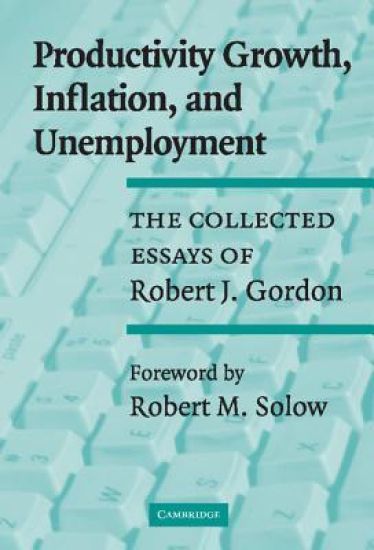
Productivity Growth, Inflation, and Unemployment
Robert J. Gordon; Robert M. Solow
Cambridge University Press
2003
sidottu
The seventeen seminal essays by Robert J. Gordon collected here, including three previously unpublished works, offer sharply etched views on the principal topics of macroeconomics - growth, inflation, and unemployment. The author re-examines their salient points in a uniquely creative, accessible introduction that serves on its own as an introduction to modern macroeconomics. Each of the four parts into which the essays are grouped also offers a new introduction. The papers in Part I explore different key aspects of the history, theory, and measurement of productivity growth. The essays in Part II investigate the sources of business cycles and productivity fluctuations. Those in Part III cover the effects of supply shocks in macroeconomics. The final group presents empirical studies of the dynamics of inflation in the United States. The foreword by Nobel Laureate Robert M. Solow comments on the abiding importance of these essays drawn from 1968 to the present.

Productivity Growth, Inflation, and Unemployment
Robert J. Gordon; Robert M. Solow
Cambridge University Press
2003
pokkari
The 17 seminal essays by Robert J. Gordon collected here, including three previously unpublished works, offer sharply etched views on the principal topics of macroeconomics - growth, inflation, and unemployment. The author re-examines their salient points in a uniquely creative, accessible introduction that serves on its own as an introduction to modern macroeconomics. Each of the four parts into which the essays are grouped also offers a new introduction. The papers in Part I explore different key aspects of the history, theory, and measurement of productivity growth. The essays in Part II investigate the sources of business cycles and productivity fluctuations. Those in Part III cover the effects of supply shocks in macroeconomics. The final group presents empirical studies of the dynamics of inflation in the United States. The foreword by Nobel Laureate Robert M. Solow comments on the abiding importance of these essays drawn from 1968 to the present.
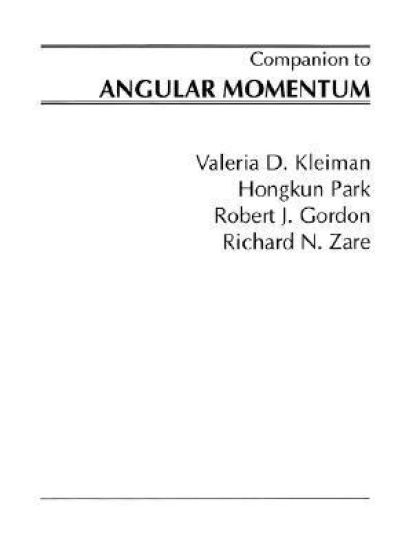
A Companion to Angular Momentum
Valeria D. Kleiman; Hongkun Park; Robert J. Gordon; Richard N. Zare
John Wiley Sons Inc
1998
nidottu
Angular momentum is a basic concept used in classical physics. Examples of phenomena that are related to angular momentum are: 1) Why a moving bicycle does not fall over and 2) why the currents in the ocean of the rotating earth tend to follow circular motions. Designed as a learning tool for those with limited background in quantum mechanics and to compliment Zare's Angular Momentum, this book provides examples, problems, & solutions in angular momentum in quantum mechanics and its applications to chemistry and physics.

The Denver African Expedition of 1925 sought "the cradle of Humanity." The explorers returned claiming to have found the "Missing Link" in the Heikum bushmen of the Kalahari—and they proceeded to market this image. As Robert J. Gordon shows in Picturing Bushmen, the impact of the expedition lay not simply in its slick merchandising of bushmen images but also in the fact that the pictures were exotic and aesthetically pleasing. Like all significant events, the expedition and its images had unanticipated consequences. The Denver Expedition played a key role in romanticizing bushmen. Indeed, its image of bushmen has permeated Western mass culture. Before the expedition, bushmen commonly had been presented as impoverished savages. In its wake, the bushmen of South Africa have inspired commercial advertisements, art exhibitions, and novels. Bushmen are frequently the archetypal "other" to Western intellectual and popular thought. Explaining the impact of the expedition involves, in part, considering the culture of visualization that gave the expedition direction and in turn was influenced by it. Although Rob Gordon is an anthropologist, this study ranges into questions of film theory, history, and popular culture. It offers a perspective on coffee-table books, ethnology, and the nature of research on those labeled "others." While suggesting how "ethnographic photographs" might be appreciated, Picturing Bushmen is also a subtle analysis of the perennial issues that haunt field workers—especially what and how they "see" and how their perception is influenced by the mundane in their own societies.
