

Kirjailija
Robert J. Richards
Kirjat ja teokset yhdessä paikassa: 11 kirjaa, julkaisuja vuosilta 1989-2025, suosituimpien joukossa Ruminating on Ruse. Vertaile teosten hintoja ja tarkista saatavuus suomalaisista kirjakaupoista.
Mukana myös kirjoitusasut: Robert J Richards
11 kirjaa
Kirjojen julkaisuhaarukka 1989-2025.


Charles Darwin is easily the most famous scientist of the modern age, and his theory of evolution is constantly referenced in many contexts by scientists and nonscientist alike. And yet, despite how frequently his ideas are evoked, there remains a surprising amount we don't know about the father of modern evolutionary thinking, his intellectual roots, and the science he produced. Debating Darwin seeks to change that, bringing together two leading Darwin scholars Robert J. Richards and Michael Ruse to engage in a spirited and insightful dialogue, offering their interpretations of Darwin and their critiques of each other's thinking. Examining key disagreements about Darwin that continue to confound even committed Darwinists, Richards and Ruse offer divergent views on the origins and nature of Darwin and his ideas. Ruse argues that Darwin was quintessentially British and that the roots of his thought can be traced back to the eighteenth century, particularly to the Industrial Revolution and thinkers such as Adam Smith and Thomas Robert Malthus. Ruse argues that when these influences are appreciated, we can see how Darwin's work in biology is an extension of their theories. In contrast, Richards presents Darwin as a more cosmopolitan, self-educated man, influenced as much by French and particularly German thinkers. Above all, argues Richards, it was Alexander von Humboldt who both inspired Darwin and gave him the conceptual tools that he needed to find and formulate his evolutionary hypotheses. Together, the authors show how the reverberations of the contrasting views on Darwin's influences can be felt in theories about the nature of natural selection, the role of metaphor in science, and the place of God in Darwin's thought. Revealing how much there still is to investigate and interrogate about Darwin's ideas, Debating Darwin contributes to our understanding of evolution itself. The book concludes with a jointly authored chapter that brings this debate into the present, focusing on human evolution, consciousness, religion, and morality. This will be powerful, essential reading for anyone seeking a comprehensive understanding of modern-day evolutionary science and philosophy.
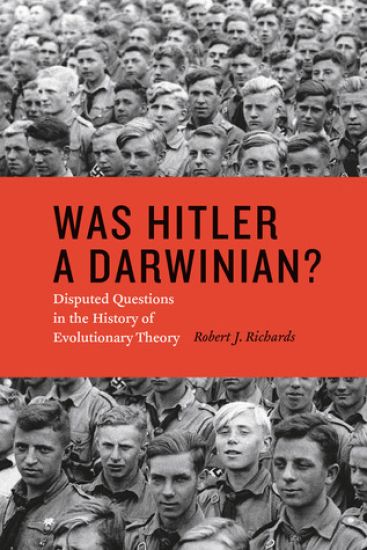
In tracing the history of Darwin's accomplishment and the trajectory of evolutionary theory during the late nineteenth and early twentieth centuries, most scholars agree that Darwin introduced blind mechanism into biology, thus banishing moral values from the understanding of nature. According to the standard interpretation, the principle of survival of the fittest has rendered human behavior, including moral behavior, ultimately selfish. Few doubt that Darwinian theory, especially as construed by the master's German disciple, Ernst Haeckel, inspired Hitler and led to Nazi atrocities. In this collection of essays, Robert J. Richards argues that this orthodox view is wrongheaded. A close historical examination reveals that Darwin, in more traditional fashion, constructed nature with a moral spine and provided it with a goal: man as a moral creature. The book takes up many topics-including the character of Darwin's chief principles of natural selection and divergence, his dispute with Alfred Russel Wallace over man's big brain, the role of language in human development, his relationship to Herbert Spencer, how much his views had in common with Haeckel's, and the general problem of progress in evolution. Moreover, Richards takes a forceful stand on the timely issue of whether Darwin is to blame for Hitler's atrocities. Was Hitler a Darwinian? is intellectual history at its boldest.

In tracing the history of Darwin's accomplishment and the trajectory of evolutionary theory during the late nineteenth and early twentieth centuries, most scholars agree that Darwin introduced blind mechanism into biology, thus banishing moral values from the understanding of nature. According to the standard interpretation, the principle of survival of the fittest has rendered human behavior, including moral behavior, ultimately selfish. Few doubt that Darwinian theory, especially as construed by the master's German disciple, Ernst Haeckel, inspired Hitler and led to Nazi atrocities. In this collection of essays, Robert J. Richards argues that this orthodox view is wrongheaded. A close historical examination reveals that Darwin, in more traditional fashion, constructed nature with a moral spine and provided it with a goal: man as a moral creature. The book takes up many topics - including the character of Darwin's chief principles of natural selection and divergence, his dispute with Alfred Russel Wallace over man's big brain, the role of language in human development, his relationship to Herbert Spencer, how much his views had in common with Haeckel's, and the general problem of progress in evolution. Moreover, Richards takes a forceful stand on the timely issue of whether Darwin is to blame for Hitler's atrocities. Was Hitler a Darwinian? is intellectual history at its boldest.

Prior to World War I, more people learned of evolutionary theory from the voluminous writings of Charles Darwin's foremost champion in Germany, Ernst Haeckel (1834-1919), than from any other source, including the writings of Darwin himself. But, with detractors ranging from paleontologist Stephen Jay Gould to modern-day creationists and advocates of intelligent design, Haeckel is better known as a divisive figure than as a pioneering biologist. Robert J. Richards' intellectual biography rehabilitates Haeckel, providing the most accurate measure of his science and art yet written, as well as a moving account of Haeckel's eventful life.
The Cambridge Companion to the 'Origin of Species'
Robert J. Richards
Cambridge University Press
2008
pokkari
The Origin of Species by Charles Darwin is universally recognised as one of the most important science books ever written. The Origin of Species is also a work of great cultural and religious significance, in that Darwin maintained that all organisms, including humans, are part of a natural process of growth from simple forms. This Companion commemorates the 150th anniversary of the publication of the Origin of Species and examines its main arguments. Drawing on the expertise of leading authorities in the field, it also provides the contexts - religious, social, political, literary, and philosophical - in which the Origin was composed. Written in a clear and friendly yet authoritative manner, this volume will be essential reading for both scholars and students. More broadly, it will appeal to general readers who want to learn more about one of the most important and controversial books of modern times.
The Cambridge Companion to the 'Origin of Species'
Robert J. Richards
Cambridge University Press
2008
sidottu
The Origin of Species by Charles Darwin is universally recognised as one of the most important science books ever written. The Origin of Species is also a work of great cultural and religious significance, in that Darwin maintained that all organisms, including humans, are part of a natural process of growth from simple forms. This Companion commemorates the 150th anniversary of the publication of the Origin of Species and examines its main arguments. Drawing on the expertise of leading authorities in the field, it also provides the contexts - religious, social, political, literary, and philosophical - in which the Origin was composed. Written in a clear and friendly yet authoritative manner, this volume will be essential reading for both scholars and students. More broadly, it will appeal to general readers who want to learn more about one of the most important and controversial books of modern times.
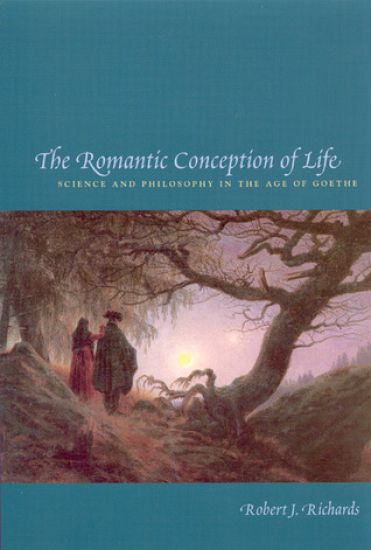
"All art should become science and all science art; poetry and philosophy should be made one." Friedrich Schlegel's words perfectly capture the project of the German Romantics, who believed that the aesthetic approaches of art and literature could reveal patterns and meaning in nature that couldn't be uncovered through rationalistic philosophy and science alone. In this wide-ranging work, Robert J. Richards shows how the Romantic conception of the world influenced (and was influenced by) both the lives of the people who held it and the development of nineteenth-century science.Integrating Romantic literature, science, and philosophy with an intimate knowledge of the individuals involved—from Goethe and the brothers Schlegel to Humboldt and Friedrich and Caroline Schelling—Richards demonstrates how their tempestuous lives shaped their ideas as profoundly as their intellectual and cultural heritage. He focuses especially on how Romantic concepts of the self, as well as aesthetic and moral considerations—all tempered by personal relationships—altered scientific representations of nature. Although historians have long considered Romanticism at best a minor tributary to scientific thought, Richards moves it to the center of the main currents of nineteenth-century biology, culminating in the conception of nature that underlies Darwin's evolutionary theory.Uniting the personal and poetic aspects of philosophy and science in a way that the German Romantics themselves would have honored, The Romantic Conception of Life alters how we look at Romanticism and nineteenth-century biology.
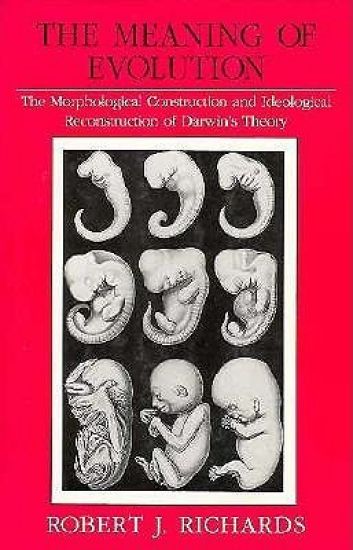
Did Darwin see evolution as progressive, directed toward producing ever more advanced forms of life? Most contemporary scholars say no. In this challenge to prevailing views, Robert J. Richards says yes-and argues that current perspectives on Darwin and his theory are both ideologically motivated and scientifically unsound. This provocative new reading of Darwin goes directly to the origins of evolutionary theory. Unlike most contemporary biologists or historians and philosophers of science, Richards holds that Darwin did concern himself with the idea of progress, or telos, as he constructed his theory. Richards maintains that Darwin drew on the traditional embryological meanings of the terms "evolution" and "descent with modification." In the 1600s and 1700s, "evolution" referred to the embryological theory of preformation, the idea that the embryo exists as a miniature adult of its own species that simply grows, or evolves, during gestation. By the early 1800s, however, the idea of preformation had become the concept of evolutionary recapitulation, the idea that during its development an embryo passes through a series of stages, each the adult form of an ancestor species. Richards demonstrates that, for Darwin, embryological recapitulation provided a graphic model of how species evolve. If an embryo could be seen as successively taking the structures and forms of its ancestral species, then one could see the evolution of life itself as a succession of species, each transformed from its ancestor. Richards works with the Origin and other published and archival material to show that these embryological models were much on Darwin's mind as he considered the evidence for descent with modification. Why do so many modern researchers find these embryological roots of Darwin's theory so problematic? Richards argues that the current tendency to see evolution as a process that is not progressive and not teleological imposes perspectives on Darwin that incorrectly deny the clearly progressive heart of his embryological models and his evolutionary theory.
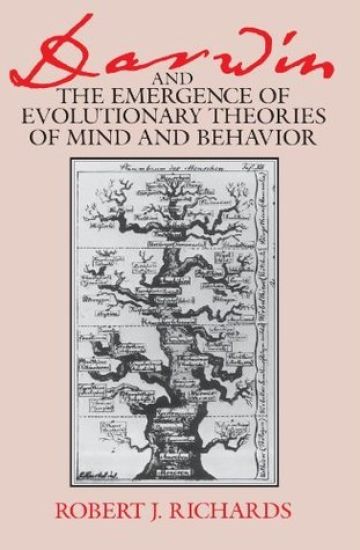
Darwin and the Emergence of Evolutionary Theories of Mind and Behavior
Robert J. Richards
University of Chicago Press
1989
nidottu
With insight and wit, Robert J. Richards focuses on the development of evolutionary theories of mind and behavior from their first distinct appearance in the eighteenth century to their controversial state today. Particularly important in the nineteenth century were Charles Darwin's ideas about instinct, reason, and morality, which Richards considers against the background of Darwin's personality, training, scientific and cultural concerns, and intellectual community. Many critics have argued that the Darwinian revolution stripped nature of moral purpose and ethically neutered the human animal. Richards contends, however, that Darwin, Herbert Spencer, and their disciples attempted to reanimate moral life, believing that the evolutionary process gave heart to unselfish, altruistic behavior. "Richards's book is now the obvious introduction to the history of ideas about mind and behavior in the nineteenth century."—Mark Ridley, Times Literary Supplement "Not since the publication of Michael Ghiselin's The Triumph of the Darwinian Method has there been such an ambitious, challenging, and methodologically self-conscious interpretation of the rise and development and evolutionary theories and Darwin's role therein."—John C. Greene, Science "His book . . . triumphantly achieves the goal of all great scholarship: it not only informs us, but shows us why becoming thus informed is essential to understanding our own issues and projects."—Daniel C. Dennett, Philosophy of Science