Kirjojen hintavertailu. Mukana 12 152 606 kirjaa ja 12 kauppaa.

Kirjailija

Robert Kuttner

Kirjat ja teokset yhdessä paikassa: 12 kirjaa, julkaisuja vuosilta 1987-2022, suosituimpien joukossa Debtors' Prison: The Politics of Austerity Versus Possibility. Vertaile teosten hintoja ja tarkista saatavuus suomalaisista kirjakaupoista.

12 kirjaa

Kirjojen julkaisuhaarukka 1987-2022.

Going Big

Going Big

Robert Kuttner; Joseph E. Stiglitz

THE NEW PRESS
2022
sidottu
With history and the extraordinary parallels between Biden and FDR as his guide, the veteran political analyst diagnoses what’s at stake for America in 2022 and beyondJoe Biden has found his way back to Franklin Roosevelt’s New Deal. After four decades of diminishing prospects for ordinary people, the public likes what Biden is offering. Yet American democracy is in dire peril as Republicans, increasingly the national minority, try to destroy democracy in order to cling to power. It is the best of times and the worst of times. In Going Big, bestselling author and political journalist Robert Kuttner assesses the promise and peril of this critical juncture. Biden, like FDR in his time, faces multiple challenges. Roosevelt had to make terrible compromises with racist legislators to win enactment of his program. Biden, to achieve the necessary governing coalition, needs to achieve durable multiracial coalitions. Roosevelt had to conquer fascism in Europe; Biden must defeat it at home. And after four decades of neoliberal policy disasters reflecting Wall Street’s political influence, Biden needs to go beyond what even FDR achieved, to restore a democratic economy of broad possibility. From a writer with an unparalleled understanding of the history and politics that have made this moment possible, this book is the essential guide to what is at stake for Joe Biden, for America, and for our democracy.

The Stakes

The Stakes

Robert Kuttner

WW Norton Co
2019
sidottu
The 2020 presidential election will be pivotal for the credibility of government and for democracy itself, argues Robert Kuttner in this compelling call to arms. Either America continues the twin slides into corrupt autocracy and corporate plutocracy—the course set in the past half century by Republican and Democratic presidents alike—or Americans elect a progressive Democrat in the mould of FDR. At stake is nothing less than the continued success of the American experiment in liberal democracy. Kuttner convincingly shows that a progressive Democrat also has a better chance than a centrist of winning the presidency in the current political environment. The Stakes is the book to read ahead of the 2020 primaries.
Can Democracy Survive Global Capitalism?

Can Democracy Survive Global Capitalism?

Robert Kuttner

WW Norton Co
2019
nidottu
In the years surrounding the Second World War, a serendipitous confluence of events created a healthy balance between the market and the polity—between the engine of capitalism and the egalitarian ideals of democracy. Yet, from the 1970s on, a power shift occurred in which financial regulations were rolled back, taxes were cut, inequality worsened and disheartened voters turned to far-right, faux populism. Robert Kuttner lays out the events that led to the post-war miracle and charts its dissolution all the way to Trump, Brexit and the tenuous state of the EU. He asks whether today’s poisonous alliance of reckless finance and ultra-nationalism is inevitable, and whether democracy can find a way to survive.
Can Democracy Survive Global Capitalism?

Can Democracy Survive Global Capitalism?

Robert Kuttner

WW Norton Co
2018
sidottu
In the years surrounding the Second World War, a serendipitous confluence of events created a healthy balance between the market and the polity—between the engine of capitalism and the egalitarian ideals of democracy. Yet, from the 1970s on, a power shift occurred in which financial regulations were rolled back, taxes were cut, inequality worsened and disheartened voters turned to far-right, faux populism. Robert Kuttner lays out the events that led to the post-war miracle and charts its dissolution all the way to Trump, Brexit and the tenuous state of the EU. He asks whether today’s poisonous alliance of reckless finance and ultra-nationalism is inevitable, and whether democracy can find a way to survive.
Debtors' Prison: The Politics of Austerity Versus Possibility
Since the financial crisis of 2008, the conversation about economic recovery has centered on the question of debt: whether we have too much of it, whose debt to forgive, and how to cut the deficit. But what if we've been asking the wrong questions all along? In Debtors' Prison, leading economic thinker Robert Kuttner makes the most powerful argument to date that with austerity as a solution all we're doing is jailing ourselves. Just as debtors' prisons once prevented individuals from resuming a productive life, austerity measures shackle, rather than restore, economic growth. This is the simple truth belied by the sound bites of presidential elections and fiscal-cliff debates, and the perverse policies of the European Union. Blending current affairs with economics and history, from Robinson Crusoe author Daniel Defoe's campaign for debt forgiveness in the seventeenth century to the two world wars and Bretton Woods, Kuttner uncovers the double standards in the politics of debt. Lucid, authoritative, provocative--a book that corrects the economic conversation and encourages a search for new solutions.
After the Great Recession

After the Great Recession

Robert Kuttner

Cambridge University Press
2014
pokkari
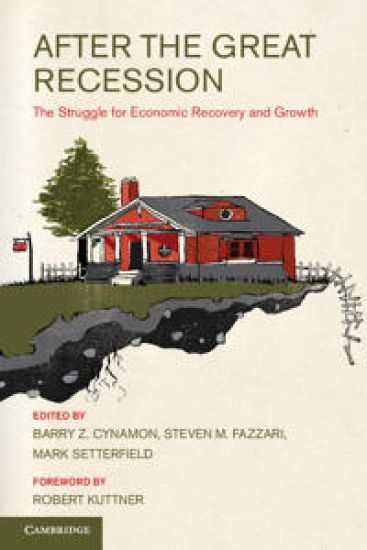
The severity of the Great Recession and the subsequent stagnation caught many economists by surprise. But a group of Keynesian scholars warned for some years that strong forces were leading the US toward a deep, persistent downturn. This book collects essays about these events from prominent macroeconomists who developed a perspective that predicted the broad outline and many specific aspects of the crisis. From this point of view, the recovery of employment and revival of strong growth requires more than short-term monetary easing and temporary fiscal stimulus. Economists and policy makers need to explore how the process of demand formation failed after 2007 and where demand will come from going forward. Successive chapters address the sources and dynamics of demand, the distribution and growth of wages, the structure of finance and challenges from globalization, and inform recommendations for monetary and fiscal policies to achieve a more efficient and equitable society.
After the Great Recession

After the Great Recession

Robert Kuttner

Cambridge University Press
2012
sidottu
The severity of the Great Recession and the subsequent stagnation caught many economists by surprise. But a group of Keynesian scholars warned for some years that strong forces were leading the US toward a deep, persistent downturn. This book collects essays about these events from prominent macroeconomists who developed a perspective that predicted the broad outline and many specific aspects of the crisis. From this point of view, the recovery of employment and revival of strong growth requires more than short-term monetary easing and temporary fiscal stimulus. Economists and policy makers need to explore how the process of demand formation failed after 2007 and where demand will come from going forward. Successive chapters address the sources and dynamics of demand, the distribution and growth of wages, the structure of finance and challenges from globalization, and inform recommendations for monetary and fiscal policies to achieve a more efficient and equitable society.
The Squandering of America: How the Failure of Our Politics Undermines Our Prosperity
A passionate, articulate argument detailing how the United States political system has failed to adapt to the economic challenges of the late 20th and early 21st centuries. The American economy is in peril. It has fallen hostage to a casino of financial speculation, creating instability as well as inequality. Tens of millions of workers are vulnerable to layoffs and outsourcing, health care and retirement burdens are increasingly being shifted from employers to individuals. Here Kuttner debunks alarmist claims about supposed economic hazards and exposes the genuine dangers: hedge funds and private equity run amok, sub-prime lenders, Wall Street middlemen, and America's dependence on foreign central banks. He then outlines a persuasive, bold alternative, a new model of managed capitalism that can deliver security and opportunity, and rekindle democracy as we know it.
Family Re-Union

Family Re-Union

Robert Kuttner; Sharland Trotter

The Free Press
2007
pokkari
All our lives, we seek affirmation and love from the people closest to us -- our parents and, later, our grown children. But too few of us get it. As adults, many of us feel that our aging parents still treat us like kids. As parents, many of us are sad that our adult children seem to have little use for us. When Robert Kuttner and Sharland Trotter were writing "Family Re-Union, " many new empty-nesters told them, "I hope I have a better relationship with my kids than I did with my parents." "Family Re-Union" offers insights on how adults and their parents can cultivate new adult- to-adult lifelong connections and become deeper friends. It is the first book to explore this challenge over the entire life course -- from a teenager's departure for college to the impending death of an aging parent. Kuttner, a well-known journalist, and Trotter, a clinical psychologist, conceived the book when their son had just gone off to college and their daughter was a junior in high school. The message of "Family Re-Union" is deepened by the unusual circumstances of its writing: a year into the work, Sharland Trotter learned she had cancer. As Sharland deals with her illness and invites her family into her journey, the book takes on additional relevance for all those facing their own mortality -- whether prematurely or at the natural end of a long life span -- and seeking to repair family relationships. But "Family Re-Union" will prove indispensable for all adults, from the twenty-five-year-old who finds her parents overbearing, through the forty-year-old hoping to have a better relationship with his son than he had with his father, to the seventy-year-old trying to reconnect with a middle-aged daughter, and all steps in between. These are life stages we all encounter, and "Family Re-Union" offers hope that, no matter what our personal circumstances, it is never too late to create loving, respectful family ties.
Everything for Sale

Everything for Sale

Robert Kuttner

University of Chicago Press
1999
nidottu
This text disputes the laissez-faire direction of both economic theory and practice that has gained prominence since the mid-1970s. Dissenting voices, the author argues, have been drowned out by a sea of circular arguments and complex mathematical models that ignore real-world conditions and disregard values that can't easily be turned into commodities. Included is an explanation of how some sectors of the economyrequire a blend of market, regulation and social outlay.
The End of Laissez-Faire

The End of Laissez-Faire

Robert Kuttner

University of Pennsylvania Press
1992
pokkari
Here is a book that explores what American economic policy should and can be-a superb yet controversial interpretation of the relation between domestic economic health and international politics, and of how we should set priorities to maintain our economy and our competitive vigor in the future.
The Economic Illusion

The Economic Illusion

Robert Kuttner

University of Pennsylvania Press
1987
pokkari
In The Economic Illusion Robert Kuttner sets out to refute the conventional view that a more egalitarian distribution of income and services is only achievable at the expense of a prosperous and growing capitalism. By carefully examining issues where economic growth and social justice appear to be in conflict-issues such as social security, protectionism, income taxation, and welfare-he convincingly argues that equality and economic prosperity are not mutually exclusive pursuits. As a means to reconcile equality with efficiency-i.e., prosperity-Kuttner argues for economic polices that would deemphasize private markets, for an increase in trade protection, and for an adapted version of the technical approaches of such countries as Sweden, Germany, Austria, and Japan. Kuttner concludes his arguments with the suggestion that injustice is not necessarily an economic issue and that practical social alternatives are possible.