Kirjojen hintavertailu. Mukana 12 595 353 kirjaa ja 12 kauppaa.

Kirjailija

Robert L. Glicksman

Kirjat ja teokset yhdessä paikassa: 5 kirjaa, julkaisuja vuosilta 2002-2023, suosituimpien joukossa Environmental Protection: Law and Policy [Connected eBook with Study Center]. Vertaile teosten hintoja ja tarkista saatavuus suomalaisista kirjakaupoista.

5 kirjaa

Kirjojen julkaisuhaarukka 2002-2023.

Environmental Protection: Law and Policy [Connected eBook with Study Center]

Environmental Protection: Law and Policy [Connected eBook with Study Center]

Robert L. Glicksman; William W. Buzbee; Daniel R. Mandelker

Aspen Publishing
2023
sidottu
Buy a new version of this textbook and receive access to the Connected eBook with Study Center on Casebook Connect, including lifetime access to the online ebook with highlight, annotation, and search capabilities. Access also includes practice questions, an outline tool, and other helpful resources. Connected eBooks provide what you need most to be successful in your law school classes. Buy a new version of this textbook and receive access to the Connected eBook with Study Center on CasebookConnect, including: lifetime access to the online ebook with highlight, annotation, and search capabilities; practice questions from your favorite study aids; an outline tool and other helpful resources. Connected eBooks provide what you need most to be successful in your law school classes. Environmental Protection: Law and Policy, respected for its intellectual breadth and depth, is an interdisciplinary overview of Environmental Law, incorporating history, theory, litigation, regulation, policy, science, economics, and ethics. It covers the history of environmental protection; policy objectives; regulatory design strategies; and constitutional federalism and related statutory interpretation issues concerning the design and implementation of the environmental laws. Coverage also includes the Clean Air Act, the Clean Water Act, the Resource Conservation and Recovery Act, CERCLA, and other pollution control statutes; a chapter on climate change that discusses scientific, policy, program design, and statutory authority questions; and natural resource management issues (including the National Environmental Policy Act, the Endangered Species Act, and limited coverage of national forest management). New to the 9th Edition: New co-author Alejandro Camacho, a leading scholar on natural resources and public land law Ch.1: New materials on the Flint, Michigan battles over lead contamination of the municipal water system Ch.2: Discussion of regulatory and judicial skirmishes resulting from policy differences among the Obama, Trump, and Biden administrations Ch.3: Changes, driven by the Supreme Court, to areas such as standard of judicial review (including the Court's endorsement of the major questions doctrine) and potential changes to entrenched law in areas such as the nondelegation doctrine Ch.4: Council on Environmental Quality's overhaul of its 1978 NEPA regulations under the Trump administration and the Biden CEQ's phased revision of those regulations; Food and Water Watch v. FERC; Sierra Club v. EPA Ch.5: Discussion of recent research and scholarship on biodiversity loss, the Trump administration's efforts to restrict the scope of the Endangered Species Act, and the Biden administration's attempts to reverse or revise these changes; recent developments on listing, critical habitat, federal agency consultation, taking prohibitions, and incidental takings Ch.6: Updated references to air pollution science Ch.7: Updates on ongoing litigation involving the "waters of the United States" definition in the Clean Water Act Ch.8: EPA's efforts to implement 2016 amendments to the Toxic Substances Control Act; League of United Latin American Citizens v. Regan Ch.9: New case law under CERCLA; discussion of the treatment in the Restatement (Third) Torts of joint and several liability Ch.10: Streamlined coverage of environmental enforcement process Ch.11: Updated coverage of climate change law, policy, and science to reflect opposed regulatory responses to climate change by the Trump and Biden administrations; West Virginia v. EPA Online environmental justice supplement Streamlined note material Benefits for instructors and students: Thorough, nuanced treatment of existing laws, regulations, and cases, regulatory design strategies, and current and developing policy objectives Interdisciplinary approach incorporating science, economics, and ethics Coverage of major federal pollution control, environmental assessment, and species protection laws Charts and graphics Exercises and problems Distinguished author team with extensive practical, scholarly, and teaching experience
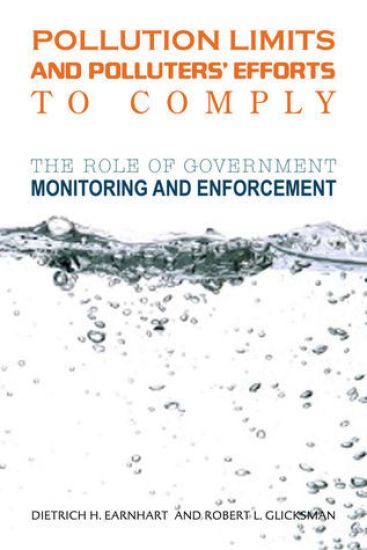
Pollution Limits and Polluters' Efforts to Comply

Pollution Limits and Polluters' Efforts to Comply

Dietrich H. Earnhart; Robert L. Glicksman

Stanford University Press
2011
sidottu
This book integrates the fields of economics and law to empirically examine compliance with regulatory obligations under the Clean Water Act (CWA). It examines four dimensions of federal water pollution control policy in the United States: limits imposed on industrial facilities' pollution discharges; facilities' efforts to comply with pollution limits, identified as "environmental behavior"; facilities' success at controlling their discharges to comply with pollution limits, identified as "environmental performance"; and regulators' efforts to induce compliance via inspections and enforcement actions, identified as "government interventions." The authors gather and analyze data on environmental performance and government interventions from Environmental Protection Agency (EPA) databases, and data on environmental behavior gathered from their own survey of all 1,612 chemical manufacturing facilities permitted to discharge wastewater in 2002. By analyzing links between critical elements in the puzzle of enforcement of and compliance with environmental protection laws, the text speaks to several important, policy-relevant research questions: Do government interventions help induce better environmental behavior and/or better environmental performance? Do tighter pollution limits improve environmental behavior and/or performance? And, does better environmental behavior lead to better environmental performance?
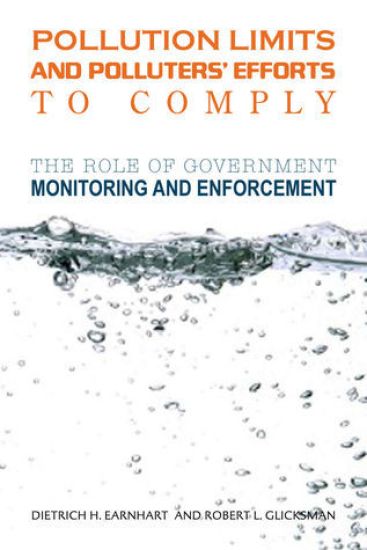
Pollution Limits and Polluters' Efforts to Comply

Pollution Limits and Polluters' Efforts to Comply

Dietrich H. Earnhart; Robert L. Glicksman

Stanford University Press
2011
pokkari
This book integrates the fields of economics and law to empirically examine compliance with regulatory obligations under the Clean Water Act (CWA). It examines four dimensions of federal water pollution control policy in the United States: limits imposed on industrial facilities' pollution discharges; facilities' efforts to comply with pollution limits, identified as "environmental behavior"; facilities' success at controlling their discharges to comply with pollution limits, identified as "environmental performance"; and regulators' efforts to induce compliance via inspections and enforcement actions, identified as "government interventions." The authors gather and analyze data on environmental performance and government interventions from Environmental Protection Agency (EPA) databases, and data on environmental behavior gathered from their own survey of all 1,612 chemical manufacturing facilities permitted to discharge wastewater in 2002. By analyzing links between critical elements in the puzzle of enforcement of and compliance with environmental protection laws, the text speaks to several important, policy-relevant research questions: Do government interventions help induce better environmental behavior and/or better environmental performance? Do tighter pollution limits improve environmental behavior and/or performance? And, does better environmental behavior lead to better environmental performance?
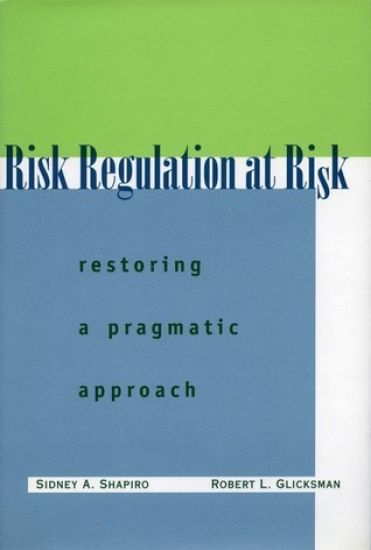
Risk Regulation at Risk

Risk Regulation at Risk

Sidney A. Shapiro; Robert L. Glicksman

Stanford University Press
2004
pokkari
In the 1960s and 1970s, Congress enacted a vast body of legislation to protect the environment and individual health and safety. Collectively, this legislation is known as "risk regulation" because it addresses the risk of harm that technology creates for individuals and the environment. In the last two decades, this legislation has come under increasing attack by critics who employ utilitarian philosophy and cost-benefit analysis. The defenders of this body of risk regulation, by contrast, have lacked a similar unifying theory. In this book, the authors propose that the American tradition of philosophical pragmatism fills this vacuum. They argue that pragmatism offers a better method for conceiving of and implementing risk regulation than the economic paradigm favored by its critics. While pragmatism offers a methodology in support of risk regulation as it was originally conceived, it also offers a perspective from which this legislation can be held up to critical appraisal. The authors employ pragmatism to support risk regulation, but pragmatism also leads them to agree with some of the criticisms against it, and even to level new criticisms of their own. In the end, the authors reject the picture—painted by risk regulation's critics—of widely excessive and irrational regulation, but the pragmatic perspective also leads them to propose a number of recommendations for useful reforms to risk regulation.
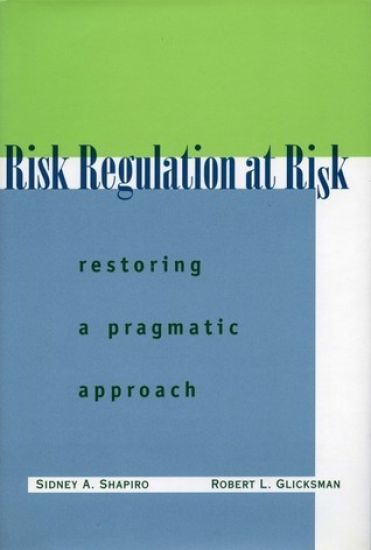
Risk Regulation at Risk

Risk Regulation at Risk

Sidney A. Shapiro; Robert L. Glicksman

Stanford University Press
2002
sidottu
In the 1960s and 1970s, Congress enacted a vast body of legislation to protect the environment and individual health and safety. Collectively, this legislation is known as "risk regulation" because it addresses the risk of harm that technology creates for individuals and the environment. In the last two decades, this legislation has come under increasing attack by critics who employ utilitarian philosophy and cost-benefit analysis. The defenders of this body of risk regulation, by contrast, have lacked a similar unifying theory. In this book, the authors propose that the American tradition of philosophical pragmatism fills this vacuum. They argue that pragmatism offers a better method for conceiving of and implementing risk regulation than the economic paradigm favored by its critics. While pragmatism offers a methodology in support of risk regulation as it was originally conceived, it also offers a perspective from which this legislation can be held up to critical appraisal. The authors employ pragmatism to support risk regulation, but pragmatism also leads them to agree with some of the criticisms against it, and even to level new criticisms of their own. In the end, the authors reject the picture—painted by risk regulation's critics—of widely excessive and irrational regulation, but the pragmatic perspective also leads them to propose a number of recommendations for useful reforms to risk regulation.