Kirjojen hintavertailu. Mukana 12 200 108 kirjaa ja 12 kauppaa.
Kirjailija
Robert L. Helmreich
Kirjat ja teokset yhdessä paikassa: 5 kirjaa, julkaisuja vuosilta 1978-2019, suosituimpien joukossa Culture at Work in Aviation and Medicine. Vertaile teosten hintoja ja tarkista saatavuus suomalaisista kirjakaupoista.
Published in 1998, culture forms a complex framework of national, organizational, and professional attitudes and values within which groups and individuals function. The reality and strength of culture become salient when we work within a new group and interact with people who have well established norms and values. In this book the authors report the results of their ongoing exploration of the influences of culture in two professions, aviation and medicine. Their focus is on commercial airline pilots and operating room teams. Within these two environments they show the effect of professional, national and organizational cultures of individual attitudes and values and team interaction.
Published in 1998, culture forms a complex framework of national, organizational, and professional attitudes and values within which groups and individuals function. The reality and strength of culture become salient when we work within a new group and interact with people who have well established norms and values. In this book the authors report the results of their ongoing exploration of the influences of culture in two professions, aviation and medicine. Their focus is on commercial airline pilots and operating room teams. Within these two environments they show the effect of professional, national and organizational cultures of individual attitudes and values and team interaction.
Culture forms a complex framework of national, organizational and professional attitudes and values within which groups and individuals function. The reality and strength of culture become salient when we work within a new group and interact with people who have well-established norms and values. In this book the authors report the results of their ongoing exploration of the influences of culture in two professions - aviation and medicine. Their focus is on commercial airline pilots and operating room teams. Within these two environments, they show the effects of professional, national and organizational cultures on individual attitudes, values and team interactions. From the Foreword by Captain Daniel Maurino:...the authors direct their attention to applied research as well as to the search for practical tools to approach and deal with the relationship between culture, error and error management, and between culture and aviation human factors training for operational personnel. They devote particular attention to the link between culture and Crew Resource Management (CRM) training, a safety and prevention tool towards which few if any have contributed so much and so well.. ...The incorporation and management of cultural factors into aviation operations and practices simply represent another tool to contribute to the aviation system‘s production goals. Encouraging progress has been made, but there is need for improvement. This book presents one possible way to move forward Vividly laced with numerous contributions from a range of practitioners and researchers from Asia, Australia, Europe and the Americas, as well as case studies and practical examples, the book is designed to be accessible to practitioners and managers wishing to improve their own organization and to researchers with an interest in gaining a greater understanding of the types of culture.
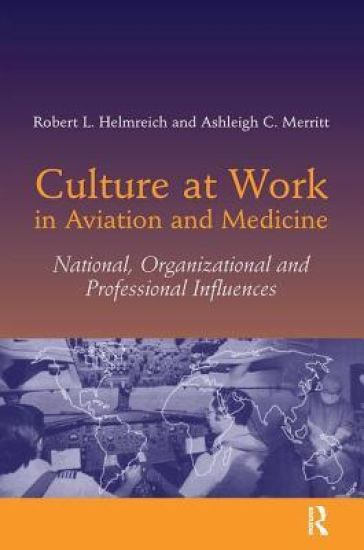
Culture forms a complex framework of national, organizational and professional attitudes and values within which groups and individuals function. The reality and strength of culture become salient when we work within a new group and interact with people who have well-established norms and values. In this book the authors report the results of their ongoing exploration of the influences of culture in two professions - aviation and medicine. Their focus is on commercial airline pilots and operating room teams. Within these two environments, they show the effects of professional, national and organizational cultures on individual attitudes, values and team interactions. From the Foreword by Captain Daniel Maurino: ’...the authors direct their attention to applied research as well as to the search for practical tools to approach and deal with the relationship between culture, error and error management, and between culture and aviation human factors training for operational personnel. They devote particular attention to the link between culture and Crew Resource Management (CRM) training, a safety and prevention tool towards which few if any have contributed so much and so well..’ ’...The incorporation and management of cultural factors into aviation operations and practices simply represent another tool to contribute to the aviation system’s production goals. Encouraging progress has been made, but there is need for improvement. This book presents one possible way to move forward’ Vividly laced with numerous contributions from a range of practitioners and researchers from Asia, Australia, Europe and the Americas, as well as case studies and practical examples, the book is designed to be accessible to practitioners and managers wishing to improve their own organization and to researchers with an interest in gaining a greater understanding of the types of culture.
Many societies assign sharply distinguished roles to men and women. Personality differences, as well as physical differences, between men and women are used to justify these different sex roles, and women are seen as more emotionally and interpersonally sensitive than men, while men are said to be more competent, achievement oriented, and assertive than women. A widely held view is that not only do men and women differ but that possession of "masculine" characteristics precludes possession of "feminine" characteristics. This bipolar conception has led to the definition of masculinity and femininity as opposites. Acceptance of this idea has caused social scientists and laypersons to consider men and women who possess cross-sex personality characteristics as less emotionally healthy and socially adjusted than those with sex-appropriate traits. Previous research by the authors and others, done almost exclusively with college students, has shown, however, that masculinity and femininity do not relate negatively to each other, thus supporting a dualistic rather than a bipolar conception of these two psychological dimensions. Spence and Helmreich present data showing that the dualistic conception holds for a large number of groups, varying widely in age, geographical location, socioeconomic status, and patterns of interest, whose psychological masculinity and femininity were measured with an objective instrument, the Personality Attributes Questionnaire, devised by the authors. Many individuals are shown to be appropriately sex-typed; that is, men tend to be high in masculinity and low in femininity and women the reverse. However, a substantial number of men and women are androgynous-high in both masculine and feminine characteristics-while some are not high in either. Importantly, the authors find that androgynous individuals display more self-esteem, social competence, and achievement orientation than individuals who are strong in either masculinity or femininity or are not strong in either. One of the major contributions of the work is the development of a new, multifaceted measure of achievement motivation (the Work and Family Orientation Questionnaire), which can be used successfully to predict behavior in both males and females and is related to masculinity and femininity in both sexes. In addition to investigating the correlates of masculinity and femininity, the authors attempt to isolate parental factors that contribute to the development of these characteristics and achievement motivation. The book includes analyses of data from students on their perception of their parents, which enable the authors to examine the influence of parental masculinity and femininity and parental behaviors and child-rearing attitudes on the development of masculinity and femininity and achievement motivation characteristics in their children. The important implications of these findings for theories of sex roles, personality development, and achievement motivation are examined.