Kirjojen hintavertailu. Mukana 12 389 402 kirjaa ja 12 kauppaa.

Kirjailija

Robert L Norton

Kirjat ja teokset yhdessä paikassa: 4 kirjaa, julkaisuja vuosilta 2015-2020, suosituimpien joukossa Cam Design-A Primer. Vertaile teosten hintoja ja tarkista saatavuus suomalaisista kirjakaupoista.

Mukana myös kirjoitusasut: Robert L. Norton

4 kirjaa

Kirjojen julkaisuhaarukka 2015-2020.

Cam Design-A Primer

Cam Design-A Primer

Robert L Norton

Norton Associates LLC
2020
pokkari
I have been studying, teaching about, designing, researching, analyzing, and consulting on cam follower systems for fifty years. I designed many cams at Polaroid Corporation in the 1960-1970 period then went on to teach mechanical engineering at various universities for 42 years until 2012. I usually taught courses on kinematics, dynamics, machine design, and stress analysis. Most of these courses included the design and analysis of cams. Over the years I taught, I also actively consulted for engineering companies all around the world on machine design problems, many of them involving cams. I have written six engineering textbooks. The kinematics book, Design of Machinery, has an introductory chapter on cam design and one on cam dynamics. Cam Design and Manufacturing Handbook, written late in my career, encapsulates all the art and science on cams that I have learned from study, experimentation and original research done with my graduate students, and my 50-years of experience in cam design.When I consulted with companies about cams, it was common to find that the engineers who had designed them had little idea or expertise on how to properly design a cam. This was not because they were bad engineers; they were not. I blame it on a lack of training in cam design in their engineering education. Having spent my career in the "engineering ed biz," I know for a fact that most U.S. engineering curricula seldom mention cam systems to their students, let alone teach them anything useful about the subject.If cams are taught at all, they typically are included in a first course in kinematics. Many textbooks written for that course, if they have a cam chapter, it is almost always out-of-date and full of errors and misinformation. Even kinematics books written relatively recently continue to contain the same obsolete and misleading information on cam design that has been prevalent for the past 50 years. My kinematics book Design of Machinery is a notable exception; it is up-to-date.The above-described situation gave me the motivation to write this primer on cam design. I want to provide a simple, clearly written, short, and inexpensive description of how to (and how not to) design a cam, aimed at the engineer in industry that may occasionally be required to do so, but may have little or no training and experience for the task.This book is essentially a lightly abridged version of the first few chapters of my comprehensive and complete book on the subject, the Cam Design and Manufacturing Handbook. I believe that this information will serve to get an engineer to the point that he or she can design a simple cam-follower system that will work. If their career finds them needing to do more than occasional work of this sort, then they can consult my more comprehensive book and other tomes on the same subject.
Cam Design and Manufacturing Handbook

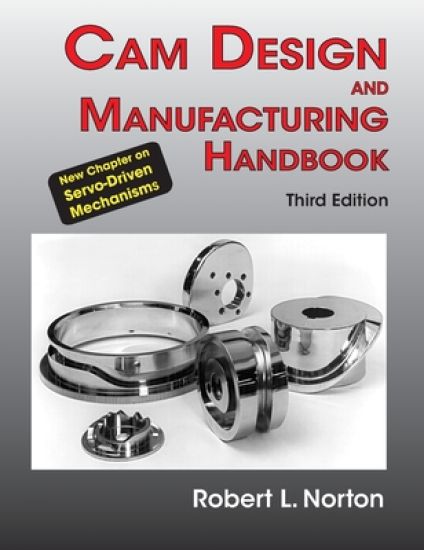
Cam Design and Manufacturing Handbook

Robert L Norton; Thomas J Lyden

Norton Associates LLC
2020
sidottu
The third edition of Cam Design and Manufacturing Handbook brings together the latest cam design technology, proper cam design methods and manufacturing procedures, and cam research results in one volume that is indispensable to the design, analysis, and manufacturing of cam-follower systems. Much of the material is original and based on 30 years of cam research involving many of the author's graduate students whose theses were advised by the author and on papers published in professional journals. It covers treatments of shape-preserving and B-splines for cams, calculations of 3-D globoidal cams, modeling of multi-DOF cam systems, calculation of torque-compensation cams that can zero the net inertial torque on a cam system's camshaft, and equations to model the deliberate impact of a follower against a valve seat or hard-stop. This edition adds a new chapter on servo-driven mechanisms. The mathematics to program servo drives is the same as that for cam motions, though there are other pitfalls, which are discussed in this chapter. Covering both introductory and advanced topics in depth, this comprehensive handbook provides all the information you need to properly design, model, analyze, specify, and manufacture cam-follower systems including: - Proper Cam Design Techniques - Roller and Flat Followers- Polydyne and Splinedyne Cams - Translating and Oscillating Followers- Single- and Multi-Dwell Cams - Measuring Cam-Follower Dynamics- Classical Cam Functions - Residual Vibrations- Polynomial and Spline Cams - Forward and Inverse Dynamic Analysis- Conjugate Cams - Lubrication of the Cam-Follower Joint- Pressure Angle and Radius of Curvature - Case Studies of Cam Designs- Radial, Barrel, and Linear Cams - An Extensive Bibliography on CamsThis book provides all the information a cam designer needs to create low-vibration, high-speed cam-follower systems for both machine and automotive applications.
The Evolution of Engineering in the 20th Century

The Evolution of Engineering in the 20th Century

Robert L Norton

Norton Associates LLC
2020
pokkari
This book describes the technological and educational advances that occurred from 1950 to 2000 and how they have improved the practice and teaching of engineering. The author began his career as an apprentice machinist out of high school in 1956. He retired from Worcester Polytechnic Institute as a chaired professor of mechanical engineering in 2012. During those years he worked for several engineering companies large and small, and also taught engineering at universities for 45 years. During his teaching career, he consulted for many engineering companies and kept abreast of their innovations. He did original research in engineering with his graduate students and published many technical papers in the literature. He wrote several engineering textbooks that are still in use around the world in several languages. This book tells the story of a technological revolution in engineering and manufacturing that has made American industry a leader in the world.
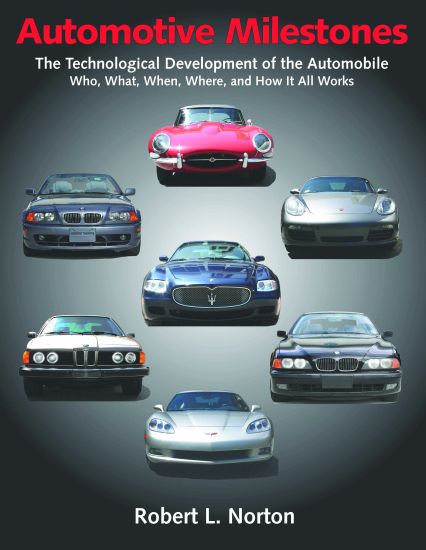
Automotive Milestones

Automotive Milestones

Robert L. Norton

Industrial Press Inc.,U.S.
2015
pokkari
This is a general interest trade book that describes the development of automotive technology and engineering from the start of the industry before 1900 to the present day. It explains how various systems and elements in the automobile work in layman's terms, without resorting to mathematics, and highlights the keymilestones in the historical development of automotive technology. All photos and illustrations are in full color. The intended audience is older teens to adults of any age who are interested in the subject and may be involved in it as a hobby. Sometimes referred to as "gearheads" or "motorheads", they form a huge market. Over the years many of the author's engineering students were in this category, and he often would meet with on-campus car clubs to explain the way things automotive worked, being careful to damp down or eliminate any complicated mathematics, as he does in this book. An Internet search found only titles that are either "hard-engineering oriented" -- such as publications from the Society of Automotive Engineers (SAE) -- or mere compendiums of dates. Books in the latter category note the milestones but without hardly any explanation at all of how these developments actually work in a technical sense - which is the aim of this book. "Automotive Milestones, by Robert L. Norton, is about all the mechanisms that are needed in an automobile and how they work. The book consists of eight main chapters, each one covering a major mechanical system of the automobile plus a summary chapter and appendices. There are numerous photographs and illustrations used throughout the book to support the concepts discussed. The author has thoroughly researched the subject and leaves the reader with a new appreciation of what has been tried over the nearly 250 years of automobile history. The book is logically organized and clearly explained in a way that only a person with in-depth knowledge could do. His latest book is Automotive Milestones which provides the cornerstones of a thorough understanding of automobile technology. If you are just looking for a general understanding of the automobile, looking for inspiration in support of a new idea, or just want a concise history of automotive milestones, this book is a must read."—Parker Ackley, Antique Automobile EnthusiastDid you ever wonder?...Who formed the first automobile company in America?When and who made the first fully automatic transmission? (Hint: it was not GM in 1939)What is the difference between sprung and unsprung weight in a car, and why does it matter?When did the frame of a car get replaced by the unibody?How does a differential work?It took more than 100 years to develop the modern automobile. This book presents a very readable and informative description of this evolution. The author, Robert Norton, is an engineer with many years of experience in the design of machinery. Automotive Milestomes is a clear presentation of the internal workings of the automobile over the years. No matter whether you are a seasoned car buff or just curious to learn more about the history of cars, you will enjoy reading this book.—William J. Crochetiere, Professor Emeritus, Tufts UniversityRobert L. Norton, P.E. has 50 years experience in the practice and teaching of mechanical engineering. He holds undergraduate degrees in mechanical engineering and industrial technology from Northeastern University, and a M.S. in engineering design from Tufts University. Having designed cams for camera mechanisms at Polaroid Corporation, he subsequently spent many years doing design work at Gillette and many other companies. He taught kinematics, dynamics, stress analysis, and machine design to mechanical engineering students for more than 40 years at Northeastern, Tufts, and Worcester Polytechnic Institute, where he is theMilton Prince Higgins II Distinguished Professor Emeritus of Mechanical Engineering. Additionally, he has published many technical papers and holds 13 U.S. patents. He is a member of the Society of Automotive Engineers (SAE) and a Fellow of the American Society of Mechanical Engineers.Motive Power: External Combustion Engines. Internal Combustion Engines. Electric Vehicles. Chassis Layouts and Drivelines: The First Production Automobiles. Other Early European Makes. Engine Configurations: Cylinder Arrangements. Floating Power. Summary. Valve Trains, Inductions, and Supercharging: Valve Actuation. Valve Cam Functions. Valve Arrangements. Variable Valve Timing (VVT). Cylinder Deactivation. Fuel Control. Summary. Transmissions and Differentials: Gearboxes. Friction Drive. Planetary Transmissions. Overdrive Transmissions. Semi-Automatic Gearboxes. Preselector Gearboxes. Dry-Clutched, Semi-Automatic. Automatic Transmission. Differentials. Summary. Suspension and Steering: Sprung versus Unsprung Weight. Rear Suspension. Front Suspension. Dampers. Steering. Brakes: Mechanical. Hydraulic. Air. Power. Parking. Body: Body on Frame. Streamlined. Unibody. Monocoque. NVH. Summary.