Kirjojen hintavertailu. Mukana 12 390 323 kirjaa ja 12 kauppaa.

Kirjailija

Robert Loring Allen

Kirjat ja teokset yhdessä paikassa: 11 kirjaa, julkaisuja vuosilta 1985-2025, suosituimpien joukossa Communist Economic Warfare. Consultation With Robert Loring Allen. Vertaile teosten hintoja ja tarkista saatavuus suomalaisista kirjakaupoista.

11 kirjaa

Kirjojen julkaisuhaarukka 1985-2025.

Soviet Economic Warfare

Soviet Economic Warfare

Robert Loring Allen

Hassell Street Press
2021
nidottu
This work has been selected by scholars as being culturally important and is part of the knowledge base of civilization as we know it.This work is in the public domain in the United States of America, and possibly other nations. Within the United States, you may freely copy and distribute this work, as no entity (individual or corporate) has a copyright on the body of the work.Scholars believe, and we concur, that this work is important enough to be preserved, reproduced, and made generally available to the public. To ensure a quality reading experience, this work has been proofread and republished using a format that seamlessly blends the original graphical elements with text in an easy-to-read typeface.We appreciate your support of the preservation process, and thank you for being an important part of keeping this knowledge alive and relevant.
Opening Doors: Life and Work of Joseph Schumpeter
The author puts this book in the best possible context by referring to the "magisterial and paradoxical Dr. Schumpeter". A figure in a rare class with John Maynard Keynes, Friedrich von Hayek, and Alfred Marshall, the work of Joseph Schumpeter is equalled only in monumental significance by his personal trials and tribulations. The work is divided into two volumes - the first covering his career in Europe and the second his life and achievements in America.Walt Rostow, in his Foreword, sums up Robert Loring Allen's achievement in biography and intellectual history thus: "In dealing with Schumpeter's life, Allen exhibits a rare consciousness of the extraordinary complexity and only limited penetrability of the human personality Schumpeter's closely interwoven personal and professional life unfolds, Allen develops without dogmatism a pattern of linkages for the reader to contemplate. In a splendid final passage, he provides a memorable summation."What makes this enormous effort so successful is the linkage of the personal and the professional, the biographical with the intellectual. Indeed, it is Schumpeter's single-minded determination to explain within a single, formal theory, the dynamics of capitalism that bridges the gap in space, time, and personality. To his books The Theory of Economic Development, and Capitalism, Socialism and Democracy, both published by Transaction, is now added the specific contexts in which these and his other works were written.The author of this biography, like the subject himself, is a masterful student of the craft of economics, and its place within the larger social science contexts that Schumpeter worked. In this work, we are introduced into the main current of European and American social science alike. The title of the book, Opening Doors, derives from Schumpeter's life long aim to appeal to inquiring minds to move through such doors in an effort to create the social science of the future. In this, the volume succeeds admirably.
Opening Doors: Life and Work of Joseph Schumpeter
The author puts this book in the best possible context by referring to the "magisterial and paradoxical Dr. Schumpeter". A figure in a rare class with John Maynard Keynes, Friedrich von Hayek, and Alfred Marshall, the work of Joseph Schumpeter is equalled only in monumental significance by his personal trials and tribulations. The work is divided into two volumes - the first covering his career in Europe and the second his life and achievements in America.Walt Rostow, in his Foreword, sums up Robert Loring Allen's achievement in biography and intellectual history thus: "In dealing with Schumpeter's life, Allen exhibits a rare consciousness of the extraordinary complexity and only limited penetrability of the human personality Schumpeter's closely interwoven personal and professional life unfolds, Allen develops without dogmatism a pattern of linkages for the reader to contemplate. In a splendid final passage, he provides a memorable summation."What makes this enormous effort so successful is the linkage of the personal and the professional, the biographical with the intellectual. Indeed, it is Schumpeter's single-minded determination to explain within a single, formal theory, the dynamics of capitalism that bridges the gap in space, time, and personality. To his books The Theory of Economic Development, and Capitalism, Socialism and Democracy, both published by Transaction, is now added the specific contexts in which these and his other works were written.The author of this biography, like the subject himself, is a masterful student of the craft of economics, and its place within the larger social science contexts that Schumpeter worked. In this work, we are introduced into the main current of European and American social science alike. The title of the book, Opening Doors, derives from Schumpeter's life long aim to appeal to inquiring minds to move through such doors in an effort to create the social science of the future. In this, the volume succeeds admirably.

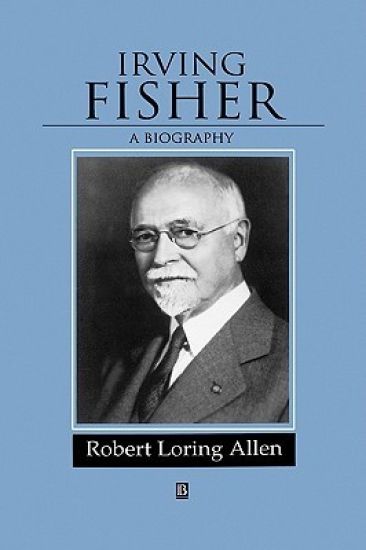
Irving Fisher

Irving Fisher

Robert Loring Allen

Blackwell Publishers
1993
sidottu
Irving Fisher was one of the greatest and certainly one of the most colorful American economists. Widely acknowledged as the chief architect of modern neo-classical economics, he was a writer and teacher of prodigious scope and output whose business career included the earning of a fortune from the invention of a card index system, and its subsequent loss in the Great Crash. He was also an active campaigner for numerous causes, including world peace, prohibition, and 100 percent deposit reserve money. This biography, focusing both on Fisher's personal life, as well as on his intellectual contributions, will be of wide interest to economists and of particular interest to American economics scholars who regard him as their pre-1950 giant of the discipline.
Opening Doors: Life and Work of Joseph Schumpeter

Opening Doors: Life and Work of Joseph Schumpeter

Robert Loring Allen

Transaction Publishers
1991
nidottu
The author puts this book in the best possible context by referring to the "magisterial and paradoxical Dr. Schumpeter". A figure in a rare class with John Maynard Keynes, Friedrich von Hayek, and Alfred Marshall, the work of Joseph Schumpeter is equalled only in monumental significance by his personal trials and tribulations. The work is divided into two volumes - the first covering his career in Europe and the second his life and achievements in America.Walt Rostow, in his Foreword, sums up Robert Loring Allen's achievement in biography and intellectual history thus: "In dealing with Schumpeter's life, Allen exhibits a rare consciousness of the extraordinary complexity and only limited penetrability of the human personality Schumpeter's closely interwoven personal and professional life unfolds, Allen develops without dogmatism a pattern of linkages for the reader to contemplate. In a splendid final passage, he provides a memorable summation."What makes this enormous effort so successful is the linkage of the personal and the professional, the biographical with the intellectual. Indeed, it is Schumpeter's single-minded determination to explain within a single, formal theory, the dynamics of capitalism that bridges the gap in space, time, and personality. To his books The Theory of Economic Development, and Capitalism, Socialism and Democracy, both published by Transaction, is now added the specific contexts in which these and his other works were written.The author of this biography, like the subject himself, is a masterful student of the craft of economics, and its place within the larger social science contexts that Schumpeter worked. In this work, we are introduced into the main current of European and American social science alike. The title of the book, Opening Doors, derives from Schumpeter's life long aim to appeal to inquiring minds to move through such doors in an effort to create the social science of the future. In this, the volume succeeds admirably.

Opening Doors: Life and Work of Joseph Schumpeter

Opening Doors: Life and Work of Joseph Schumpeter

Robert Loring Allen

Transaction Publishers
1991
nidottu
The author puts this book in the best possible context by referring to the "magisterial and paradoxical Dr. Schumpeter". A figure in a rare class with John Maynard Keynes, Friedrich von Hayek, and Alfred Marshall, the work of Joseph Schumpeter is equalled only in monumental significance by his personal trials and tribulations. The work is divided into two volumes - the first covering his career in Europe and the second his life and achievements in America.Walt Rostow, in his Foreword, sums up Robert Loring Allen's achievement in biography and intellectual history thus: "In dealing with Schumpeter's life, Allen exhibits a rare consciousness of the extraordinary complexity and only limited penetrability of the human personality Schumpeter's closely interwoven personal and professional life unfolds, Allen develops without dogmatism a pattern of linkages for the reader to contemplate. In a splendid final passage, he provides a memorable summation."What makes this enormous effort so successful is the linkage of the personal and the professional, the biographical with the intellectual. Indeed, it is Schumpeter's single-minded determination to explain within a single, formal theory, the dynamics of capitalism that bridges the gap in space, time, and personality. To his books The Theory of Economic Development, and Capitalism, Socialism and Democracy, both published by Transaction, is now added the specific contexts in which these and his other works were written.The author of this biography, like the subject himself, is a masterful student of the craft of economics, and its place within the larger social science contexts that Schumpeter worked. In this work, we are introduced into the main current of European and American social science alike. The title of the book, Opening Doors, derives from Schumpeter's life long aim to appeal to inquiring minds to move through such doors in an effort to create the social science of the future. In this, the volume succeeds admirably.