Kirjojen hintavertailu. Mukana 12 595 353 kirjaa ja 12 kauppaa.

Kirjailija

Robert M. Anderson

Kirjat ja teokset yhdessä paikassa: 3 kirjaa, julkaisuja vuosilta 1980-1996, suosituimpien joukossa Divided Loyalties. Vertaile teosten hintoja ja tarkista saatavuus suomalaisista kirjakaupoista.

3 kirjaa

Kirjojen julkaisuhaarukka 1980-1996.

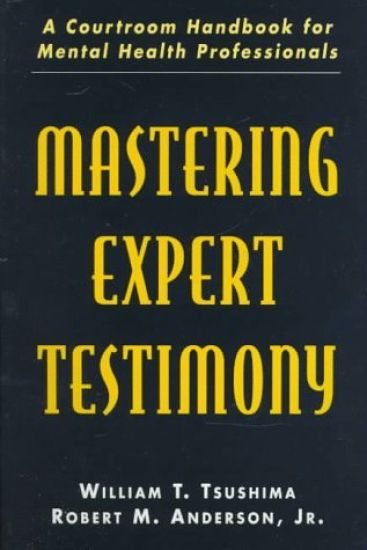
Mastering Expert Testimony

Mastering Expert Testimony

William T. Tsushima; Jr. Anderson; Robert M. Anderson

Routledge Member of the Taylor and Francis Group
1996
nidottu
The past two decades have seen a rapidly growing involvement of psychologists and psychiatrists in legal proceedings for criminal cases, divorces, and traffic and industrial accidents. Mental health professionals are traditionally not trained to cope with the legal responsibilities that arise from their routine clinical work and are eager to learn the professional skills that are needed in forensic settings. There is presently no book which focuses entirely on the strategies and verbal tactics employed by attorneys who critically examine and challenge the testimony of mental health professionals. If psychologists and psychiatrists can familiarize themselves with the kind of questions and verbal exchanges that take place in the courtroom, they would be better prepared to provide their expertise in an effective manner. This book fills that need. Designed as a practical handbook to assist practitioners from all mental health disciplines, it focuses on typical courtroom dialogue between attorneys and mental health professionals who testify regarding their psychotherapy clients and also those who are hired by attorneys specifically to provide expert opinions. The authors, who have extensive experience in the courtroom, offer well-thought-out, effective responses as contrasted with impulsive and weak answers to attorneys' queries. Actual cases are employed to illustrate typical challenges in various legal areas, including criminal law, child custody hearings, and personal injury cases. Certain forensic issues such as the scientific bases of expert opinions, the accuracy of psychological vs. medical tests, and malingering, are emphasized throughout the chapters. The book is based on the belief that exposure to courtroom dialogue enhances the awareness of appropriate professional responses to an attorney's cross-examination and greatly alleviates fear toward a situation well-known to provoke intense levels of anxiety. Although it is written alluding to the forensic psychologist or psychiatrist, the strategies for the witness are readily applicable in most instances to all mental health professionals. Issues such as therapist bias, unconfirmed observations, and cultural and ethnic factors are clearly relevant to all who provide mental health services.
Mastering Expert Testimony

Mastering Expert Testimony

William T. Tsushima; Jr. Anderson; Robert M. Anderson

Routledge Member of the Taylor and Francis Group
1996
sidottu
The past two decades have seen a rapidly growing involvement of psychologists and psychiatrists in legal proceedings for criminal cases, divorces, and traffic and industrial accidents. Mental health professionals are traditionally not trained to cope with the legal responsibilities that arise from their routine clinical work and are eager to learn the professional skills that are needed in forensic settings. There is presently no book which focuses entirely on the strategies and verbal tactics employed by attorneys who critically examine and challenge the testimony of mental health professionals. If psychologists and psychiatrists can familiarize themselves with the kind of questions and verbal exchanges that take place in the courtroom, they would be better prepared to provide their expertise in an effective manner. This book fills that need. Designed as a practical handbook to assist practitioners from all mental health disciplines, it focuses on typical courtroom dialogue between attorneys and mental health professionals who testify regarding their psychotherapy clients and also those who are hired by attorneys specifically to provide expert opinions. The authors, who have extensive experience in the courtroom, offer well-thought-out, effective responses as contrasted with impulsive and weak answers to attorneys' queries. Actual cases are employed to illustrate typical challenges in various legal areas, including criminal law, child custody hearings, and personal injury cases. Certain forensic issues such as the scientific bases of expert opinions, the accuracy of psychological vs. medical tests, and malingering, are emphasized throughout the chapters. The book is based on the belief that exposure to courtroom dialogue enhances the awareness of appropriate professional responses to an attorney's cross-examination and greatly alleviates fear toward a situation well-known to provoke intense levels of anxiety. Although it is written alluding to the forensic psychologist or psychiatrist, the strategies for the witness are readily applicable in most instances to all mental health professionals. Issues such as therapist bias, unconfirmed observations, and cultural and ethnic factors are clearly relevant to all who provide mental health services.
Divided Loyalties

Divided Loyalties

Robert M. Anderson; Robert Perrucci; Dan E. Schendel

Purdue University Press
1980
nidottu
This study provides a detailed, in-depth analysis of a single incident rooted in the effort of a group of professional employees to serve the public welfare. It reveals in microcosm the interplay of political forces, economic interests, personal ambition, organizational structure, and professional ethics that culminated in an act of whistle-blowing. The incident took place during the final construction phase of the Bay Area Rapid Transit System (BART), designed to be America's first attempt at space-age mass transportation. Three BART engineers, convinced of the lack of responsiveness of management to their concerns about the system's safety, were fired for insubordination and other organizational sins. Based upon repeated interviews with the engineers, with BART managers and directors, and with the professional societies involved, as well as upon an extensive body of documents and court depositions, legislative reports, media reports, and institutional memoranda. Divided Loyalties sets a theoretical context for the issues, traces the incident from its beginning, examines the aftermath of the engineers' dismissal, and concludes with a set of recommendations that should be considered by public and private organizations, professional associations, agencies of government, and individual professional employees.