Kirjojen hintavertailu. Mukana 12 295 717 kirjaa ja 12 kauppaa.

Kirjailija

Robert M. Solow

Kirjat ja teokset yhdessä paikassa: 12 kirjaa, julkaisuja vuosilta 1995-2017, suosituimpien joukossa An Almost Practical Step Toward Sustainability. Vertaile teosten hintoja ja tarkista saatavuus suomalaisista kirjakaupoista.

12 kirjaa

Kirjojen julkaisuhaarukka 1995-2017.

An Almost Practical Step Toward Sustainability
Nobel Laureate Robert Solow explores how changes in social accounting practice could contribute to more rational debate and action in crafting economic and environmental policy. A thoughtful work about the wise use of society's natural resources, intergenerational equity, and the translation of ideas about sustainability into real policy.
The Academic Scribblers

The Academic Scribblers

William Breit; Roger L. Ransom; Robert M. Solow

Princeton University Press
2016
sidottu
The Academic Scribblers offers a thoughtful and highly literate summary of modern economic thought. It presents the story of economics through the lives of twelve major modern economists, beginning with Alfred Marshall and concluding with Paul Samuelson and Milton Friedman. In a very real sense, this book picks up where Robert Heilbroner's classic The Wordly Philosophers leaves off. Whereas Heilbroner begins with Smith and ends with Joseph Schumpeter, Breit and Ransom bring the story of modern American and British economic theory up to the 1980s. The Academic Scribblers is an elegant summary of modern economic policy debate and an enticement into a happy engagement with the "dismal science" of economics." Originally published in 1998. The Princeton Legacy Library uses the latest print-on-demand technology to again make available previously out-of-print books from the distinguished backlist of Princeton University Press. These editions preserve the original texts of these important books while presenting them in durable paperback and hardcover editions. The goal of the Princeton Legacy Library is to vastly increase access to the rich scholarly heritage found in the thousands of books published by Princeton University Press since its founding in 1905.
The Academic Scribblers

The Academic Scribblers

William Breit; Roger L. Ransom; Robert M. Solow

Princeton University Press
2014
pokkari
The Academic Scribblers offers a thoughtful and highly literate summary of modern economic thought. It presents the story of economics through the lives of twelve major modern economists, beginning with Alfred Marshall and concluding with Paul Samuelson and Milton Friedman. In a very real sense, this book picks up where Robert Heilbroner's classic The Wordly Philosophers leaves off. Whereas Heilbroner begins with Smith and ends with Joseph Schumpeter, Breit and Ransom bring the story of modern American and British economic theory up to the 1980s. The Academic Scribblers is an elegant summary of modern economic policy debate and an enticement into a happy engagement with the "dismal science" of economics." Originally published in 1998. The Princeton Legacy Library uses the latest print-on-demand technology to again make available previously out-of-print books from the distinguished backlist of Princeton University Press. These editions preserve the original texts of these important books while presenting them in durable paperback and hardcover editions. The goal of the Princeton Legacy Library is to vastly increase access to the rich scholarly heritage found in the thousands of books published by Princeton University Press since its founding in 1905.
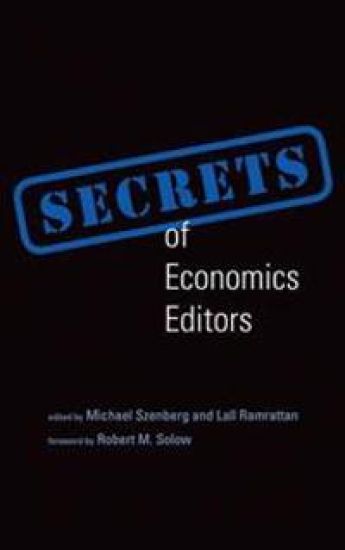
Secrets of Economics Editors

Secrets of Economics Editors

Robert M. Solow

MIT Press
2014
pokkari
Experienced economics editors discuss navigating the world of scholarly journals, with details on submission, reviews, acceptance, rejection, and editorial policy.Editors of academic journals are often the top scholars in their fields. They are charged with managing the flow of hundreds of manuscripts each year-from submission to review to rejection or acceptance-all while continuing their own scholarly pursuits. Tenure decisions often turn on who has published what in which journals, but editors can accept only a fraction of the papers submitted. In this book, past and present editors of economics journals discuss navigating the world of academic journals. Their contributions offer essential reading for anyone who has ever submitted a paper, served as a referee or associate editor, edited a journal-or read an article and wondered why it was published.The editors describe their experiences at journals that range from the American Economic Review to the Journal of Sports Economics. The issues they examine include late referee reports, slow resubmission of manuscripts, and plagiarism-as well as the difficulties of "herding cats" and the benefits of husband-wife editorial partnerships. They consider the role of the editor, as gatekeeper or developer of content; and they advise authors to write more carefully and clearly, to include citations that locate their articles in the context of the existing literature, and to update their work after it has been submitted and rejected elsewhere. The chapters also offer a timely, insider's perspective on the general effectiveness of the system of academic journals in economics. ContributorsRichard V. Adkisson, Richard G. Anderson, William A. Barnett, Suzanne R. Becker, William R. Becker, Daniel W. Bromley, William G. Dewald, Antony W. Dnes, Zvi Eckstein, Richard Friberg, Esther Gal-Or, Craufurd Goodwin, Thorvaldur Gylfason, Campbell R. Harvey, Geoffrey M. Hodgson, Leo H. Kahane, R. Preston McAfee, John Pencavel, Gerald Pfann, Steven Pressman, Lall B. Ramrattan, J. Barkley Rosser Jr., Paul H. Rubin, William F. Shughart II, Robert M. Solow, Daniel F. Spulber, Michael Szenberg, Timothy Taylor, Abu N.M. Wahid, Michael Watts, Lawrence J. White, Jurgen von Hagen, Fabrizio Zilibotti
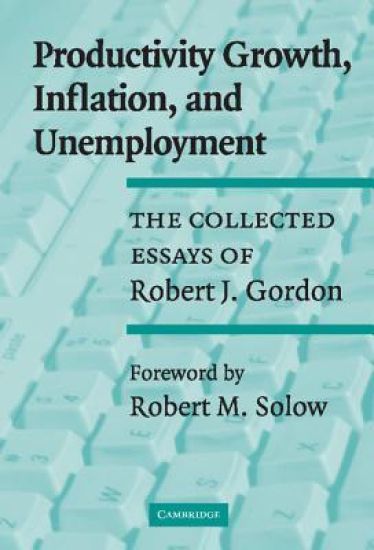
Productivity Growth, Inflation, and Unemployment

Productivity Growth, Inflation, and Unemployment

Robert J. Gordon; Robert M. Solow

Cambridge University Press
2003
sidottu
The seventeen seminal essays by Robert J. Gordon collected here, including three previously unpublished works, offer sharply etched views on the principal topics of macroeconomics - growth, inflation, and unemployment. The author re-examines their salient points in a uniquely creative, accessible introduction that serves on its own as an introduction to modern macroeconomics. Each of the four parts into which the essays are grouped also offers a new introduction. The papers in Part I explore different key aspects of the history, theory, and measurement of productivity growth. The essays in Part II investigate the sources of business cycles and productivity fluctuations. Those in Part III cover the effects of supply shocks in macroeconomics. The final group presents empirical studies of the dynamics of inflation in the United States. The foreword by Nobel Laureate Robert M. Solow comments on the abiding importance of these essays drawn from 1968 to the present.
Productivity Growth, Inflation, and Unemployment

Productivity Growth, Inflation, and Unemployment

Robert J. Gordon; Robert M. Solow

Cambridge University Press
2003
pokkari
The 17 seminal essays by Robert J. Gordon collected here, including three previously unpublished works, offer sharply etched views on the principal topics of macroeconomics - growth, inflation, and unemployment. The author re-examines their salient points in a uniquely creative, accessible introduction that serves on its own as an introduction to modern macroeconomics. Each of the four parts into which the essays are grouped also offers a new introduction. The papers in Part I explore different key aspects of the history, theory, and measurement of productivity growth. The essays in Part II investigate the sources of business cycles and productivity fluctuations. Those in Part III cover the effects of supply shocks in macroeconomics. The final group presents empirical studies of the dynamics of inflation in the United States. The foreword by Nobel Laureate Robert M. Solow comments on the abiding importance of these essays drawn from 1968 to the present.
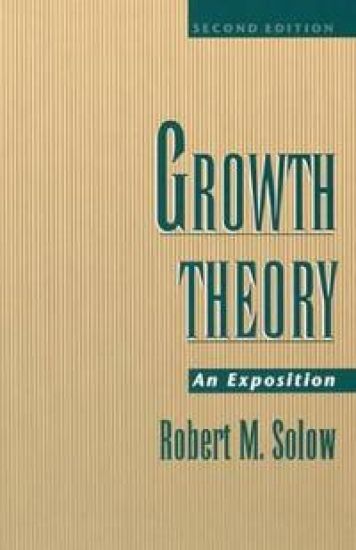
Growth Theory

Growth Theory

Robert M. Solow

Oxford University Press Inc
2000
nidottu
In the preface to the first edition of Growth Theory (copyright 1970), the author writes: "I have tried to give some feeling for the scope of aggregate theory of growth, a notion of technical details, and some idea of the directions in which future research is likely to go. About four years ago, the OUP NY economics editor suggested to Professor Solow that he bring this book up to date, because of the large amount of recent literature, often referred to as the "new growth theory," or more technically as "endogenous growth theory". This second edition of Growth Theory, which grew out of that conversation, begins with the author's Nobel Prize Lecture "Growth Theory and After" (1987) followed by the original six chapters of the first edition. The first edition appeared in 1970; the author maintains that basic growth theory is still best summarized in these chapters, using what is often classified as "exogenous growth theory." In the 70s, which happened to coincide witha worldwide productivity slowdown, very little new work occurred in growth theory. It wasn't until the 1980s that a surge of new writing appeared, with the work of Roemer, Lucas, and others, what the author refers to as "an astonishing burst of theoretical and empirical research that still continues." The author developed "a second half" of the book for this edition, six entirely new chpaters in which he discusses new growth theory (endogenous growth theory) and its relationship to exogenous theory. As a "bridge" between the two sets of chapters, he has written an essay entitled "Intermezzo" in which he discusses the relatively inactive period for growth theory in the 70s, before introducing the "new" endogenous theory of growth and contrasting it with earlier work. Solow is quick to agree that older growth theory can aptly be described as "exogenous," because the growth rate itself was left unexplained, or rather was considered a "given" (basically a result of the actual rate of labor-augmenting technology). But treating the growth rate as exogenous does not make it a permanent constant or inexplicable. Certainly things can be said about a variety of (exogenous) factors affecting the growth rate; nevertheless the "old" theory did not provide, or try to give, a systematic theory of the growth rate. To sum up, according to the author, the way to understand exogenous growth theory is to show how aggregate output adjusts to the rate of population growth and the rate of technological process, whatever they happen to be and for however long the persist (treated in Chapters 1-6 and the "Intermezzo"). By contrast, the main contribution of the (new) endogenous grotwh theory is to propose a systematic theory of technological progress, a model that actually explains the rate of growth. It is the contention of the author that no theory of innovation or growth can come up with a formulaic way to arrive at a growth rate. For that reason he believes there is something arbitrary introduced into all endogenous theories of the rate of growth. They claim to explain more than they can be expected to do. Rather than trying to pin down determinants of any "steady-state" growth rate, exogenous growth theory describes trends and policies that increase growth, including the growth rate. For reasons made explicit in the book, the author deals with "AK"theory, convergence, and international cross-section studies, with only the passing attention he believes they deserve. In the "second half of the book," starting in Chapter 7, the author recasts the older (exogenous) model (Chapters 1-6) so that it can be more easily compared with new models. Chapters 8-11 takes a close analytical look at hte key models: Lucas (8); Roemer (9); Grossman/Helpman (10); Aghion and Howitt (11). In each chapter he shows how an unwarranted assumption creeps into these models that try to determin growth rate endogenously. The final chapter looks at lessons from the new growth theory and suggests where gaps may usefully be filled in future research. Despite his criticisms of the new growth theory, the author is quik to acknowledge outstanding contributions made by the new generation of theorists. This is an important book that will be required reading in graduate programs in macroeconomics as well as specific courses on growth theory, at both the undergraduate and graduate levels. No other book provides such a broad overviwe of the whole field and its evolution to the present.
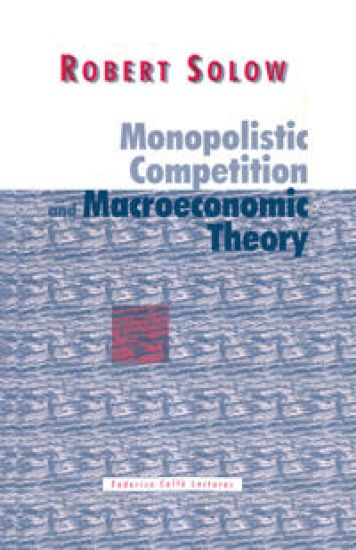
Monopolistic Competition and Macroeconomic Theory

Monopolistic Competition and Macroeconomic Theory

Robert M. Solow

Cambridge University Press
1998
sidottu
Much of today's conventional macroeconomic theory presumes that markets for goods approach the state of perfect competition. Monopolistic Competition and Macroeconomic Theory assumes that markets are imperfect, so that sellers have some power over price, and must therefore form quantity expectations about the location of the firm's demand curve. The question is then about the macroeconomic implications of imperfect competition in goods markets. The first chapter is a brief survey of ideas proposed in economics including multiple equilibria. The second chapter describes a particular micro-based macro model that allows several families of equilibria. The third chapter shows how a standard locational model can be used to describe a sample macroeconomy when firms have close rivals. In this volume derived from his Federico Caffe Lecture, Nobel Laureate Robert Solow shows that there are simple and tractable micro-based models that offer the possibility of a richer and more intuitive macroeconomics.
Monopolistic Competition and Macroeconomic Theory

Monopolistic Competition and Macroeconomic Theory

Robert M. Solow

Cambridge University Press
1998
pokkari
Much of today’s conventional macroeconomic theory presumes that markets for goods approach the state of perfect competition. Monopolistic Competition and Macroeconomic Theory assumes that markets are imperfect, so that sellers have some power over price, and must therefore form quantity expectations about the location of the firm’s demand curve. The question is then about the macroeconomic implications of imperfect competition in goods markets. The first chapter is a brief survey of ideas recently proposed in economics including multiple equilibria. The second chapter describes a particular micro-based macro model that allows several families of equilibria. The third chapter shows how a standard locational model can be used to describe a sample macroeconomy when firms have close rivals. In this volume derived from his Federico Caffe Lecture, Nobel Laureate Robert Solow shows that there are simple and tractable micro-based models that offer the possibility of a richer and more intuitive macroeconomics.
An Almost Practical Step Toward Sustainability

An Almost Practical Step Toward Sustainability

Robert M. Solow

Resources for the Future Press (RFF Press)
1998
nidottu
Nobel Laureate Robert Solow explores how changes in social accounting practice could contribute to more rational debate and action in crafting economic and environmental policy. A thoughtful work about the wise use of society's natural resources, intergenerational equity, and the translation of ideas about sustainability into real policy.
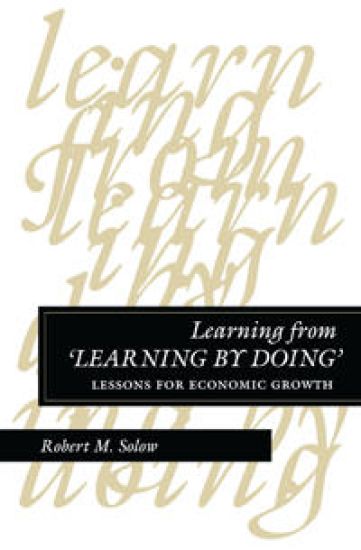
Learning from 'Learning by Doing'

Learning from 'Learning by Doing'

Robert M. Solow

Stanford University Press
1997
sidottu
This book by a Nobel laureate in economics begins with a brief exposition of Kenneth J. Arrow's classic paper "The Economic Implications of Learning by Doing" (1962). It shows how Arrow's idea fits into the modern theory of economic growth, and uses it as a springboard for a critical consideration of spectacular recent developments that have made growth theory a dynamic topic today. The author then develops a new theory that combines learning by doing (identifying it with the concept of "continuous improvement") with a separate process of discrete "innovations." Learning by doing leads to a fairly smooth reduction in labor required per unit of output, tied to the rate of gross investment in new capital equipment. Innovations arrive at random; when one of them happens, the labor requirement takes a jump downward. This new model, simple as it is, does not lend itself to self-contained solution. The author accordingly presents the results of a series of computer simulations that exhibit the variety of paths the new model economy can follow, showing, among other things, that early good luck can have a persistent effect. The book concludes with some general reflections on policies for economic growth, drawn not from any one modeling exercise but from general experience with a variety of growth models. Of the four chapters of this book, the first two were presented as the Kenneth J. Arrow Lectures at Stanford University in 1993. The computer simulations were specially done for inclusion in this book. The final chapter on policies for economic growth was first presented as the Ernest Sturc Lecture at the Johns Hopkins School of Advanced International Studies in Washington in 1991.
Full Employment Regained?

Full Employment Regained?

James Edward Meade; Robert M. Solow

Cambridge University Press
1995
pokkari
‘Have we given up trying to gain full employment?’ ‘If not, what should we be trying to do about it?’ These are the fundamental questions that James Meade poses, and attempts to answer, in this short but timely book. As the issue of full employment moves once again to the centre of the political debate, Professor Meade draws our attention to a number of economic and financial factors which are neglected in the current debate, and suggests a novel package of changes which could be used to tackle the full employment problem. He condemns the neglect of macroeconomic analysis in designing full-employment policies, and asserts that the money value of total domestic production rather than the price level should be the object of a combined fiscal-monetary policy, which itself should focus on low interest rates rather than low tax rates.