Kirjojen hintavertailu. Mukana 12 390 323 kirjaa ja 12 kauppaa.
Kirjailija
Robert MacIntosh
Kirjat ja teokset yhdessä paikassa: 10 kirjaa, julkaisuja vuosilta 2012-2023, suosituimpien joukossa Strategic Management. Vertaile teosten hintoja ja tarkista saatavuus suomalaisista kirjakaupoista.
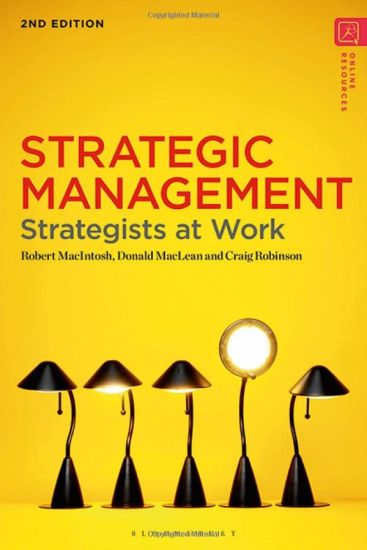
Focusing on the practicalities of developing business strategy, this textbook provides an intuitive approach to developing a strategic plan. The authors share what they have learned through two decades of strategy work with a myriad of organisations, presenting theory and delivering key insights into the strategist's role.The authors demonstrate their unique Strategy Cycle approach, which combines strategic logic (in the form of detailed plans) with the aesthetic, creative and interpretive process of bringing a strategy to life by storytelling. They examine familiar planning tools to identify where value truly lies, while introducing new ideas and methods, culminating in a simple and succinct 10-component strategy.Visit the authors' website at strategystory.co.uk
Focusing on the practicalities of developing business strategy, this textbook provides an intuitive approach to developing a strategic plan. The authors share what they have learned through two decades of strategy work with a myriad of organisations, presenting theory and delivering key insights into the strategist's role.The authors demonstrate their unique Strategy Cycle approach, which combines strategic logic (in the form of detailed plans) with the aesthetic, creative and interpretive process of bringing a strategy to life by storytelling. They examine familiar planning tools to identify where value truly lies, while introducing new ideas and methods, culminating in a simple and succinct 10-component strategy.Visit the authors' website at strategystory.co.uk
Impact is of increasing importance to all researchers, given its growing centrality to those who fund, assess and use research around the world. Delivering Impact in Management Research sets out a detailed and nuanced analysis of how research impact is best delivered in practice. Starting with a rich conceptualisation, the authors move on to discuss models through which meaningful impact is framed and delivered. The book explains processes, skills and approaches to impact, along with examples and insights into potential pitfalls and solutions.Examples are drawn from around the world and systems such as the UK Research Excellence Framework (REF) are discussed as part of a key contribution to primary debates globally. A significant contribution to the long-standing discussion about relevance in business, management and organisation studies research, this concise book is essential reading for scholars and university administrators seeking to advance their understanding of delivering and demonstrating world-class research that matters.
Impact is of increasing importance to all researchers, given its growing centrality to those who fund, assess and use research around the world. Delivering Impact in Management Research sets out a detailed and nuanced analysis of how research impact is best delivered in practice. Starting with a rich conceptualisation, the authors move on to discuss models through which meaningful impact is framed and delivered. The book explains processes, skills and approaches to impact, along with examples and insights into potential pitfalls and solutions.Examples are drawn from around the world and systems such as the UK Research Excellence Framework (REF) are discussed as part of a key contribution to primary debates globally. A significant contribution to the long-standing discussion about relevance in business, management and organisation studies research, this concise book is essential reading for scholars and university administrators seeking to advance their understanding of delivering and demonstrating world-class research that matters.
This updated and revised edition offers a comprehensive overview of key research methods and the main choices available when undertaking research in business and management. New to this edition is a comprehensive, practical guide on how to write your dissertation – invaluable to all. It is a clear, concise and practical guide containing wealth of outstanding examples for each method covered. Central to this edition is the 'methods map' (chapter 4), which sets out a logical process for researchers to articulate their position in relation to five key aspects of their research philosophy. In addition, the editors have developed a free app to accompany the book and this enables novice researchers to quickly develop a comprehensive justification of their particular research design in an interactive way. Taking you through the entire life cycle of a dissertation, the text covers everything from the purposes of research through to chapters on gathering primary and secondary data; using literature; quantitative and qualitative research; managing your research; using data and research ethics. Individual chapters are allied to a powerful critical commentary showing how some of the world’s leading scholars have used particular methods in their own research. Carefully constructed to achieve the greatest clarity for the student the text gives the reader: * In-text exercises * End of chapter’ review questions with solutions * Exemplar papers identified and discussed for each of the main methods *Directed further reading for developing understanding in key areas It is an essential learning aid for upper level undergraduates and postgraduates across a wide range of business and management courses and it comes with a range of supported learning materials including tutorials, lecture slides and tutor notes. Kevin O’Gorman is Professor of Management and Business History and Head of Business Management in the School of Languages and Management in Heriot-Watt University, Edinburgh. He trained in Glasgow, Salamanca and Rome as a philosopher, theologian and historian. His research interests have a dual focus: Origins, history and cultural practices of hospitality, and philosophical, ethical and cultural underpinnings of contemporary management practices. Using a wide range of methodological approaches he has published over 80 journal articles, books, chapters, and conference papers in business and management studies. Robert MacIntosh is Professor of Strategy and Head of the School of Management and Languages at Heriot-Watt University. He trained as an engineer and has worked at the Universities of Glasgow and Strathclyde. His research on the ways in which top teams develop strategy and on organizational change has been published in a wide range of outlets. He has a long-standing interest in research methods for business and management studies and has published on the relevance of management research using methods that include ethnography and action research. He has consulted extensively with public and private sector organizations and sits on the board of the charity Turning Point Scotland.
Managing a global business introduces particular challenges; managers must decide whether to standardize and centralize or to devolve key decisions to local markets, how to handle performance management, talent management and a range of other concerns. In this core text a range of leading experts present an introduction to management in a global context. Covering the major management disciplines, Introducing Management in a Global Context provides an introductory overview of key topic areas and to glimpse the latest research in domains such as strategy, technology and change, economics and development, politics and the social world, marketing, ethics and corporate decision making. To help support their learning, readers have access to a range of online resources including chapter-by-chapter multiple choice questions which will enable them to assess how well they have grasped individual chapters. The text also features a range of supplementary readings, in text exercises and cases/examples to help bring concepts to life. Understanding the content and context of this book will help shape you as a globally oriented manager. Includes: * In text exercises and end of chapter review questions with ‘solutions’; * PowerPoint slide sets for each chapter, suitable for 2 hours teaching; * Exemplar papers for each topic area to encourage further reading and research * “Who to Read” summaries at the end of each chapter identifying leading thinkers in the field; * MCQs which could be used for class test or self-assessment purposes to enhance student learning. Kevin O’Gorman was formerly Professor of Management and Business History and Head of Business Management in the School of Languages and Management in Heriot-Watt University, Edinburgh. He trained in Glasgow, Salamanca and Rome as a philosopher, theologian and historian. His research interests have a dual focus: Origins, history and cultural practices of hospitality, and philosophical, ethical and cultural underpinnings of contemporary management practices. Using a wide range of methodological approaches he has published over 80 journal articles, books, chapters, and conference papers in business and management studies. Robert MacIntosh is Professor of Strategy and Head of the School of Management and Languages at Heriot-Watt University. He trained as an engineer and has worked at the Universities of Glasgow and Strathclyde. His research on the ways in which top teams develop strategy and on organizational change has been published in a wide range of outlets. He has a long-standing interest in research methods for business and management studies and has published on the relevance of management research using methods that include ethnography and action research. He has consulted extensively with public and private sector organizations and sits on the board of the charity Turning Point Scotland.
Managing a global business introduces particular challenges; managers must decide whether to standardize and centralize or to devolve key decisions to local markets, how to handle performance management, talent management and a range of other concerns. In this core text a range of leading experts present an introduction to management in a global context. Covering the major management disciplines, Introducing Management in a Global Context provides an introductory overview of key topic areas and to glimpse the latest research in domains such as strategy, technology and change, economics and development, politics and the social world, marketing, ethics and corporate decision making. To help support their learning, readers have access to a range of online resources including chapter-by-chapter multiple choice questions which will enable them to assess how well they have grasped individual chapters. The text also features a range of supplementary readings, in text exercises and cases/examples to help bring concepts to life. Understanding the content and context of this book will help shape you as a globally oriented manager. Includes: * In text exercises and end of chapter review questions with ‘solutions’; * PowerPoint slide sets for each chapter, suitable for 2 hours teaching; * Exemplar papers for each topic area to encourage further reading and research * “Who to Read” summaries at the end of each chapter identifying leading thinkers in the field; * MCQs which could be used for class test or self-assessment purposes to enhance student learning. Kevin O’Gorman was formerly Professor of Management and Business History and Head of Business Management in the School of Languages and Management in Heriot-Watt University, Edinburgh. He trained in Glasgow, Salamanca and Rome as a philosopher, theologian and historian. His research interests have a dual focus: Origins, history and cultural practices of hospitality, and philosophical, ethical and cultural underpinnings of contemporary management practices. Using a wide range of methodological approaches he has published over 80 journal articles, books, chapters, and conference papers in business and management studies. Robert MacIntosh is Professor of Strategy and Head of the School of Management and Languages at Heriot-Watt University. He trained as an engineer and has worked at the Universities of Glasgow and Strathclyde. His research on the ways in which top teams develop strategy and on organizational change has been published in a wide range of outlets. He has a long-standing interest in research methods for business and management studies and has published on the relevance of management research using methods that include ethnography and action research. He has consulted extensively with public and private sector organizations and sits on the board of the charity Turning Point Scotland.
This new text offers a completely comprehensive overview of key research methods and the main choices available when undertaking a dissertation. It is a clear, concise and practical guide containing wealth of outstanding examples for each method covered. Taking you through the entire life cycle of a dissertation, the text covers everything from the purposes of research through to chapters on gathering primary and secondary data; using literature; quantitative and qualitative research; managing your research; using data and research ethics. Individual chapters are allied to a powerful critical commentary showing how some of the world’s leading scholars have used particular methods in their own research. Carefully constructed to achieve the greatest clarity for the student the text gives the reader: * In-text exercises * End of chapter’ review questions with solutions * Exemplar papers identified and discussed for each of the main methods ( Directed further reading for developing understanding in key areas It is an essential learning aid for upper level undergraduates and postgraduates across a wide range of business and management courses and it comes with a range of supported learning materials including tutorials, lecture slides and tutor notes. Kevin O’Gorman is Professor of Management and Business History and Head of Business Management in the School of Languages and Management in Heriot-Watt University, Edinburgh. He trained in Glasgow, Salamanca and Rome as a philosopher, theologian and historian. His research interests have a dual focus: Origins, history and cultural practices of hospitality, and philosophical, ethical and cultural underpinnings of contemporary management practices. Using a wide range of methodological approaches he has published over 80 journal articles, books, chapters, and conference papers in business and management studies. Robert MacIntosh is Professor of Strategy and Head of the School of Management and Languages at Heriot-Watt University. He trained as an engineer and has worked at the Universities of Glasgow and Strathclyde. His research on the ways in which top teams develop strategy and on organizational change has been published in a wide range of outlets. He has a long-standing interest in research methods for business and management studies and has published on the relevance of management research using methods that include ethnography and action research. He has consulted extensively with public and private sector organizations and sits on the board of the charity Turning Point Scotland.
This new text offers a completely comprehensive overview of key research methods and the main choices available when undertaking a dissertation. It is a clear, concise and practical guide containing wealth of outstanding examples for each method covered. Taking you through the entire life cycle of a dissertation, the text covers everything from the purposes of research through to chapters on gathering primary and secondary data; using literature; quantitative and qualitative research; managing your research; using data and research ethics. Individual chapters are allied to a powerful critical commentary showing how some of the world’s leading scholars have used particular methods in their own research. Carefully constructed to achieve the greatest clarity for the student the text gives the reader: * In-text exercises * End of chapter’ review questions with solutions * Exemplar papers identified and discussed for each of the main methods *Directed further reading for developing understanding in key areas It is an essential learning aid for upper level undergraduates and postgraduates across a wide range of business and management courses and it comes with a range of supported learning materials including tutorials, lecture slides and tutor notes. Kevin O’Gorman is Professor of Management and Business History and Head of Business Management in the School of Languages and Management in Heriot-Watt University, Edinburgh. He trained in Glasgow, Salamanca and Rome as a philosopher, theologian and historian. His research interests have a dual focus: Origins, history and cultural practices of hospitality, and philosophical, ethical and cultural underpinnings of contemporary management practices. Using a wide range of methodological approaches he has published over 80 journal articles, books, chapters, and conference papers in business and management studies. Robert MacIntosh is Professor of Strategy and Head of the School of Management and Languages at Heriot-Watt University. He trained as an engineer and has worked at the Universities of Glasgow and Strathclyde. His research on the ways in which top teams develop strategy and on organizational change has been published in a wide range of outlets. He has a long-standing interest in research methods for business and management studies and has published on the relevance of management research using methods that include ethnography and action research. He has consulted extensively with public and private sector organizations and sits on the board of the charity Turning Point Scotland.
The ability to manage change successfully is an essential part of business. It is a skill that is much valued by employers, and it is therefore one of the most commonly delivered courses. This book helps you to understand three key activities for managing change: diagnosing, explaining and enacting. Both practical and action-oriented, it gives students and managers the tools they need to deal with the messy reality of change. It combines theory and diagnostic tools with practical examples that focus on actions and outcomes. It also includes short vignettes and longer cases, from a range of international contexts, for classroom study or for use on distance learning courses. Managing Change is written for advanced undergraduates and graduate students taking modules on change management, strategy and organizations. Its class-tested approach has been successfully delivered in a wide variety of settings, including over fifty executive short courses with FTSE-listed businesses.