Kirjailija
Robert N. Bellah
Kirjat ja teokset yhdessä paikassa: 16 kirjaa, julkaisuja vuosilta 1985-2024, suosituimpien joukossa The Robert Bellah Reader. Vertaile teosten hintoja ja tarkista saatavuus suomalaisista kirjakaupoista.
Mukana myös kirjoitusasut: Robert N Bellah
16 kirjaa
Kirjojen julkaisuhaarukka 1985-2024.
Perhaps best known for his coauthored bestselling books Habits of the Heart and The Good Society, Robert N. Bellah is a truly visionary leader in the social study of religion. For more than four decades, he has examined the role of religion in modern and premodern societies, attempting to discern how religious meaning is formed and how it shapes ethical and political practices. The Robert Bellah Reader brings together twenty-eight of Bellah’s seminal essays. While the essays span a period of more than forty years, nearly half of them were written in the past decade, many in the past few years.The Reader is organized around four central concerns. It seeks to place modernity in theoretical and historical perspective, drawing from major figures in social science, historical and contemporary, from Aristotle and Rousseau through Durkheim and Weber to Habermas and Mary Douglas. It takes the United States to be in some respects the type-case of modernity and in others the most atypical of modern societies, analyzing its common faith in individual freedom and democratic self-government, and its persistent paradoxes of inequality, exclusion, and empire. The Reader is also concerned to test the axiomatic modern assumption that rational cognition and moral evaluation, fact and value, are absolutely divided, arguing instead that they overlap and interact much more than conventional wisdom in the university today usually admits. Finally, it criticizes modernity’s affirmation that faith and knowledge stand even more utterly at odds, arguing instead that their overlap and interaction, obvious in every premodern society, animate the modern world as well.Through such critical and constructive inquiry this Reader probes many of our deepest social and cultural quandaries, quandaries that put modernity itself, with all its immense achievements, at mortal risk. Through the practical self-understanding such inquiry spurs, Bellah shows how we may share responsibility for the world we have made and seek to heal it.

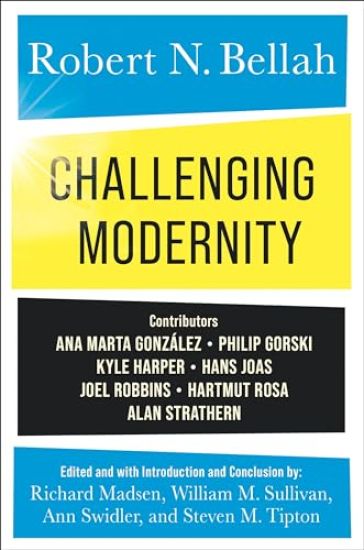
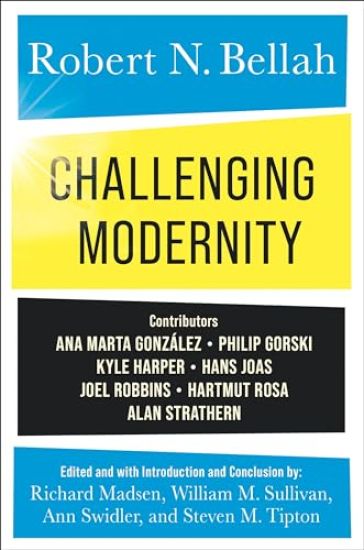
From the 1960s until his death in 2013, Robert N. Bellah was the preeminent figure in the study of religion and society. He broke new ground in mapping the religious dimensions of human experience, from the great breakthroughs of the first millennium BCE to the paradoxes of American civic life. In three final essays, published here for the first time, Bellah grapples with the contradictions of modernity, and seven leading thinkers respond with profound, exhilarating new perspectives on our present predicament.Challenging Modernity critically assesses the modern project to shed light on the tensions between its transcendent aspirations and the perils we now face. Its contributors analyze the roots of the collapse of the political, economic, and cultural institutions that promised perpetual progress but now threaten global catastrophe. Reflecting the range of Bellah’s scholarship, they span the disciplines of history, sociology, anthropology, and philosophy. They extend Bellah’s insight that only deep historical, cultural, and religious understanding can help us meet modernity’s harrowing challenges by sharing responsibility for the global interdependence of our common fate.
Der Ursprung Der Religion: Vom Palaolithikum Bis Zur Achsenzeit
Robert N. Bellah
Verlag Herder
2021
sidottu
Der Ursprung der Religion ist das groae Alterswerk von Robert N. Bellah, einem der fuhrenden Soziologen unserer Zeit. Mit den neuesten Erkenntnissen der Biologie, Kognitionswissenschaft und Evolutionspsychologie rekonstruiert er, wie die Menschen vom Palaolithikum bis zum ersten Jahrtausend v. Chr. Fahigkeiten und Bedurfnisse entwickelten, die zu neuen Vorstellungen des Lebens und Formen des Zusammenlebens fuhrten. Bellah zeigt, wie sich in vier groaen Zivilisationen der Achsenzeit das alte Israel, Griechenland, China und Indien Religionen durchgesetzt haben, die wir heute als Weltreligionen kennen.
Habits of the Heart, Updated Edition Lib/E: Individualism and Commitment in American Life
Robert N. Bellah; Richard Madsen; William M. Sullivan
Blackstone Publishing
2019
cd
Habits of the Heart, Updated Edition: Individualism and Commitment in American Life
Robert N. Bellah; Richard Madsen; William M. Sullivan
Blackstone Publishing
2019
cd
A New York Times Book Review Editors’ Choice An ABC Australia Best Book on Religion and Ethics of the Year Distinguished Book Award, Sociology of Religion Section of the American Sociological AssociationReligion in Human Evolution is a work of extraordinary ambition—a wide-ranging, nuanced probing of our biological past to discover the kinds of lives that human beings have most often imagined were worth living. It offers what is frequently seen as a forbidden theory of the origin of religion that goes deep into evolution, especially but not exclusively cultural evolution.“Of Bellah’s brilliance there can be no doubt. The sheer amount this man knows about religion is otherworldly…Bellah stands in the tradition of such stalwarts of the sociological imagination as Emile Durkheim and Max Weber. Only one word is appropriate to characterize this book’s subject as well as its substance, and that is ‘magisterial.’”—Alan Wolfe, New York Times Book Review“Religion in Human Evolution is a magnum opus founded on careful research and immersed in the ‘reflective judgment’ of one of our best thinkers and writers.”—Richard L. Wood, Commonweal
Habits of the Heart, With a New Preface
Robert N. Bellah; Richard Madsen; William M. Sullivan; Ann Swidler; Steven M. Tipton
University of California Press
2007
pokkari
First published in 1985, "Habits of the Heart" continues to be one of the most discussed interpretations of modern American society, a quest for a democratic community that draws on our diverse civic and religious traditions. In a new preface the authors relate the arguments of the book both to the current realities of American society and to the growing debate about the country's future. With this new edition one of the most influential books of recent times takes on a new immediacy.
Reflections on Fieldwork in Morocco
Paul Rabinow; Robert N. Bellah; Pierre Bourdieu
University of California Press
2007
pokkari
In this landmark study, now celebrating thirty years in print, Paul Rabinow takes as his focus the fieldwork that anthropologists do. How valid is the process? To what extent do the cultural data become artifacts of the interaction between anthropologist and informants? Having first published a more standard ethnographic study about Morocco, Rabinow here describes a series of encounters with his informants in that study, from a French innkeeper clinging to the vestiges of a colonial past, to the rural descendants of a seventeenth-century saint. In a new preface, Rabinow considers the thirty-year life of this remarkable book and his own distinguished career.
One of the most influential sociologists living today, Robert N. Bellah began his career as a Japan specialist, and has continued to contribute to the field over the past thirty years. Imagining Japan is a collection of some of his most important writings, including essays that consider the entire sweep of Japanese history and the character of Japanese society and religion. Combining intellectual rigor, broad scholarship, and ethical commitment, this book also features a new and extensive introduction that brings together intellectual and institutional dimensions of Japanese history.
This Second Edition represents Bellah's summation of his views on civil religion in America. In his 1967 classic essay "Civil Rights in America," Bellah argued that the religious dimensions of American society—as distinct from its churches—has its own integrity and required "the same care in understanding that any religion." This edition includes his 1978 article "Religion and the Legitimation of the American Republic," and a new Preface.
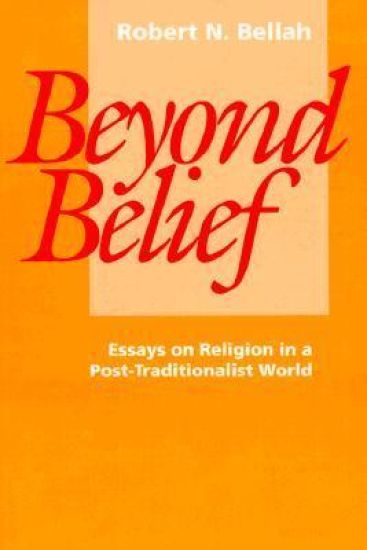
Beyond Belief collects fifteen celebrated, broadly ranging essays in which Robert Bellah interprets the interplay of religion and society in concrete contexts from Japan to the Middle East to the United States. First published in 1970, Beyond Belief is a classic in the field of sociology of religion.
Argues that Buddhism, Confucianism, and Shintoism are more responsible for Japan's current economic success than contact with the West, and discusses Japanese religion and culture