
Kirjojen hintavertailu. Mukana 12 595 353 kirjaa ja 12 kauppaa.

Kirjailija

Robert S. Emmett

Kirjat ja teokset yhdessä paikassa: 3 kirjaa, julkaisuja vuosilta 2016-2017, suosituimpien joukossa Cultivating Environmental Justice. Vertaile teosten hintoja ja tarkista saatavuus suomalaisista kirjakaupoista.

3 kirjaa

Kirjojen julkaisuhaarukka 2016-2017.

The Environmental Humanities

The Environmental Humanities

Robert S. Emmett; David E. Nye

MIT Press
2017
pokkari
A concise overview of this multidisciplinary field, presenting key concepts, central issues, and current research, along with concrete examples and case studies.The emergence of the environmental humanities as an academic discipline early in the twenty-first century reflects the growing conviction that environmental problems cannot be solved by science and technology alone. This book offers a concise overview of this new multidisciplinary field, presenting concepts, issues, current research, concrete examples, and case studies. Robert Emmett and David Nye show how humanists, by offering constructive knowledge as well as negative critique, can improve our understanding of such environmental problems as global warming, species extinction, and over-consumption of the earth's resources. They trace the genealogy of environmental humanities from European, Australian, and American initiatives, also showing its cross-pollination by postcolonial and feminist theories. Emmett and Nye consider a concept of place not synonymous with localism, the risks of ecotourism, and the cultivation of wild areas. They discuss the decoupling of energy use and progress, and point to OECD countries for examples of sustainable development. They explain the potential for science to do both good and harm, examine dark visions of planetary collapse, and describe more positive possibilities-alternative practices, including localization and degrowth. Finally, they examine the theoretical impact of new materialism, feminism, postcolonial criticism, animal studies, and queer ecology on the environmental humanities.
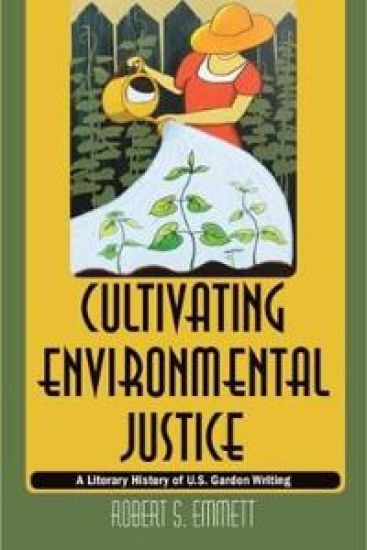
Cultivating Environmental Justice

Cultivating Environmental Justice

Robert S. Emmett

University of Massachusetts Press
2016
sidottu
While Michael Pollan and others have popularized ideas about how growing one’s own food can help lead to environmental sustainability, environmental justice activists have pushed for more access to gardens and fresh food in impoverished communities. Now, Robert S. Emmett argues that mid-twentieth-century American garden writing included many ideas that became formative for these contemporary environmental writers and activists. Drawing on ecocriticism, environmental history, landscape architecture, and recent work in environmental justice and food studies, Emmett explores how the language of environmental justice emerged in descriptions of gardening across a variety of literary forms. He reveals early egalitarian associations found in garden writing, despite a popular focus on elite sites such as suburban lawns and formal southern gardens. Cultivating Environmental Justice emphasizes the intergenerational work of gardeners and garden writers who, from the 1930s on, asserted increasingly radical socioeconomic and ecological claims to justice. Emmett considers a wide range of texts by authors including Bernard M’Mahon, Scott and Helen Nearing, Katharine S. White, Elizabeth Lawrence, Alice Walker, and Novella Carpenter.
Cultivating Environmental Justice

Cultivating Environmental Justice

Robert S. Emmett

University of Massachusetts Press
2016
nidottu
While Michael Pollan and others have popularized ideas about how growing one’s own food can help lead to environmental sustainability, environmental justice activists have pushed for more access to gardens and fresh food in impoverished communities. Now, Robert S. Emmett argues that mid-twentieth-century American garden writing included many ideas that became formative for these contemporary environmental writers and activists.Drawing on ecocriticism, environmental history, landscape architecture, and recent work in environmental justice and food studies, Emmett explores how the language of environmental justice emerged in descriptions of gardening across a variety of literary forms. He reveals early egalitarian associations found in garden writing, despite a popular focus on elite sites such as suburban lawns and formal southern gardens. Cultivating Environmental Justice emphasizes the intergenerational work of gardeners and garden writers who, from the 1930s on, asserted increasingly radical socioeconomic and ecological claims to justice. Emmett considers a wide range of texts by authors including Bernard M’Mahon, Scott and Helen Nearing, Katharine S. White, Elizabeth Lawrence, Alice Walker, and Novella Carpenter.