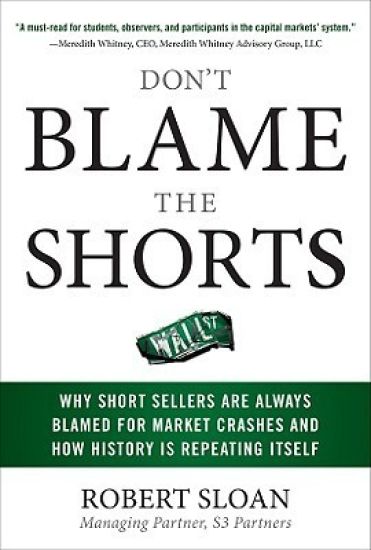
Listed in Bloomberg’s TOP 50 BUSINESS BOOKS OF 2010 and shortlisted for Spear’s FINANCIAL HISTORY OF THE YEAR AWARD“Robert Sloan works in the hedge-fund industry. As he shows in this readable polemic, dislike of shorting has a long history. . . . Someone has to point out when the emperor has no clothes. The shorts were among the biggest skeptics of the subprime-mortgage boom and of the banks that financed it. And when they were proved right, their activities were banned. Gratitude, huh?”The Economist“If Robert Sloan manages to go the distance in Don’t Blame the Shorts, it is because his book is as much about historical tensions between Washington and Wall Street as the practice of short selling. He puts it all in the context of the opposing views of the federalist Alexander Hamilton, who was pro-speculation, and Jeffersonian republicans, who were pro-agriculture and convinced that making money from money was nonsense. . . . His book is a useful corrective to the view of short selling as ‘unpatriotic’ or uniquely antisocial . . . it is a brave act to take on anti-finance populists at this time.”Financial Times“In this knowing book about the business of short-selling stocks, financier Robert Sloan gives a modern day lesson on why we shouldn’t shoot the messenger. . . Rather than blast short sellers, we should praise them for exposing management methane. . . .The story may be old, but Sloan’s easy and informative writing makes for a thoroughly worthwhile update.” Barron’s”Bob Sloan, a Wall Street veteran, cites the confrontation in his new book, Don’t Blame the Shorts, as evidence that blind fury from politicians and unrepentant shrugs from bankers are far from new. As the title suggests, Sloan’s main thrust is to defend the practice of short-selling. . . . Today, Sloan says, the very same battle of ideas is being played out in America . . . this is just the latest bitter expression of the constant tension between a moneyed east coast financial elite, and the manufacturers, mom-and-pop shops and the scrappy entrepreneurs who bitterly resent the power of Wall Street—but don’t want the cash taps to be turned off.”The Observer “Timely, concise, accessible to the lay reader and with a decorously polemical edge, it is both revealing and entertaining. No matter what the politicians do, the markets will find a way to challenge the finaglers and the optimists who sustain them. Like the poor, the shorts will always be with us.”Spear’s“Post-crisis reading . . . best books on the financial crisis and its aftermath. . . . While other authors point accusing fingers, in his book, Don’t Blame the Shorts, Robert Sloan leaps to the defense of short sellers who, as he describes, have been long scapegoated for market crashes and are once again in the wake of the recent crisis. The Dutch East India Company was blaming its troubles on them as far back as 1609.”Economist.com“This book is a rare treat. Unlike most books about Wall Street, it is written from a perspective sympathetic to the banking and securities industries. Better still, Bob Sloan is not only a practitioner and market participant himself, but one with a fine sense of history. Sloan rightly describes prime brokerage as ‘the largest, most unnoticed banking system in the word.’”Global Custodian“Short and to the point and very well researched. As we are living in an era of history repeating itself, Mr. Sloan depicts the negative market psychology that has transcended Wall Street since the birth of our nation.” Instablog“Sloan’s recent book…provides an excellent survey of the shorting debate. Sloan recounts how a succession of U.S. government agencies have enacted rules over the decades to restrain short sellers—usually in the aftermath of financial crises such as the one we have just endured. Sloan believes those rules have always had counterproductive results. Sloan’s book is a smooth read, mainly because he has done his homework and has lots of entertaining scoundrels and inept politicians to write about… Sloan’s work provides a real service to market regulators and practitioners alike. With a deft quill, he exposes the futility of government regulation while offering a useful back story to the views of contemporary market regulators.” ABA Banking JournalAbout the Book:On the 80th anniversary of the Crash of 1929, we find ourselves peering backwards through a virtual looking-glass to a time when global markets were in free fall, and venerable financial institutions were in tatters. Yet, here in the present, these same patterns seem to repeat, causing cable newsers, Congressmen, and commoners alike to scream the same refrain, "Blame the short sellers!" Certainly, short sellers make convenient villains; for one thing, they win only when others lose. But in Don't Blame the Shorts, Bob Sloan taps into a 200-year-old American debate to convincingly and emphatically argue that short selling is not what ails our equities trading markets, but what keeps them honest. To Sloan, short sellers’ objectives are simple: find overvalued securities and bet against overconfident investors. It's an approach that uncovered widespread fraud at Enron, WorldCom, HealthSouth, and other failed outfits long before regulators ever set foot in the door.Taking the long view of history, Sloan unearths the deep roots of the conflict over speculative investing and its role in our economy. It's a debate that oftentimes puts titans of American history and finance on opposite sides of the divide: Jefferson and Hamilton, over the fundamental nature of America's economic systems; a century later, J.P. Morgan and William Rockefeller, the brother of John D. Rockefeller, who was thought to be part of a cabal of short sellers that brought the country to its financial knees. Further, Sloan reintroduces us to the likes of Ferdinand Pecora, the federal prosecutor whose investigations in the early 1930s revealed a wide range of abusive practices of banks, and led to the creation of vital legislation, including the Glass-Steagall Act. Don't Blame the Shorts is an eye-opening account that overturns conventional wisdom about short selling, and the vital systemic (and symbolic) role it plays in making financial markets less opaque, more accountable, and, therefore, stronger.