Kirjojen hintavertailu. Mukana 12 595 353 kirjaa ja 12 kauppaa.
Kirjailija
Robert Stevens
Kirjat ja teokset yhdessä paikassa: 26 kirjaa, julkaisuja vuosilta 1997-2025, suosituimpien joukossa An Exposition of the Counsel of God for the Redemption of the World, for the Use and Instruction. Vertaile teosten hintoja ja tarkista saatavuus suomalaisista kirjakaupoista.
Nearly all our safety data collection and reporting systems are backwardlooking: incident reports; dashboards; compliance monitoring systems; and so on. This book shows how we can use safety data in a forward-looking, predictive sense.Predictive Safety Analytics: Reducing Risk through Modeling and Machine Learning contains real use cases where organizations have reduced incidents by employing predictive analytics to foresee and mitigate future risks. It discusses how Predictive Safety Analytics is an opportunity to break through the plateau problem where safety rate improvements have stagnated in many organizations. The book presents how the use of data, coupled with advanced analytical techniques, including machine learning, has become a proven and successful innovation. Emphasis is placed on how the book can “meet you where you are” by illuminating a path to get there, starting with simple data the organization likely already has. Highlights of the book are the real examples and case studies that will assist in generating thoughts and ideas for what might work for individual readers and how they can adapt the information to their particular situations.This book is written for professionals and researchers in system reliability, risk and safety assessment, quality control, operational managers in selected industries, data scientists, and ML engineers. Students taking courses in these areas will also find this book of interest to them.
In The Laws of Restitution, Robert Stevens seeks to show that there is no unified law of restitution or unjust enrichment. This is in contrast to the traditional view of restitution which has long been thought to be reducible to a single "unjust enrichment". The author proposes that there are instead (depending on how you count them) seven or eight different kinds of private law claim, none of which have anything important in common one with another, that have been grouped together by commentators. Few of these claims have anything to do with enrichment, and what is restituted differs between them. Like all private law claims, those gathered here concern (in)justice between individuals, but they have no further unity. Many of them are not based upon an agreement or a wrong, but that negative feature has no utility. As such, Stevens argues that "restitution" or "unjust enrichment" should cease to be discussed as unified areas of law. In this work, Stevens identifies and describes the various reasons for "restitution" that any properly constructed system of private law ought to recognise. He also explains how the law of restitution relates to, and is bound up with, areas of contract, torts, equity, and property law.
Nearly all our safety data collection and reporting systems are backwardlooking: incident reports; dashboards; compliance monitoring systems; and so on. This book shows how we can use safety data in a forward-looking, predictive sense.Predictive Safety Analytics: Reducing Risk through Modeling and Machine Learning contains real use cases where organizations have reduced incidents by employing predictive analytics to foresee and mitigate future risks. It discusses how Predictive Safety Analytics is an opportunity to break through the plateau problem where safety rate improvements have stagnated in many organizations. The book presents how the use of data, coupled with advanced analytical techniques, including machine learning, has become a proven and successful innovation. Emphasis is placed on how the book can “meet you where you are” by illuminating a path to get there, starting with simple data the organization likely already has. Highlights of the book are the real examples and case studies that will assist in generating thoughts and ideas for what might work for individual readers and how they can adapt the information to their particular situations.This book is written for professionals and researchers in system reliability, risk and safety assessment, quality control, operational managers in selected industries, data scientists, and ML engineers. Students taking courses in these areas will also find this book of interest to them.
In The Laws of Restitution, Robert Stevens shows that there is no unified law of restitution or unjust enrichment. Instead, there are seven or eight different kinds of private law claim, depending on how you count them, which have nothing important in common one with another that have been grouped together by commentators. Few of these claims have anything to do with enrichment, and what is restituted differs between them. Like all private law claims, those gathered here concern (in)justice between individuals, but they have no further unity. Many of them are not based upon an agreement or a wrong, but that negative feature has no utility. "Restitution" or "unjust enrichment' should cease to be discussed as unified areas of law. With close attention to caselaw and legislation, the work identifies and describes the various reasons for "restitution" that any properly constructed system of private law ought to recognise. It explains how the law of restitution relates to, and is bound up with, contract, torts, equity, and property law.
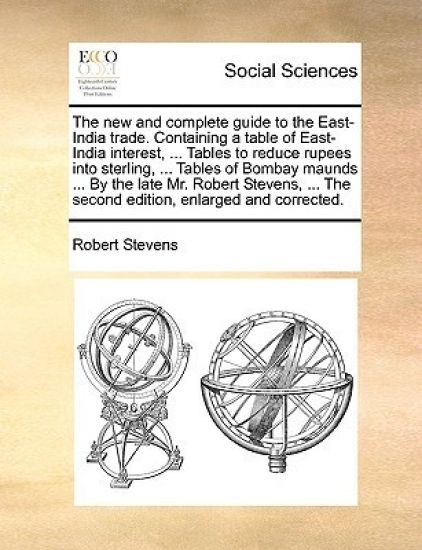
The 18th century was a wealth of knowledge, exploration and rapidly growing technology and expanding record-keeping made possible by advances in the printing press. In its determination to preserve the century of revolution, Gale initiated a revolution of its own: digitization of epic proportions to preserve these invaluable works in the largest archive of its kind. Now for the first time these high-quality digital copies of original 18th century manuscripts are available in print, making them highly accessible to libraries, undergraduate students, and independent scholars.Delve into what it was like to live during the eighteenth century by reading the first-hand accounts of everyday people, including city dwellers and farmers, businessmen and bankers, artisans and merchants, artists and their patrons, politicians and their constituents. Original texts make the American, French, and Industrial revolutions vividly contemporary.++++The below data was compiled from various identification fields in the bibliographic record of this title. This data is provided as an additional tool in helping to insure edition identification: ++++British LibraryT128969London: printed for the author, and sold by S. Bladon; D. Steel; and by Mr. Gregory, mathematical instrument maker, 1766. viii,157, 1]p.: ill.; 2
The 18th century was a wealth of knowledge, exploration and rapidly growing technology and expanding record-keeping made possible by advances in the printing press. In its determination to preserve the century of revolution, Gale initiated a revolution of its own: digitization of epic proportions to preserve these invaluable works in the largest archive of its kind. Now for the first time these high-quality digital copies of original 18th century manuscripts are available in print, making them highly accessible to libraries, undergraduate students, and independent scholars.Delve into what it was like to live during the eighteenth century by reading the first-hand accounts of everyday people, including city dwellers and farmers, businessmen and bankers, artisans and merchants, artists and their patrons, politicians and their constituents. Original texts make the American, French, and Industrial revolutions vividly contemporary.++++The below data was compiled from various identification fields in the bibliographic record of this title. This data is provided as an additional tool in helping to insure edition identification: ++++British LibraryT147396With a final advertisement leaf.London: printed for D. Steel; S. Bladon; and S. Hooper, 1775. vii, 1],142, 2]p.: ill.; 4
Biology has much to tell us about how we should live. Modern Biology reveals that all living beings are organised for a purpose. All living beings, in common with human artifacts, are good for something - that is they are valuable. Since all living beings are equally organised for a purpose they are equally valuable. To say that a being is valuable is to say that we should do no harm to it without justification. The only justification for doing harm to a living being is that it is necessary to our own flourishing or the flourishing of someone or something we care about. Human flourishing does not consist in getting what we want but getting what we need for good health - both mental and physical. Part of good mental health is having a sense of connection with all living beings. Morality and ethics are distinct. Morality is focussed on our obligations to human beings as members of a society. Ethics is concerned with how we should respond to all living beings including humans.
Reference service remains a core function of modern libraries. However, how and where we provide assistance has evolved with changing technologies and the shifting habits and preferences of our users. One way libraries can provide the on-demand, in-person assistance while managing and developing new services and resources that will benefit current and future users is to reconsider how their reference points and services are staffed and adopt a staff-based reference model. The authors, staff members at Eastern Michigan University, chose to address this by implementing an inclusive reference model in which staff and student assistants are trained to answer certain levels of reference questions while working at the reference desk and at other service points. The result was that librarians became more available to work with students who needed in-depth assistance and users were able to get simple questions answered throughout the library. Similar training for all staff and student assistants who work in the library results in better service, more accurate answers, and improved interdepartmental communication. In Implementing an Inclusive Staffing Model for Today's Reference Services, they describe step-by-step how to transition from the traditional librarian-staffed reference desk to an inclusive reference model where non-MLS personnel are equipped and empowered to answer reference questions wherever these questions might be asked. Users ask questions of staff at all service points, not just at the Reference Desk. It is vitally important that those who work at circulation, periodicals, maps, archives and other public service points be trained in how to answer certain reference questions. When this is accomplished, users who have simple questions will not have to make useless treks to the Reference Desk. Topics covered include: ·Recognizing that nearly all staff answer reference questions, but few are trained to do so ·documenting the necessity for a change in reference model ·gaining buy-in from all interested parties—librarians, non-MLS staff, and administrators ·determining the optimal staffing level ·creating training materials and schedules ·monitoring the quality of reference service ·supervising staff ·evaluating the new model using multiple methods Additionally, each chapter contains practical resources such as checklists, forms, and sample materials, and other usable features to support readers as they implement the inclusive reference model. The book describes in detail the process of transforming traditional reference into a model that transcends departmental and job title boundaries, is focused on the user, and allows librarians to better utilize their time and talents, and include non-professional staff in their reference services.
The book titled ""The New Economics And World Peace: Pacifism And Economics, Series 6, No. 1, November, 1944"" is written by Robert Stevens. It is a comprehensive guide that explores the relationship between economics and world peace. The book is part of a series and is the sixth installment. It was published in November 1944.The author argues that pacifism and economics are closely linked, and that a new economic system is needed to achieve world peace. The book offers a detailed analysis of the existing economic system and highlights its flaws. It also proposes a new economic model that is based on cooperation, social justice, and sustainability.The book is divided into several chapters, each dealing with a specific topic. The first chapter provides an overview of the existing economic system and its impact on world peace. The second chapter discusses the role of pacifism in achieving world peace. The third chapter proposes a new economic model based on cooperation and social justice. The fourth chapter discusses the importance of sustainability in the new economic model.The book is well-researched and provides a detailed analysis of the subject matter. It is written in a clear and concise manner, making it easy to understand for both experts and non-experts. The author's arguments are well-supported by evidence and examples, making the book a valuable resource for anyone interested in economics and world peace.Overall, ""The New Economics And World Peace: Pacifism And Economics, Series 6, No. 1, November, 1944"" is an insightful and thought-provoking book that offers a new perspective on the relationship between economics and world peace. It is a must-read for anyone interested in these topics.This scarce antiquarian book is a facsimile reprint of the old original and may contain some imperfections such as library marks and notations. Because we believe this work is culturally important, we have made it available as part of our commitment for protecting, preserving, and promoting the world's literature in affordable, high quality, modern editions, that are true to their original work.
The law of torts is concerned with the secondary obligations generated by the infringement of primary rights. This work seeks to show that this apparently simple proposition enables us to understand the law of torts as found in the common law. Using primarily English materials, but drawing heavily upon the law of other common law jurisdictions, Stevens seeks to give an account of the law of torts which relies upon the core material familiar to most students and practitioners with a grasp of the law of torts. This material is drawn together in support of a single argument in a provocative and accessible style, and puts forward a new theoretical model for analysing the law of torts, providing an overarching framework for radically reconceiving the subject.
The law of torts is concerned with the secondary obligations generated by the infringement of primary rights. This work seeks to show that this apparently simple proposition enables us to understand the law of torts as found in the common law. Using primarily English materials, but drawing heavily upon the law of other common law jurisdictions, Stevens seeks to give an account of the law of torts which relies upon the core material familiar to most students and practitioners with a grasp of the law of torts. This material is drawn together in support of a single argument in a provocative and accessible style, and puts forward a new theoretical model for analysing the law of torts, providing an overarching framework for radically reconceiving the subject.
In this new book Robert Stevens looks at the English Judiciary from an historical perspective with especial reference to its changing role in the 20th Century. He examines current debates about the position of the judges in the light of the possible future role of the judiciary in the Constitution. The centrepiece of the book is a detailed study of the political influences on the judiciary and the influence the judiciary has had on politics in the 20th Century. It concludes with a series of proposed reforms to ensure that the English judiciary will both maintain its strength but enhance its utility in the 21st Century. It offers no simple-minded argument for separation of powers but analyses what is needed to clarify the balance of powers and to advance the debate about the role of an unelected judiciary in an increasingly democratic society.
This is the paperback edition of Robert Stevens' popular and widely reviewed book concerned with the independence of the judiciary in England. Using records kept by the Lord Chancellor's office Robert Stevens charts the progress of the concept of judicial independence through the Victorian era and the early twentieth century up to 1963, the most recent year for which records were available to the author. In reading the book we are reminded that of all our great institutions the judiciary has been subject, in modern times, to perhaps the least scrutiny and reform. Robert Stevens' scholarly and entertaining book explains, with the help of many valuable jurisprudential and social insights why this is so, and in the process offers the reader an unusual and very candid picture of the careers and lives of many of England's best known judges and politicians.