Kirjojen hintavertailu. Mukana 12 390 323 kirjaa ja 12 kauppaa.

Kirjailija

Robert Sugden

Kirjat ja teokset yhdessä paikassa: 6 kirjaa, julkaisuja vuosilta 1978-2020, suosituimpien joukossa The Theory of Choice. Vertaile teosten hintoja ja tarkista saatavuus suomalaisista kirjakaupoista.

6 kirjaa

Kirjojen julkaisuhaarukka 1978-2020.

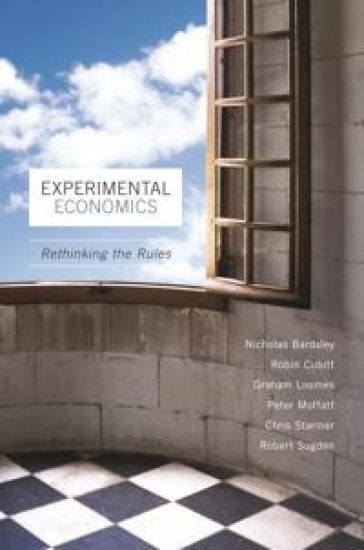
Experimental Economics

Experimental Economics

Nicholas Bardsley; Robin Cubitt; Graham Loomes; Peter Moffatt; Chris Starmer; Robert Sugden

Princeton University Press
2020
pokkari
Since the 1980s, there has been explosive growth in the use of experimental methods in economics, leading to exciting developments in economic theory and policy. Despite this, the status of experimental economics remains controversial. In Experimental Economics, the authors draw on their experience and expertise in experimental economics, economic theory, the methodology of economics, philosophy of science, and the econometrics of experimental data to offer a balanced and integrated look at the nature and reliability of claims based on experimental research. The authors explore the history of experiments in economics, provide examples of different types of experiments, and show that the growing use of experimental methods is transforming economics into a genuinely empirical science. They explain that progress is being held back by an uncritical acceptance of folk wisdom regarding how experiments should be conducted, a failure to acknowledge that different objectives call for different approaches to experimental design, and a misplaced assumption that principles of good practice in theoretical modeling can be transferred directly to experimental design. Experimental Economics debates how such limitations might be overcome, and will interest practicing experimental economists, nonexperimental economists wanting to interpret experimental research, and philosophers of science concerned with the status of knowledge claims in economics.
The Community of Advantage

The Community of Advantage

Robert Sugden

Oxford University Press
2018
sidottu
The Community of Advantage asks how economists should do normative analysis. Normative analysis in economics has usually aimed at satisfying individuals' preferences. Its conclusions have supported a long- standing liberal tradition of economics that values economic freedom and views markets favourably. However, behavioural research shows that individuals' preferences, as revealed in choices, are often unstable, and vary according to contextual factors that seem irrelevant for welfare. Robert Sugden proposes a reformulation of normative economics that is compatible with what is now known about the psychology of choice. The growing consensus in favour of paternalism and 'nudging' is based on a very different way of reconciling normative economics with behavioural findings. This is to assume that people have well-defined 'latent' preferences which, because of psychologically-induced errors, are not always revealed in actual choices. The economist's job is then to reconstruct latent preferences and to design policies to satisfy them. Challenging this consensus, The Community of Advantage argues that latent preference and error are psychologically ungrounded concepts, and that economics needs to be more radical in giving up rationality assumptions. Sugden advocates a kind of normative economics that does not use the concept of preference. Its recommendations are addressed, not to an imagined 'social planner', but to citizens, viewed as potential parties to mutually beneficial agreements. Its normative criterion is the provision of opportunities for individuals to participate in voluntary transactions. Using this approach, Sugden reconstructs many of the normative conclusions of the liberal tradition. He argues that a well-functioning market economy is an institution that individuals have reason to value, whether or not their preferences satisfy conventional axioms of rationality, and that individuals' motivations in such an economy can be cooperative rather than self-interested.
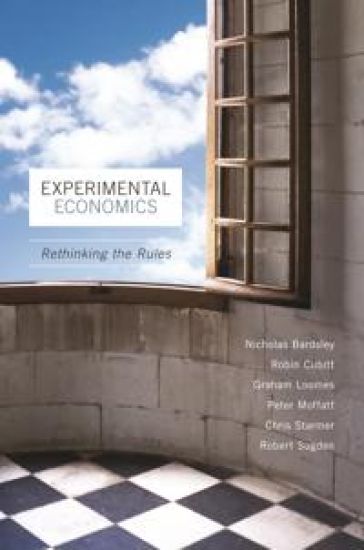
Experimental Economics

Experimental Economics

Nicholas Bardsley; Robin Cubitt; Graham Loomes; Peter Moffatt; Chris Starmer; Robert Sugden

Princeton University Press
2009
sidottu
Since the 1980s, there has been explosive growth in the use of experimental methods in economics, leading to exciting developments in economic theory and policy. Despite this, the status of experimental economics remains controversial. In Experimental Economics, the authors draw on their experience and expertise in experimental economics, economic theory, the methodology of economics, philosophy of science, and the econometrics of experimental data to offer a balanced and integrated look at the nature and reliability of claims based on experimental research. The authors explore the history of experiments in economics, provide examples of different types of experiments, and show that the growing use of experimental methods is transforming economics into a genuinely empirical science. They explain that progress is being held back by an uncritical acceptance of folk wisdom regarding how experiments should be conducted, a failure to acknowledge that different objectives call for different approaches to experimental design, and a misplaced assumption that principles of good practice in theoretical modeling can be transferred directly to experimental design. Experimental Economics debates how such limitations might be overcome, and will interest practicing experimental economists, nonexperimental economists wanting to interpret experimental research, and philosophers of science concerned with the status of knowledge claims in economics.
Transnationals and Governments

Transnationals and Governments

David Bailey; George Harte; Robert Sugden

Routledge
1994
sidottu
The potential ease with which transnational corporations can relocate their activities gives them great leverage over individual governments. The authors outline the various policies that the world's major economies have adopted to cope with the unique issues created by transnationals. They reveal that there has been a marked contrast in the level of concern about transnationals' activities across the countries studied, and that this has resulted in significantly different approaches towards transnationals.
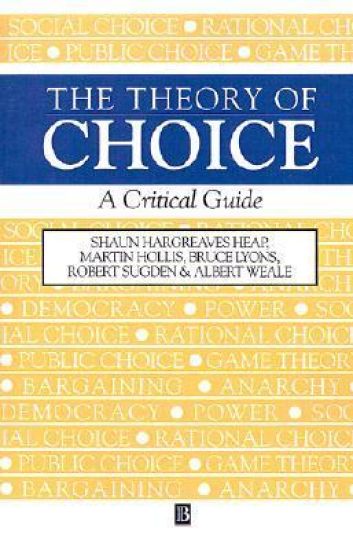
The Theory of Choice

The Theory of Choice

Shaun Heap; Bruce Lyons; Martin Hollis; Robert Sugden; Albert Weale

Blackwell Publishers
1992
nidottu
The book is in three parts with a section of keywords. Part I covers individual choice , Part II examines interactive choice . The final part covers interactive choice .