Kirjojen hintavertailu. Mukana 12 595 353 kirjaa ja 12 kauppaa.
Kirjailija
Robert W. Proctor
Kirjat ja teokset yhdessä paikassa: 13 kirjaa, julkaisuja vuosilta 1990-2023, suosituimpien joukossa Attention. Vertaile teosten hintoja ja tarkista saatavuus suomalaisista kirjakaupoista.
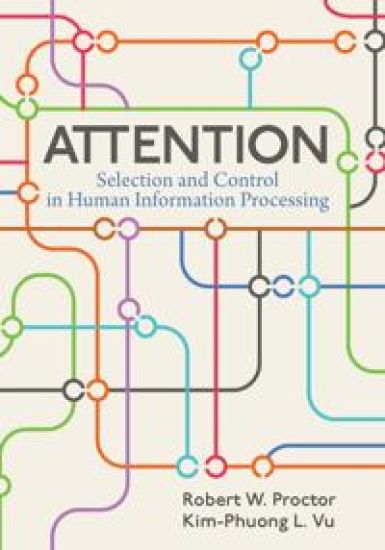
This text presents a comprehensive and accessible overview of the science of attention, conveying its central findings and applications to real-world issues, including its relationship with technology, learning, and memory. The study of attention is a core area of psychology that is particularly relevant today, given the ever-increasing demands on our mental workload. This book conveys the essential issues in attention research, showing how theory and research co-evolve. The authors use an interdisciplinary information-processing framework that draws from cognitive psychology and neuroscience. Each chapter reviews a specific type of attention and related cognitive processes, including auditory and visual selective attention, attentional control and inhibition, divided attention and multitasking, sensory and working memory, and memory consolidation and information retrieval. Feature boxes help readers translate key research findings into real-world applications. A special focus is the relationship between attention and modern technology, for example in processing multisensory input in virtual and online environments, and in situations such as air traffic control, piloting, and driving, where situation awareness is crucial. Various pathologies that affect attention are also reviewed, including ADHD, autism-spectrum disorders, dementia, and head injuries.
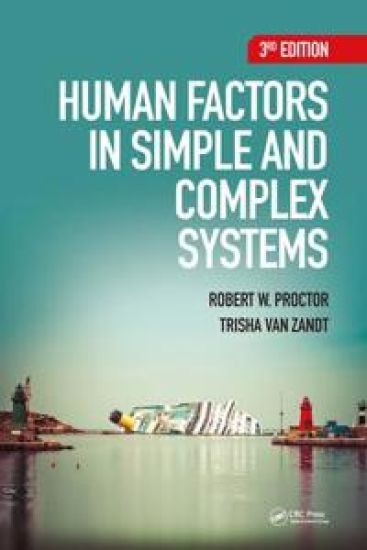
Recently, there have been a number of advances in technology, including in mobile devices, globalization of companies, display technologies and healthcare, all of which require significant input and evaluation from human factors specialists. Accordingly, this textbook has been completely updated, with some chapters folded into other chapters and new chapters added where needed. The text continues to fill the need for a textbook that bridges the gap between the conceptual and empirical foundations of the field.
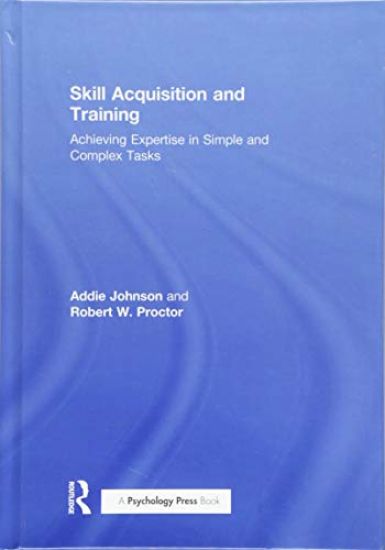
Skill Acquisition and Training describes the building blocks of cognitive, motor, and teamwork skills, and the factors to take into account in training them. The basic processes of perception, cognition and action that provide the foundation for understanding skilled performance are discussed in the context of complex task requirements, individual differences, and extreme environmental demands. The role of attention in perceiving, selecting, and becoming aware of information, in learning new information, and in performance is described in the context of specific skills.A theme throughout this book is that much learning is implicit; the types of knowledge and relations that can profitably be learned implicitly and the conditions under which this learning benefits performance are discussed. The question of whether skill acquisition in cognitive domains shares underlying mechanisms with the acquisition of perceptual and motor skills is also addressed with a view to identifying commonalities that allow for widely applicable, general theories of skill acquisition. Because the complexity of real-world environments puts demands on the individual to adapt to new circumstances, the question of how skills research can be applied to organizational training contexts is an important one. To address this, this book dedicates much content to practical applications, covering such issues as how training needs can be captured with task and job analyses and how to maximize training transfer by taking trainee self-efficacy and goal orientation into account.This comprehensive yet readable textbook is optimized for students of cognitive psychology looking to understand the intricacies of skill acquisition.
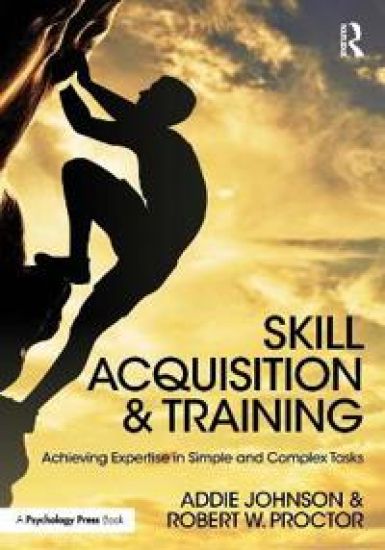
Skill Acquisition and Training describes the building blocks of cognitive, motor, and teamwork skills, and the factors to take into account in training them. The basic processes of perception, cognition and action that provide the foundation for understanding skilled performance are discussed in the context of complex task requirements, individual differences, and extreme environmental demands. The role of attention in perceiving, selecting, and becoming aware of information, in learning new information, and in performance is described in the context of specific skills.A theme throughout this book is that much learning is implicit; the types of knowledge and relations that can profitably be learned implicitly and the conditions under which this learning benefits performance are discussed. The question of whether skill acquisition in cognitive domains shares underlying mechanisms with the acquisition of perceptual and motor skills is also addressed with a view to identifying commonalities that allow for widely applicable, general theories of skill acquisition. Because the complexity of real-world environments puts demands on the individual to adapt to new circumstances, the question of how skills research can be applied to organizational training contexts is an important one. To address this, this book dedicates much content to practical applications, covering such issues as how training needs can be captured with task and job analyses and how to maximize training transfer by taking trainee self-efficacy and goal orientation into account.This comprehensive yet readable textbook is optimized for students of cognitive psychology looking to understand the intricacies of skill acquisition.
Psychology is of interest to academics from many fields, as well as to the thousands of academic and clinical psychologists and general public who can't help but be interested in learning more about why humans think and behave as they do. This award-winning twelve-volume reference covers every aspect of the ever-fascinating discipline of psychology and represents the most current knowledge in the field. This ten-year revision now covers discoveries based in neuroscience, clinical psychology's new interest in evidence-based practice and mindfulness, and new findings in social, developmental, and forensic psychology.
The study of science, sometimes referred to as metascience, is a new and growing field that includes the philosophy of science, history of science, sociology of science, and anthropology of science. In the last ten years, the formal study of the psychology of science has also emerged. The psychology of science focuses on the individual scientist, influenced by intelligence, motivation, personality, and the development of scientific interest, thought, ability, and achievement over a lifespan. Science can be defined as explicitly and systematically testing hypotheses. Defined more broadly, science includes wider processes, such as theory construction and the hypothesis testing seen in children and "non-scientific" adults. Most prior work in the study of science has emphasized the role of explicit reasoning; however, contemporary research in psychology emphasizes the importance of implicit processes in decision-making and choice and assumes that the performance of many tasks involves a complex relationship between implicit and explicit processes. Psychology of Science brings together contributions from leaders in the emerging discipline of the psychology of science with other experts on the roles of implicit and explicit processes in thinking. Highlighting the role of implicit processes in the creation of scientific knowledge, this volume links the psychology of science to many strands of psychology , including cognitive, social, and developmental psychology, as well as neuroscience. Ultimately, this volume raises awareness of the psychology of science among psychologists, philosophers, and sociologists of science, and anyone interested in the metasciences.
Why Science Matters: Understanding the Methods of Psychological Research rises above standard research methods texts by presenting an up-to-date view of contemporary psychological science as it is currently understood and practiced. Explores not only the procedural aspects of psychological research, but also delves into the issue of how to accomplish effective science. Explicates how hypotheses and theories are to be evaluated. Suggests that the proper approach to devising and evaluating theories is by abduction, not by induction or deduction alone. Incorporates new investigatory procedures, current methodologists, conflicts and issues, implications of the philosophy of science, and a lively prose style. Provides a picture of science that will engage students and expand their abilities as both scientists and psychologists.
Why Science Matters: Understanding the Methods of Psychological Research rises above standard research methods texts by presenting an up-to-date view of contemporary psychological science as it is currently understood and practiced. Explores not only the procedural aspects of psychological research, but also delves into the issue of how to accomplish effective science. Explicates how hypotheses and theories are to be evaluated. Suggests that the proper approach to devising and evaluating theories is by abduction, not by induction or deduction alone. Incorporates new investigatory procedures, current methodologists, conflicts and issues, implications of the philosophy of science, and a lively prose style. Provides a picture of science that will engage students and expand their abilities as both scientists and psychologists.
"The book is well-organized and comprehensive in covering the essential material. The inclusion of human factors material is a strength that is not covered in other books. . . . The book is a balanced survey which will be of value to graduate students or anyone wanting to enter the field and needing a broad overview." --Steven Yantis, The Johns Hopkins University "My overall impression is that the authors have combined their expertise and experience in the classroom to provide a text that will clearly cover attention more completely and in a more coherent and less confusing manner than any other available text. . . . this is the best available text on the psychology of attention at the advanced undergraduate level." --Mark Faust, University of South Alabama "This text represents a strong review of the empirical and theoretical developments in attention work." --Tom Busey, Indiana University "A nice overview of the 'classic' work on attention, with up-to-date consideration of the literature, usefully bringing together some more applied literatures in which attention is a central construct…The scholarship seems comprehensive and up-to-date, and the authors do a nice job of presenting research in a fair and neutral manner." --Richard Carlson, Pennsylvania State University "The chapters present the material at a level appropriate for a first course on attention. The focus on providing a comprehensive treatment of the highlights of a variety of different topics related to attention is a strength." --Art Kramer, University of Illinois Attention is one of the fastest growing research areas in cognitive psychology. In light of the growing importance of this topic, there are surprisingly few texts that provide a coherent overview of the field of attention. Authors Addie Johnson and Robert W. Proctor have written Attention: Theory and Practice for students, researchers, and practitioners who wish to gain insight into this area in a comprehensible and consistent manner. Attention: Theory and Practice provides a balance between a readable overview of attention and an emphasis on how theories and paradigms for the study of attention have developed. The book highlights the important issues and major findings while giving sufficient details of experimental studies, models, and theories so that results and conclusions are easy to follow and evaluate. Rather than brushing over tricky technical details, the authors explain them clearly, giving readers the benefit of understanding the motivation for and techniques of the experiments in order to allow readers to think through results, models, and theories for themselves. Features and benefits of this text: Balanced. The book gives equal coverage to theory, experimental paradigms and results, neuropsychology, and applications. Adaptable. "Technical Boxes" isolate technical procedures and difficult models, which can be omitted without interrupting the flow of the chapters, allowing instructors to adjust the material to the level of their course. Pedagogical. The book includes brief chapter previews, chapter summaries, highlighted key words, an end-of-book glossary, and an abundance of figures and tables that enhance student understanding. Attention is an accessible text for advanced undergraduate and graduate students in psychology, as well as an important resource for researchers and practitioners interested in gaining an overview of the field of attention.
"The book is well-organized and comprehensive in covering the essential material. The inclusion of human factors material is a strength that is not covered in other books. . . . The book is a balanced survey which will be of value to graduate students or anyone wanting to enter the field and needing a broad overview." --Steven Yantis, The Johns Hopkins University "My overall impression is that the authors have combined their expertise and experience in the classroom to provide a text that will clearly cover attention more completely and in a more coherent and less confusing manner than any other available text. . . . this is the best available text on the psychology of attention at the advanced undergraduate level." --Mark Faust, University of South Alabama "This text represents a strong review of the empirical and theoretical developments in attention work." --Tom Busey, Indiana University "A nice overview of the 'classic' work on attention, with up-to-date consideration of the literature, usefully bringing together some more applied literatures in which attention is a central construct…The scholarship seems comprehensive and up-to-date, and the authors do a nice job of presenting research in a fair and neutral manner." --Richard Carlson, Pennsylvania State University "The chapters present the material at a level appropriate for a first course on attention. The focus on providing a comprehensive treatment of the highlights of a variety of different topics related to attention is a strength." --Art Kramer, University of Illinois Attention is one of the fastest growing research areas in cognitive psychology. In light of the growing importance of this topic, there are surprisingly few texts that provide a coherent overview of the field of attention. Authors Addie Johnson and Robert W. Proctor have written Attention: Theory and Practice for students, researchers, and practitioners who wish to gain insight into this area in a comprehensible and consistent manner. Attention: Theory and Practice provides a balance between a readable overview of attention and an emphasis on how theories and paradigms for the study of attention have developed. The book highlights the important issues and major findings while giving sufficient details of experimental studies, models, and theories so that results and conclusions are easy to follow and evaluate. Rather than brushing over tricky technical details, the authors explain them clearly, giving readers the benefit of understanding the motivation for and techniques of the experiments in order to allow readers to think through results, models, and theories for themselves. Features and benefits of this text: Balanced. The book gives equal coverage to theory, experimental paradigms and results, neuropsychology, and applications. Adaptable. "Technical Boxes" isolate technical procedures and difficult models, which can be omitted without interrupting the flow of the chapters, allowing instructors to adjust the material to the level of their course. Pedagogical. The book includes brief chapter previews, chapter summaries, highlighted key words, an end-of-book glossary, and an abundance of figures and tables that enhance student understanding. Attention is an accessible text for advanced undergraduate and graduate students in psychology, as well as an important resource for researchers and practitioners interested in gaining an overview of the field of attention.
"Contextualism, in my view, will be the major theoretical issue in psychology (as well as in the social sciences generally) in the first quarter of the next century. The authors have written the best general account of the issues at stake, and it is my guess that this will be the most important and perhaps the best-selling item in your list for some years. I say this even though I am one of those dreadful contextualist excoriated by the authors." --James E. Deese, University of Virginia "I admit I was a bit reluctant to tackle this one having looked at a lot of the subject in two tries at a Philosophy of Psychology course. I was pleased way beyond my expectations, and I am thoroughly envious of what 'they' have done. It is a wonderful book and should be on the 'must read' list of all psychologists, especially those new to or just entering psychology." --David C. Edwards, Iowa State University "It is written in a remarkably lucid and articulate manner, particularly considering the abstract, erudite, indeed even esoteric and abstruse topic to which it is addressed." --Michael Wertheimer, University of Colorado, Boulder "This book will give you the grounds for comparing and evaluating the claims of the several alternative 'postmodern' psychologies that have appeared in recent years. It will show you their varieties, their grounds for disagreement with mainstream psychology, and the adequacy of their claims and complaints. Along the way it will instruct you in some modern perspectives on what makes up an adequate philosophy of science." --David C. Edwards, Iowa State University Contextualism is a major growing movement that sees itself in opposition to the currently dominant approach in psychology, which it characterizes as mechanism. Contextualism is a variety of pragmatism that endorses radical empiricism and is closely related to a variety of other relativistic movements, such as social constructionism. This book identifies two distinct contextualist camps and asks whether either form of contextualism provides a satisfactory basis for the conduct of empirical and theoretical psychology. The two varieties of contextualism are contrasted with the authors' own conception of the philosophy of science, which is freely adopted from Larry Laudan. This conception provides a much more up-to-date and better basis than contextualism for the conduct of research and theory in psychology. The book describes methodological changes in contextualism that will have to occur if its impact on psychology is to increase.
"Contextualism, in my view, will be the major theoretical issue in psychology (as well as in the social sciences generally) in the first quarter of the next century. The authors have written the best general account of the issues at stake, and it is my guess that this will be the most important and perhaps the best-selling item in your list for some years. I say this even though I am one of those dreadful contextualist excoriated by the authors." --James E. Deese, University of Virginia "I admit I was a bit reluctant to tackle this one having looked at a lot of the subject in two tries at a Philosophy of Psychology course. I was pleased way beyond my expectations, and I am thoroughly envious of what 'they' have done. It is a wonderful book and should be on the 'must read' list of all psychologists, especially those new to or just entering psychology." --David C. Edwards, Iowa State University "It is written in a remarkably lucid and articulate manner, particularly considering the abstract, erudite, indeed even esoteric and abstruse topic to which it is addressed." --Michael Wertheimer, University of Colorado, Boulder "This book will give you the grounds for comparing and evaluating the claims of the several alternative 'postmodern' psychologies that have appeared in recent years. It will show you their varieties, their grounds for disagreement with mainstream psychology, and the adequacy of their claims and complaints. Along the way it will instruct you in some modern perspectives on what makes up an adequate philosophy of science." --David C. Edwards, Iowa State University Contextualism is a major growing movement that sees itself in opposition to the currently dominant approach in psychology, which it characterizes as mechanism. Contextualism is a variety of pragmatism that endorses radical empiricism and is closely related to a variety of other relativistic movements, such as social constructionism. This book identifies two distinct contextualist camps and asks whether either form of contextualism provides a satisfactory basis for the conduct of empirical and theoretical psychology. The two varieties of contextualism are contrasted with the authors' own conception of the philosophy of science, which is freely adopted from Larry Laudan. This conception provides a much more up-to-date and better basis than contextualism for the conduct of research and theory in psychology. The book describes methodological changes in contextualism that will have to occur if its impact on psychology is to increase.
In this new volume in Springer-Verlag's series "Recent Research in Psychology", Drs. Proctor and Weeks examine what has long been a "self-asserted superiority" of behavior analysts and Skinnerian researchers. Most behavior-analytic views derive from the philosophy of radical behaviorism, as conceived by B.F. Skinner, and prescribe a "world view" where environmental contingencies determine all aspects of behavior. This view necessarily assumes all other views to be inferior because of its world view, hence, those subscribing to behavior analysis will tolerate no other theory. The Goal of B.F. Skinner and Behavior Analysis examines closely the rationale behind the Skinnerian philosophy, challenging its validity through the author's own research.