

Kirjailija
Robert Watson
Kirjat ja teokset yhdessä paikassa: 61 kirjaa, julkaisuja vuosilta 1990-2026, suosituimpien joukossa The Single Senior Social Scene. Vertaile teosten hintoja ja tarkista saatavuus suomalaisista kirjakaupoista.
61 kirjaa
Kirjojen julkaisuhaarukka 1990-2026.
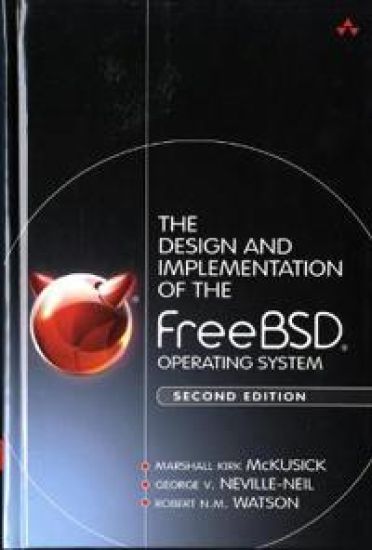
Design and Implementation of the FreeBSD Operating System, The
Marshall McKusick; George Neville-Neil; Robert Watson
Addison-Wesley Educational Publishers Inc
2014
sidottu
The most complete, authoritative technical guide to the FreeBSD kernel’s internal structure has now been extensively updated to cover all major improvements between Versions 5 and 11. Approximately one-third of this edition’s content is completely new, and another one-third has been extensively rewritten. Three long-time FreeBSD project leaders begin with a concise overview of the FreeBSD kernel’s current design and implementation. Next, they cover the FreeBSD kernel from the system-call level down–from the interface to the kernel to the hardware. Explaining key design decisions, they detail the concepts, data structures, and algorithms used in implementing each significant system facility, including process management, security, virtual memory, the I/O system, filesystems, socket IPC, and networking. This Second Edition • Explains highly scalable and lightweight virtualization using FreeBSD jails, and virtual-machine acceleration with Xen and Virtio device paravirtualization • Describes new security features such as Capsicum sandboxing and GELI cryptographic disk protection • Fully covers NFSv4 and Open Solaris ZFS support • Introduces FreeBSD’s enhanced volume management and new journaled soft updates • Explains DTrace’s fine-grained process debugging/profiling • Reflects major improvements to networking, wireless, and USB support Readers can use this guide as both a working reference and an in-depth study of a leading contemporary, portable, open source operating system. Technical and sales support professionals will discover both FreeBSD’s capabilities and its limitations. Applications developers will learn how to effectively and efficiently interface with it; system administrators will learn how to maintain, tune, and configure it; and systems programmers will learn how to extend, enhance, and interface with it. Marshall Kirk McKusick writes, consults, and teaches classes on UNIX- and BSD-related subjects. While at the University of California, Berkeley, he implemented the 4.2BSD fast filesystem. He was research computer scientist at the Berkeley Computer Systems Research Group (CSRG), overseeing development and release of 4.3BSD and 4.4BSD. He is a FreeBSD Foundation board member and a long-time FreeBSD committer. Twice president of the Usenix Association, he is also a member of ACM, IEEE, and AAAS. George V. Neville-Neil hacks, writes, teaches, and consults on security, networking, and operating systems. A FreeBSD Foundation board member, he served on the FreeBSD Core Team for four years. Since 2004, he has written the “Kode Vicious” column for Queue and Communications of the ACM. He is vice chair of ACM’s Practitioner Board and a member of Usenix Association, ACM, IEEE, and AAAS. Robert N.M. Watson is a University Lecturer in systems, security, and architecture in the Security Research Group at the University of Cambridge Computer Laboratory. He supervises advanced research in computer architecture, compilers, program analysis, operating systems, networking, and security. A FreeBSD Foundation board member, he served on the Core Team for ten years and has been a committer for fifteen years. He is a member of Usenix Association and ACM.

A Boy of the Great North West: The Rousing Experiences of a Young Canadian Among Cowboys, Hunters, Trappers, Fur Traders, Fishermen and Indians
Robert Watson
Literary Licensing, LLC
2013
nidottu



Scotland for Ever! and Other Poems.
Robert Watson
British Library, Historical Print Editions
2011
pokkari

Generalist Telephone Counselling and Social Indicators
Robert Watson
LAP Lambert Academic Publishing
2010
pokkari


The History of the Reign of Philip the Third, King of Spain. by Robert Watson, ... Vol. III.
Robert Watson
Gale Ecco, Print Editions
2010
pokkari




The History of the Reign of Phillip the Third
Robert Watson; William Thomson
Kessinger Pub
2009
pokkari


The History Of The Reign Of Philip The Third, King Of Spain (1818)
Robert Watson; William Thomson
KESSINGER PUBLISHING, LLC
2008
nidottu


Selected by Choice magazine as an Outstanding Academic Title Sweeping across scholarly disciplines, Back to Nature shows that, from the moment of their conception, modern ecological and epistemological anxieties were conjoined twins. Urbanization, capitalism, Protestantism, colonialism, revived Skepticism, empirical science, and optical technologies conspired to alienate people from both the earth and reality itself in the seventeenth century. Literary and visual arts explored the resulting cultural wounds, expressing the pain and proposing some ingenious cures. The stakes, Robert N. Watson demonstrates, were huge. Shakespeare's comedies, Marvell's pastoral lyrics, Traherne's visionary Centuries, and Dutch painting all illuminate a fierce submerged debate about what love of nature has to do with perception of reality.
Climate Change Policy
Catrinus J. Jepma; Mohan Munasinghe; Bert Bolin; Robert Watson; James P. Bruce
Cambridge University Press
1997
sidottu
There is increasing scientific evidence to suggest that humans are gradually but certainly changing the Earth's climate. In an effort to prevent further damage to the fragile atmosphere, and with the belief that action is required now, the scientific community has been prolific in its dissemination of information on climate change. Inspired by the results of the Intergovernmental Panel on Climate Change's Second Assessment Report, Jepma and Munasinghe set out to create a concise, practical, and compelling approach to climate change issues. They deftly explain the implications of global warming, and the risks involved in attempting to mitigate climate change. They look at how and where to start action, and what organization is needed to be able to implement the changes. This book represents a much needed synopsis of climate change and its real impacts on society. It will be an essential text for climate change researchers, policy analysts, university students studying the environment, and anyone with an interest in climate change issues.
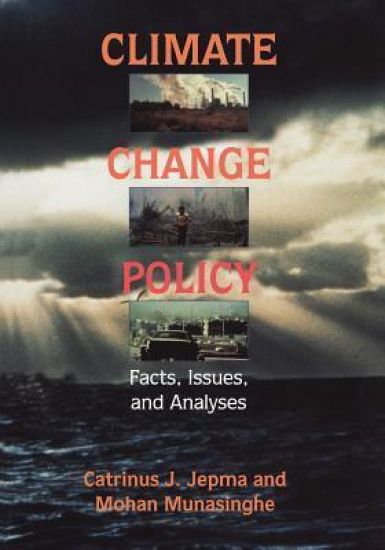
Climate Change Policy
Catrinus J. Jepma; Mohan Munasinghe; Bert Bolin; Robert Watson; James P. Bruce
Cambridge University Press
1997
pokkari
There is increasing scientific evidence to suggest that humans are gradually but certainly changing the Earth's climate. In an effort to prevent further damage to the fragile atmosphere, and with the belief that action is required now, the scientific community has been prolific in its dissemination of information on climate change. Inspired by the results of the Intergovernmental Panel on Climate Change's Second Assessment Report, Jepma and Munasinghe set out to create a concise, practical, and compelling approach to climate change issues. They deftly explain the implications of global warming, and the risks involved in attempting to mitigate climate change. They look at how and where to start action, and what organization is needed to be able to implement the changes. This book represents a much needed synopsis of climate change and its real impacts on society. It will be an essential text for climate change researchers, policy analysts, university students studying the environment, and anyone with an interest in climate change issues.

This unique text focuses upon the inherent difficulties associated with small firm contractual relationships.