Kirjojen hintavertailu. Mukana 12 595 353 kirjaa ja 12 kauppaa.

Kirjailija

Robert Wisbauer

Kirjat ja teokset yhdessä paikassa: 2 kirjaa, julkaisuja vuosilta 1991-2006, suosituimpien joukossa Foundations of Module and Ring Theory. Vertaile teosten hintoja ja tarkista saatavuus suomalaisista kirjakaupoista.

2 kirjaa

Kirjojen julkaisuhaarukka 1991-2006.

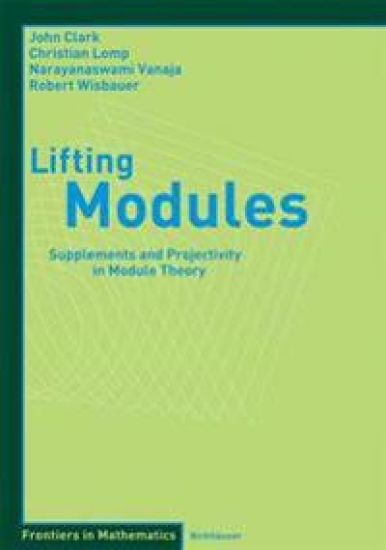
Lifting Modules

Lifting Modules

John Clark; Christian Lomp; N. Vanaja; Robert Wisbauer

Birkhauser Verlag AG
2006
nidottu
Extending modules are generalizations of injective modules and, dually, lifting modules generalize projective supplemented modules. There is a certain asymmetry in this duality. While the theory of extending modules is well documented in monographs and text books, the purpose of our monograph is to provide a thorough study of supplements and projectivity conditions needed to investigate classes of modules related to lifting modules. The text begins with an introduction to small submodules, the radical, variations on projectivity, and hollow dimension. The subsequent chapters consider preradicals and torsion theories (in particular related to small modules), decompositions of modules (including the exchange property and local semi-T-nilpotency), supplements in modules (with specific emphasis on semilocal endomorphism rings), finishing with a long chapter on lifting modules, leading up their use in the theory of perfect rings, Harada rings, andquasi-Frobenius rings. Most of the material in the monograph appears in book form for the first time. The main text is augmented by a plentiful supply of exercises together with comments on further related material and on how the theory has evolved.
Foundations of Module and Ring Theory

Foundations of Module and Ring Theory

Robert Wisbauer

Taylor Francis Ltd
1991
sidottu
This volume provides a comprehensive introduction to module theory and the related part of ring theory, including original results as well as the most recent work. It is a useful and stimulating study for those new to the subject as well as for researchers and serves as a reference volume. Starting form a basic understanding of linear algebra, the theory is presented and accompanied by complete proofs. For a module M, the smallest Grothendieck category containing it is denoted by o[M] and module theory is developed in this category. Developing the techniques in o[M] is no more complicated than in full module categories and the higher generality yields significant advantages: for example, module theory may be developed for rings without units and also for non-associative rings. Numerous exercises are included in this volume to give further insight into the topics covered and to draw attention to related results in the literature.