Kirjojen hintavertailu. Mukana 12 390 323 kirjaa ja 12 kauppaa.

Kirjailija

Robert Wuthnow

Kirjat ja teokset yhdessä paikassa: 56 kirjaa, julkaisuja vuosilta 1989-2026, suosituimpien joukossa The Religious Left. Vertaile teosten hintoja ja tarkista saatavuus suomalaisista kirjakaupoista.

56 kirjaa

Kirjojen julkaisuhaarukka 1989-2026.

Growing Up Religious

Growing Up Religious

Robert Wuthnow

Beacon Press
2000
pokkari
Memories of religious experiences remain in our minds like few other recollections.In GROWING UP RELIGIOUS, Robert Wuthnow follows the lives of ordinary people to see how the past informs the ever-change spiritual life of America.
God And Mammon In America

God And Mammon In America

Robert Wuthnow

The Free Press
1998
pokkari
Drawing on a new survey of more than two thousand working Americans, the author of Christianity in the 21st Century explores the relationship between religious faith and attitudes toward work and money to examine Americans' ambivalence toward materialism and consumerism.
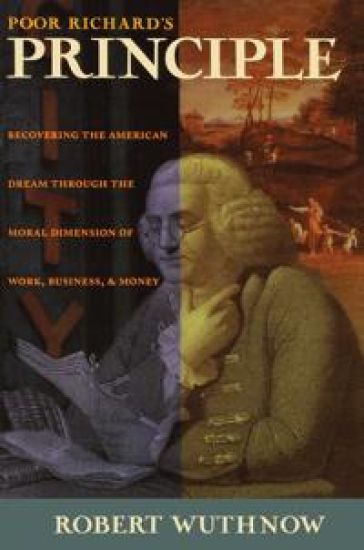
Poor Richard's Principle

Poor Richard's Principle

Robert Wuthnow

Princeton University Press
1998
pokkari
The American Dream is in serious danger, according to Robert Wuthnow--not because of economic conditions, but because its moral underpinnings have been forgotten. In the past this vision was not simply a formula for success, but a moral perspective that framed our thinking about work and money in terms of broader commitments to family, community, and humanitarian values. Nowadays, we are working harder than ever, and yet many of us feel that we are not realizing our higher aspirations as individuals or as a people. Here Wuthnow examines the struggles in which American families are now engaged as they try to balance work and family, confront the pressures of consumerism, and find meaning in their careers. He suggests that we can find economic instruction and inspiration in the nation's past--in such figures as Benjamin Franklin, for instance, who was at once the prudent Poor Richard, the engaged public person, and the enthusiastic lover of life. Drawing on first-hand accounts from scores of people in all walks of life and from a national survey, the book shows that work and money cannot be understood in terms of economic theories alone, but are inevitably rooted in our concepts of ourselves and in the symbolic rituals and taboos of everyday life. By examining these implicit cultural understandings of work and money, the book provides a foundation for bringing moral reasoning more fully to bear on economic decisions. It re-examines the moral arguments that were prominent earlier in our history, shows how these arguments were set aside with the development of economistic thinking, and suggests their continuing relevance in the lives of people who have effectively resisted the pressures of greater financial commitments. Demonstrating that most Americans do bring values implicitly to bear on their economic decisions, the book shows how some people are learning to do this more effectively and, in the process, gain greater control over their work and finances. At a time when policymakers are raising questions about the very survival of the American dream, Poor Richard's Principle offers an analysis of how moral restraint can once again play a more prominent role in guiding our thinking.
The Crisis in the Churches

The Crisis in the Churches

Robert Wuthnow

Oxford University Press Inc
1997
sidottu
A thought-provoking study of the financial and spiritual crises confronting American churches examines the failure of the clergy to address the link between faith and money, work, giving, and economic justice and argues that churches must minister to the concerns of their middle-class parishioners. UP.
Christianity and Civil Society

Christianity and Civil Society

Robert Wuthnow

Trinity Press International
1996
sidottu
Questions about civil society have been reopened in recent years with increasing urgency. How can we preserve and protect democracy? Is it possible to bring a moral dimension back into public life? How strong or weak do we want government to be? What can motivate us to be better, more responsibly engaged citizens?In this book, well-known author Robert Wuthnow presents an engaging and provocative exploration of the role of Christianity in civil society which, he says, "applies to other U.S. religions as will."Professor Wuthnow considers three aspects of the relationship between Christianity and civil society: (1) whether civil society is in jeopardy and what effects the declining influence of Christianity has on civil society; (2) whether Christians can be civil, including an examination of the conflicts that have arisen among religious groups in the public arena and the so-called culture wars that many in the media have been discussing; and (3) the growing multiculturalism in the United States, how Christian groups are responding to the new diversity, and how Christianity can regain a critical voice for itself in these debates.Robert Wuthnow is the Gerhard R. Andlinger Professor of Social Sciences and Director of the Center for the Study of American Religion at Princeton University. He is the author of fifteen books, including Learning to Care: Elementary Kindness in an Age of Indifference and God Mammon in America.
Sharing the Journey

Sharing the Journey

Robert Wuthnow

The Free Press
1996
pokkari
A look at how support groups have affected American society argues that, although support groups provide a warmth and security that holds society together, they can lead to an unhealthy self-absorption and a trivialized sense of what is sacred.
Learning to Care

Learning to Care

Robert Wuthnow

Oxford University Press Inc
1996
sidottu
Drawing on the testimony of youths involved in community service, the author shows why certain youths volunteer, what problems and pressures they face, and how parents and teachers can instill the virtue of charity in their children. UP.
Rethinking Materialism

Rethinking Materialism

Robert Wuthnow

William B Eerdmans Publishing Co
1995
pokkari
This collection of essays by ten of the nation's prominent social scientists and theologians offers serious commentary on our culture's obsession with material goods and examines the uneasy relation of materialism to religion. The contributors assess the ways in which materialism has been understood in recent analyses of American character, how the economy shapes our understandings of ourselves, the ways in which religious thought is being reshaped by economic circumstances, and the nature of consumerism. The complement to Wuthnow's God and Mammon in America, this volume challenges us all to look at materialism in new ways and suggests viable means for reversing our country's prevailing material fixation and its destructive effects on our spiritual lives.
Producing the Sacred

Producing the Sacred

Robert Wuthnow

University of Illinois Press
1994
nidottu
What is Public religion? How does it manifest the sacred? These are the fundamental questions Robert Wuthnow addresses in Producing the Sacred. Wuthnow uses as a guiding assumption the idea that cultural expressions, religious or otherwise, do not simply happen but are produced. He considers the major kinds of organizations that produce public religion--congregations, hierarchies, special interests, academies, and public rituals--showing how these organizational vehicles shape public religion's messages and how specific types of religious organization draw resources from their environments. He also reveals the implicit and unintended ways in which sacredness is expressed in modern society. A volume in the series Public Expressions of Religion in America
Acts of Compassion

Acts of Compassion

Robert Wuthnow

Princeton University Press
1993
pokkari
Robert Wuthnow finds that those who are most involved in acts of compassion are no less individualistic than anyone else--and that those who are the most intensely individualistic are no less involved in caring for others.
Communities of Discourse

Communities of Discourse

Robert Wuthnow

Harvard University Press
1993
nidottu
Sociologist Robert Wuthnow notes remarkable similarities in the social conditions surrounding three of the greatest challenges to the status quo in the development of modern society—the Protestant Reformation, the Enlightenment, and the rise of Marxist socialism.
Rediscovering the Sacred

Rediscovering the Sacred

Robert Wuthnow

William B Eerdmans Publishing Co
1992
pokkari
Claiming that the realm of the sacred in modern societies is characterized more by rediscovery than by revival, Wuthnow examines the main theoretical approaches toward religion that have emerged of late in the social sciences and shows how these approaches can help explain the shifting location of the sacred.
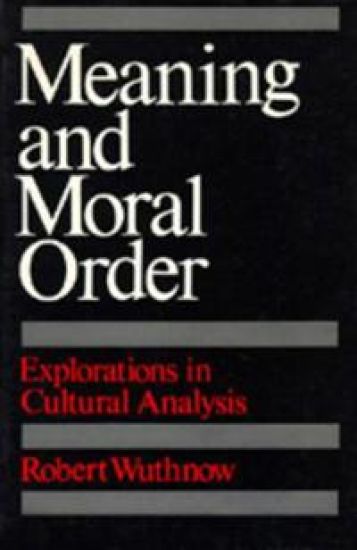
Meaning and Moral Order

Meaning and Moral Order

Robert Wuthnow

University of California Press
1989
pokkari
"Meaning and Moral Order" goes beyond classical, neoclassical, and poststructural theories of culture in its attempt to move away from problems of meaning to a more objective concept of culture. Innovative, controversial, challenging, it will compel scholars to rethink many of the assumptions on which the study of ideology, ritual, religion, science, and culture have been based.