Kirjojen hintavertailu. Mukana 12 290 406 kirjaa ja 12 kauppaa.

Kirjailija

Robert Y. Shapiro

Kirjat ja teokset yhdessä paikassa: 5 kirjaa, julkaisuja vuosilta 1992-2011, suosituimpien joukossa Politicians Don't Pander. Vertaile teosten hintoja ja tarkista saatavuus suomalaisista kirjakaupoista.

5 kirjaa

Kirjojen julkaisuhaarukka 1992-2011.

Selling Fear

Selling Fear

Brigitte L. Nacos; Yaeli Bloch-Elkon; Robert Y. Shapiro

University of Chicago Press
2011
nidottu
While we've long known that the strategies of terrorism rely heavily on media coverage of attacks, "Selling Fear" is the first detailed look at the role played by media in counterterrorism - and the ways that, in the wake of 9/11, the Bush administration manipulated coverage to maintain a climate of fear. Drawing on in-depth analysis of counterterrorism in the years after 9/11 - including the issuance of terror alerts and the decision to invade Iraq - the authors present a compelling case that the Bush administration hyped fear, while obscuring civil liberties abuses and concrete issues of preparedness. The media, meanwhile, largely abdicated its watchdog role, choosing to amplify the administration's message while downplaying issues that might have called the administration's statements and strategies into question. The book extends through Hurricane Katrina, and the more skeptical coverage that followed, then the first year of the Obama administration, when an increasingly partisan political environment presented the media, and the public, with new problems of reporting and interpretation. "Selling Fear" is a hard-hitting analysis of the intertwined failures of government and media - and their costs to our nation.

Selling Fear

Selling Fear

Brigitte L. Nacos; Yaeli Bloch-Elkon; Robert Y. Shapiro

University of Chicago Press
2011
sidottu
While we've long known that the strategies of terrorism rely heavily on media coverage of attacks, "Selling Fear" is the first detailed look at the role played by media in counterterrorism - and the ways that, in the wake of 9/11, the Bush administration manipulated coverage to maintain a climate of fear. Drawing on in-depth analysis of counterterrorism in the years after 9/11 - including the issuance of terror alerts and the decision to invade Iraq - the authors present a compelling case that the Bush administration hyped fear, while obscuring civil liberties abuses and concrete issues of preparedness. The media, meanwhile, largely abdicated its watchdog role, choosing to amplify the administration's message while downplaying issues that might have called the administration's statements and strategies into question. The book extends through Hurricane Katrina, and the more skeptical coverage that followed, then the first year of the Obama administration, when an increasingly partisan political environment presented the media, and the public, with new problems of reporting and interpretation. "Selling Fear" is a hard-hitting analysis of the intertwined failures of government and media - and their costs to our nation.

Politicians Don't Pander

Politicians Don't Pander

Lawrence R. Jacobs; Robert Y. Shapiro

University of Chicago Press
2000
nidottu
Public opinion polls are everywhere. Journalists report their results without hesitation, and political activists of all kinds spend millions of dollars on them, fuelling the widespread assumption that elected officials "pander" to public opinion -that they tailor their policy decisions to the results of polls. In this provocative and engagingly written book, the authors argue that the reality is quite the opposite. In fact, when not facing election, contemporary presidents and members of Congress routinely ignore the public's policy preferences and follow their own political philosophies, as well as those of their party's activists, their contributors and their interest group allies. Politicians devote substantial time, effort and money to tracking public opinion, not for the purposes of policymaking, but to change public opinion - to determine how to craft their public statements and actions to win support for the policies they and their supporters want. Taking two recent, dramtic episodes - President Clinton's failed health care reform campaign and Newt Gingrich's "Contract with America" - as examples, the authors show how both used public opinion research and the media to change the public's mind. Such orchestrated displays help explain the media's preoccupation with political conflict strategy and, the authors argue, have propelled levels of public distrust and fear of government to record highs. Revisiting the fundamental premises of representative democracy, this accessible book asks us to reexamine whether our government really responds to the broad public or to the narrower interests and values of certain groups. And with the 2000 campaign season heating up, "Politicians Don't Pander" could not be more timely.
Politicians Don't Pander

Politicians Don't Pander

Lawrence R. Jacobs; Robert Y. Shapiro

University of Chicago Press
2000
sidottu
Public opinion polls are everywhere. Journalists report their results without hesitation, and political activists of all kinds spend millions of dollars on them, fuelling the widespread assumption that elected officials "pander" to public opinion -that they tailor their policy decisions to the results of polls. In this provocative and engagingly written book, the authors argue that the reality is quite the opposite. In fact, when not facing election, contemporary presidents and members of Congress routinely ignore the public's policy preferences and follow their own political philosophies, as well as those of their party's activists, their contributors and their interest group allies. Politicians devote substantial time, effort and money to tracking public opinion, not for the purposes of policymaking, but to change public opinion - to determine how to craft their public statements and actions to win support for the policies they and their supporters want. Taking two recent, dramtic episodes - President Clinton's failed health care reform campaign and Newt Gingrich's "Contract with America" - as examples, the authors show how both used public opinion research and the media to change the public's mind. Such orchestrated displays help explain the media's preoccupation with political conflict strategy and, the authors argue, have propelled levels of public distrust and fear of government to record highs. Revisiting the fundamental premises of representative democracy, this accessible book asks us to reexamine whether our government really responds to the broad public or to the narrower interests and values of certain groups. And with the 2000 campaign season heating up, "Politicians Don't Pander" could not be more timely.
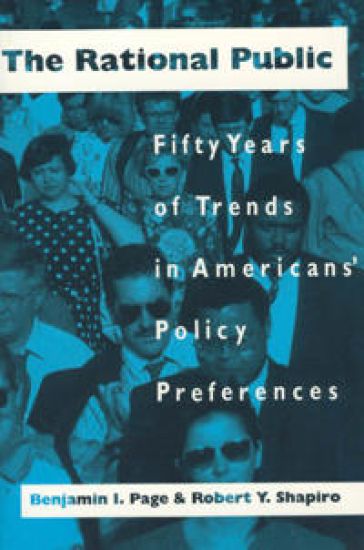
The Rational Public

The Rational Public

Benjamin I. Page; Robert Y. Shapiro

University of Chicago Press
1992
nidottu
This monumental study is a comprehensive critical survey of the policy preferences of the American public, and will be the definitive work on American public opinion for some time to come. Drawing on an enormous body of public opinion data, Benjamin I. Page and Robert Y. Shapiro provide the richest available portrait of the political views of Americans, from the 1930's to 1990. They not only cover all types of domestic and foreign policy issues, but also consider how opinions vary by age, gender, race, region, and the like. The authors unequivocally demonstrate that, notwithstanding fluctuations in the opinions of individuals, collective public opinion is remarkably coherent: it reflects a stable system of values shared by the majority of Americans and it responds sensitively to new events, arguments, and information reported in the mass media. While documenting some alarming case of manipulation, Page and Shapiro solidly establish the soundness and value of collective political opinion. The Rational Public provides a wealth of information about what we as a nation have wanted from government, how we have changed our minds over the years, and why. For anyone interested in the short- and long-term trends in Americans' policy preferences, or eager to learn what Americans have thought about issues ranging from racial equality to the MX missile, welfare to abortion, this book offers by far the most sophisticated and detailed treatment available.