Kirjojen hintavertailu. Mukana 12 595 353 kirjaa ja 12 kauppaa.

Kirjailija

ROBERTA MICHNICK GOLINKOFF

Kirjat ja teokset yhdessä paikassa: 9 kirjaa, julkaisuja vuosilta 2000-2026, suosituimpien joukossa Einstein Never Used Flashcards. Vertaile teosten hintoja ja tarkista saatavuus suomalaisista kirjakaupoista.

9 kirjaa

Kirjojen julkaisuhaarukka 2000-2026.

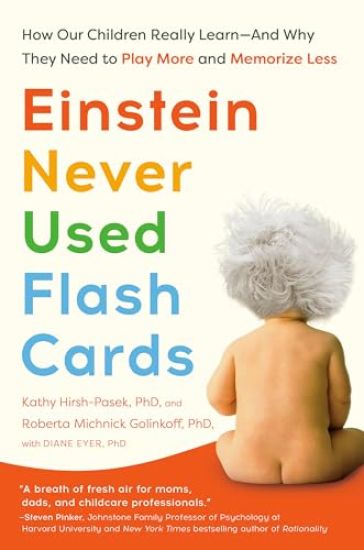
Einstein Never Used Flash Cards, Revised Edition: How Our Children Really Learn--And Why They Need to Play More and Memorize Less
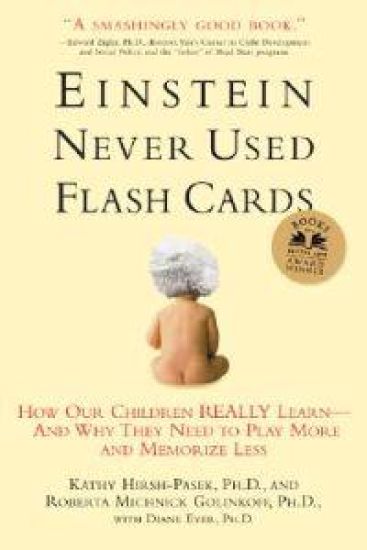
An enlightening guide to how infants, toddlers, and children learn and why play is the key to enhancing your child's development--now revised and updated with a new chapter on the impacts of screen time "A breath of fresh air for moms, dads, and childcare professionals."--Steven Pinker, Johnstone Family Professor of Psychology at Harvard University and New York Times bestselling author of When Everyone Knows That Everyone Knows In Einstein Never Used Flash Cards, award-winning early childhood development experts Kathy Hirsh-Pasek, PhD, and Roberta Michnick Golinkoff, PhD, show how parents can help their children succeed while reducing the pressures they both face. They offer a compelling message for today's parents: rather than invest in expensive enrichment programs and "educational" apps and toys, the best way to boost brainpower and interpersonal skills is to let children play. In fact, free and guided play is a better way for kids to learn and for parents to enjoy their children. Drawing on overwhelming scientific evidence, Hirsh-Pasek and Golinkoff explain how learning works from a child's point of view. They address how kids pick up key mathematical concepts, acquire language, develop a sense of self, and more. They also offer more than forty age-appropriate activities for children under nine. These simple, fun--yet powerful--exercises work as well or better than unnecessary interventions to engage kids and their ever-active, curious minds. This revised edition also includes the latest findings on how play supports learning, as well as a new chapter on the benefits and downsides of time spent with digital media. Packed with insights from fascinating studies and reassuring advice, Einstein Never Used Flash Cards empowers readers to help their children thrive while bringing more joy to the hard work of parenting.
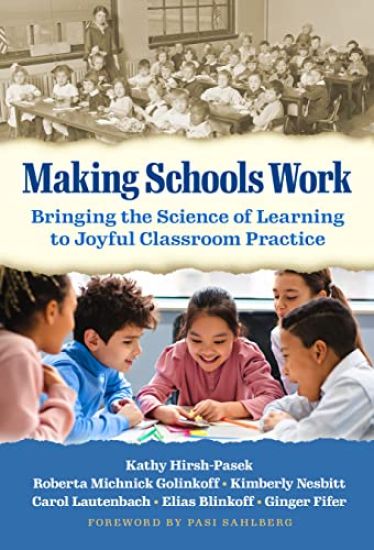
Making Schools Work

Making Schools Work

Kathy Hirsh-Pasek; Roberta Michnick Golinkoff; Kimberly Nesbitt; Carol Lautenbach; Elias Blinkoff; Ginger Fifer; Pasi Sahlberg

TEACHERS' COLLEGE PRESS
2022
sidottu
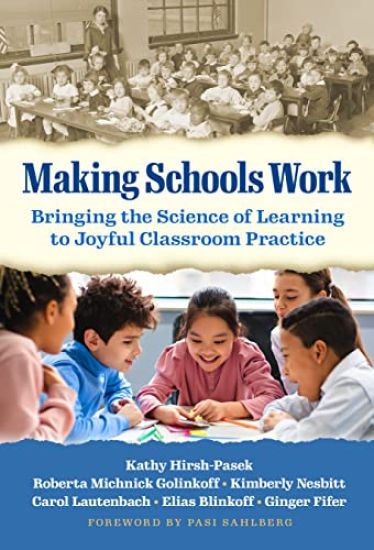
If we teach in the way that human brains learn, both students and their teachers will thrive! This book aligns evidence from the learning sciences on how and what students need to learn with classroom practice (pre-K–12). It demonstrates, with hands-on examples, how a change in educational mindset (rather than in curriculum) can improve student outcomes on both standardized tests and a breadth of 21st-century skills skills. Written collectively by classroom teachers, administrators, parents, and learning scientists, this book shows readers how to co-construct and reimagine an optimal educational system. Making Schools Work offers three case studies of schools, including a statewide system, that are all realizing a 6 Cs approach to learning focused on collaboration, communication, content, critical thinking, creative innovation, and confidence. The text documents the ever-evolving implementation process, as well as outcomes and the ongoing work of stakeholders. Readers can use this resource to create an education for all children that is culturally responsive, inclusive, effective, and fun.Book Features:Helps educators teach in the way that human minds learn.Jointly written in accessible language by teachers, administrators, parents, and learning scientists.Offers hands-on ways to reimagine classrooms without investing in new curricula.Puts teachers in the driver's seat, reminding them of why they teach.Provides culturally responsive, inclusive, effective, and fun strategies.Offers children the possibility of learning the skills they will need for 21st-century skills success.
Making Schools Work

Making Schools Work

Kathy Hirsh-Pasek; Roberta Michnick Golinkoff; Kimberly Nesbitt; Carol Lautenbach; Elias Blinkoff; Ginger Fifer; Pasi Sahlberg

TEACHERS' COLLEGE PRESS
2022
nidottu
If we teach in the way that human brains learn, both students and their teachers will thrive! This book aligns evidence from the learning sciences on how and what students need to learn with classroom practice (pre-K–12). It demonstrates, with hands-on examples, how a change in educational mindset (rather than in curriculum) can improve student outcomes on both standardized tests and a breadth of 21st-century skills skills. Written collectively by classroom teachers, administrators, parents, and learning scientists, this book shows readers how to co-construct and reimagine an optimal educational system. Making Schools Work offers three case studies of schools, including a statewide system, that are all realizing a 6 Cs approach to learning focused on collaboration, communication, content, critical thinking, creative innovation, and confidence. The text documents the ever-evolving implementation process, as well as outcomes and the ongoing work of stakeholders. Readers can use this resource to create an education for all children that is culturally responsive, inclusive, effective, and fun.Book Features:Helps educators teach in the way that human minds learn.Jointly written in accessible language by teachers, administrators, parents, and learning scientists.Offers hands-on ways to reimagine classrooms without investing in new curricula.Puts teachers in the driver's seat, reminding them of why they teach.Provides culturally responsive, inclusive, effective, and fun strategies.Offers children the possibility of learning the skills they will need for 21st-century skills success.
Einstein Never Used Flashcards

Einstein Never Used Flashcards

ROBERTA MICHNICK GOLINKOFF

Rodale Press
2018
nidottu
Two noted child psychologists condemn the growing trend toward accelerated learning and the pressure put upon parents to meet constant expectations, introducing a series of simple, creative games that parents can play with their child to enhance mental and physical development while embracing and enjoying precious moments without high-tech gadgets. Reprint. 30,000 first printing.
Link between Spatial and Mathematical Skills across the Preschool Years

Link between Spatial and Mathematical Skills across the Preschool Years

Brian N. Verdine; Roberta Michnick Golinkoff; Kathy Hirsh-Pasek; Nora S. Newcombe

John Wiley Sons Inc
2017
nidottu
Understanding the development of spatial skills is important for improving overall success in STEM (science, technology, engineering, and mathematics) fields (e.g., Wai, Lubinski, Benbow, & Steiger, 2010). Children use spatial skills to understand the world and can practice them via spatial assembly activities like puzzles or blocks. These skills have been linked to success in subjects like mathematics (Mix & Cheng, 2012) and science (Pallrand & Seeber, 1984; Pribyl & Bodner, 1987). This monograph sought to answer four questions about early spatial development: 1) Can we reliably measure spatial skills in 3- and 4-year-olds?; 2) Do spatial skills measured at 3 predict spatial skills at age 5?; 3) Do preschool spatial skills predict mathematics skills at age 5?; and 4) What factors contribute to individual differences in preschool spatial skills (e.g., SES, gender, fine-motor skills, vocabulary, and executive function)? Longitudinal data generated from a new spatial skill test for 3-year-old children, called the TOSA (Test of Spatial Assembly), show that it is a reliable and valid measure of early spatial skills that provides strong prediction to spatial skills measured with established tests at age 5. New data using this measure finds links between early spatial skill and mathematics, language, and executive function skills. Analyses suggest that preschool spatial experiences may play a central role in early mathematical skills. Executive function skills further predict mathematical performance and individual differences, specifically socio economic status, are related to spatial and mathematical skill. We conclude by exploring ways of providing rich early spatial experiences.
Becoming Brilliant

Becoming Brilliant

Roberta Michnick Golinkoff; Kathy Hirsh-Pasek

American Psychological Association
2016
pokkari
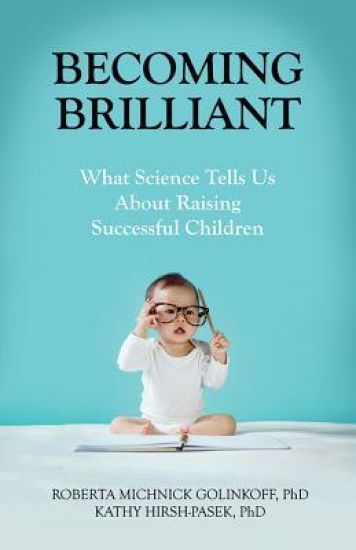
New York Times Bestseller! Becoming Brilliant offers solutions that parents can implement right now. Backed by the latest scientific evidence and illustrated with examples of what amp rsquo s being done right in schools today, this book introduces the Cs-collaboration, communication, content, critical thinking, creative innovation, and confidence-along with ways parents can nurture their children amp rsquo s development in each area. In just a few years, today's children and teens will forge careers that look nothing like those their parents and grandparents knew. Even the definition of amp quot career amp quot and amp quot job amp quot are changing as more people build their own teams to create new businesses, apps, and services. Although these changes are well underway, our system of K amp ndash 2 education in the United States lags behind. Our education system still subscribes to the idea that content is king. The exclusive focus on content is reflected in what we test and how we teach, and even the toys we offer our children at home. Employers want to hire excellent communicators, critical thinkers, and innovators - in short, they want brilliant people. But they are often disappointed. So what can we do, as parents, to help our children be brilliant and successful? Stories about the failures of our educational system abound, but most of them stop after pointing out the problems. Becoming Brilliant goes beyond complaining to offer solutions that parents can apply right now. Authors Roberta Michnick Golinkoff and Kathy Hirsh-Pasek provide a science-based framework for how we should be educating children in and outside of school. Parents become agents of change for children's success when they nurture six critical skills. Constructed from the latest scientific evidence and presented in an accessible way rich with examples, this book introduces the Cs - collaboration, communication, content, critical thinking, creative innovation, and confidence - along with tips to optimize children's development in each area. Taken together, these are the skills that will make up the straight-A report card for success in the 2 st century.
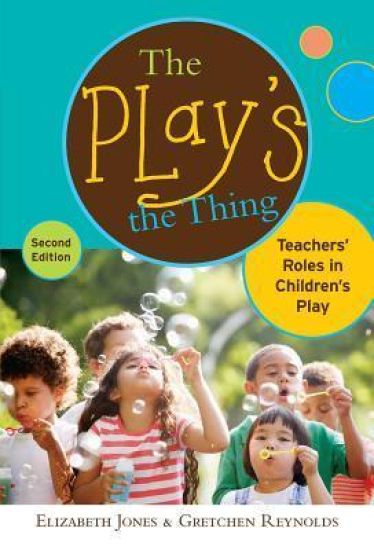
The Play's the Thing

The Play's the Thing

Elizabeth Jones; Gretchen Reynolds; Kathy Hirsh-Pasek; Roberta Michnick Golinkoff

Teachers' College Press
2011
nidottu
Responding to current debates on the place of play in schools, the authors have extensively revised their groundbreaking book. They explain how and why play is a critical part of children’s development, as well as the central role adults have to promote it. This classic textbook and popular practitioner resource offers systematic descriptions and analyses of the different roles a teacher adopts to support play, including those of stage manager, mediator, player, scribe, assessor, communicator, and planner. This new edition has been expanded to include significant developments in the broadening landscape of early learning and care, such as assessment, diversity and culture, intentional teaching, inquiry, and the construction of knowledge.New for the Second Edition of The Play’s the Thing!Additional theories on the relationship of teachers and children’s play (e.g., Vygotsky and the role of imaginary play and Reggio Emilia’s image of the competent child).Current issues from media content, consumer culture, and environmental concerns.Standards and testing in preschool and kindergarten.Bridging the cultural gap between home and school.Using digital technology to make children’s play visible.Recent brain development research.And much more!
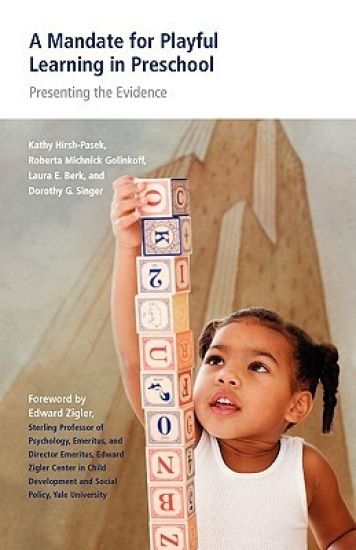
A Mandate for Playful Learning in Preschool

A Mandate for Playful Learning in Preschool

Kathy Hirsh-Pasek; Roberta Michnick Golinkoff; Laura E Berk; Dorothy Singer

Oxford University Press Inc
2008
nidottu
We are robbing young children of play time at home and school in an effort to give them a head start on academic skills like reading and mathematics. Yet the scientific evidence suggests that eliminating play from the lives of children is taking preschool education in the wrong direction. This brief but compelling book provides a strong counterargument to the rising tide of didactic instruction on preschool classrooms. The authors present scientific evidence in support of three points: 1) children need both unstructured free time and playful learning under the gentle guidance of adults to best prepare for entrance into formal school; 2) academic and social development are inextricably intertwined, so academic learning must not trump attention to social development; and 3) learning and play are not incompatible. Rather, playful learning captivates children's minds in ways that support better academic and social outcomes as well as strategies for lifelong learning. Written in clear and expressive language, this book offers a comprehensive review of research supporting playful learning along with succinct policy and practice recommendations that derive from this research. A Mandate for Playful Learning in Preschool is a must read for teachers, policy makers, and parents interested in educating a generation of life-long learners who are ready for school and ready to compete in the knowledge-based economy of the 21st century.
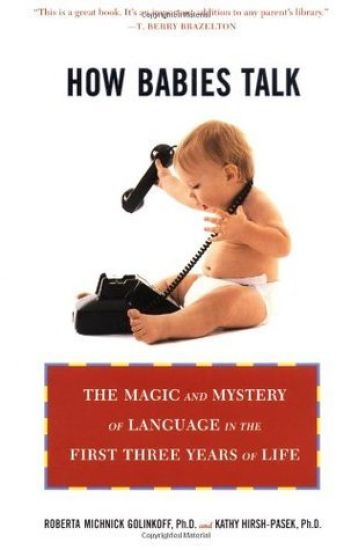
How Babies Talk: The Magic and Mystery of Language in the First Three Years of Life

How Babies Talk: The Magic and Mystery of Language in the First Three Years of Life

Roberta Michnick Golinkoff; Kathy Hirsh-Pasek

Plume Books
2000
nidottu
In their first three years of life, babies face the most complex learning endeavor they will ever undertake as human beings: They learn to talk. Now, as researchers make new forays into the mystery of the development of the human brain, Golinkoff and Hirsh-Pasek, both developmental psychologists and language experts, offer parents a powerfully insightful guidebook to how infants--even while in the womb--begin to learn language. Along the way, the authors provide parents with the latest scientific findings, developmental milestones, and important advice on how to create the most effective learning environments for their children. This book takes readers on a fascinating, vitally important exploration of the dance between nature and nurture, and explains how parents can help their children learn more successfully.