

Kirjailija
Roberto González Echevarría
Kirjat ja teokset yhdessä paikassa: 13 kirjaa, julkaisuja vuosilta 1985-2025, suosituimpien joukossa Memories from the Archive. Vertaile teosten hintoja ja tarkista saatavuus suomalaisista kirjakaupoista.
Mukana myös kirjoitusasut: Roberto Gonzalez Echevarria
13 kirjaa
Kirjojen julkaisuhaarukka 1985-2025.

A la extensa y variada bibliograf a que ya se acumula sobre la vida y obra de Severo Sarduy, este libro contribuye con una dimensi n ntima y conmovedora. Se re ne aqu una parte considerable de la correspondencia enviada por Sarduy a Roberto Gonz lez Echevarr a, quien fuera uno de sus amigos entra ables durante m s de veinte a os, desde que se conocieran en 1969 y hasta el final de sus d as. Los textos reproducidos, cuyos originales se encuentran hoy en la biblioteca de la Universidad de Princeton, son un testimonio de amistad y confianza entre dos imprescindibles intelectuales que compartieron, adem s de su ra z cubana, varios intereses comunes sobre temas como el barroco, el pensamiento franc s, la experiencia del exilio, la tradici n cultural de la Isla o la literatura latinoamericana contempor nea. Como resultado de esa comuni n, el volumen tambi n se enriquece con una entrevista que trabajaron ambos amigos y con algunas piezas literarias escritas por Sarduy y enviadas entonces a Gonz lez Echevarr a para su valoraci n exclusiva. A trav s de un di logo familiar, muy desenfadado y a la vez perspicaz, estas p ginas rescatadas no solo nos revelan detalles valiosos sobre los proyectos creativos de Sarduy, o sobre sus viajes, anhelos, ideas y v nculos con otros intelectuales, sino que adem s nos hacen part cipes de la estrecha complicidad que labraron el autor de La simulaci n y uno de sus m s sagaces cr ticos.

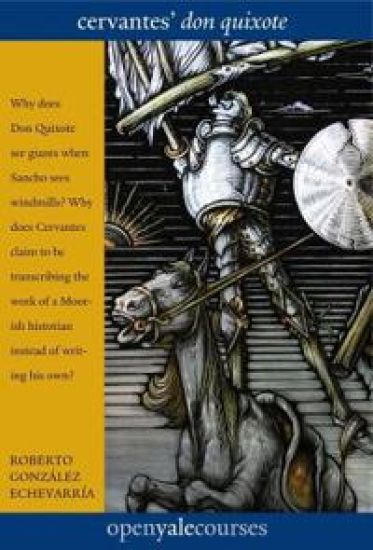
The novel Don Quixote, written in the late sixteenth and early seventeenth century by Miguel de Cervantes Saavedra, is widely considered to be one of the greatest fictional works in the entire canon of Western literature. At once farcical and deeply philosophical, Cervantes’ novel and its characters have become integrated into the cultures of the Western Hemisphere, influencing language and modern thought while inspiring art and artists such as Richard Strauss and Pablo Picasso. Based on Professor Roberto González Echevarría’s popular open course at Yale University, this essential guide to the enduring Spanish classic facilitates a close reading of Don Quixote in the artistic and historical context of renaissance and baroque Spain while exploring why Cervantes’ masterwork is still widely read and relevant today. González Echevarría addresses the novel’s major themes and demonstrates how the story of an aging, deluded would-be knight-errant embodies that most modern of predicaments: the individual’s dissatisfaction with the world in which he lives, and his struggle to make that world mesh with his desires.
Modern Latin American Literature
Roberto Gonzalez Echevarria
Oxford University Press Inc
2012
nidottu
In the 1960s, Latin American literature became known worldwide as never before. Writers such as Jorge Luis Borges, Gabriel García Márquez, Carlos Fuentes, Pablo Neruda, Octavio Paz, and Mario Vargas Llosa all became part of the general culture of educated readers of English, French, German, and Italian. But few know about the literary tradition from which these writers emerged. This Very Short Introduction remedies this situation, providing an overview of modern Latin American literature from the late eighteenth century to the present. Roberto González Echevarría covers a wide range of topics, discussing the birth of Modernismo, the first Latin American literary movement; how the end of World War I and the Mexican Revolution produced the avant-garde; and how the Cuban Revolution sparked a movement in the novel that came to be known as the Boom. Within this narrative, the author covers many of the major writers of Latin American literature, from Andrés Bello and José María de Heredia through Borges and García Márquez to Fernando Vallejo and Roberto Bolaño. ABOUT THE SERIES: The Very Short Introductions series from Oxford University Press contains hundreds of titles in almost every subject area. These pocket-sized books are the perfect way to get ahead in a new subject quickly. Our expert authors combine facts, analysis, perspective, new ideas, and enthusiasm to make interesting and challenging topics highly readable.
The consolidation of law and the development of legal writing during Spain’s Golden Age not only helped that country become a modern state but also affected its great literature. In this fascinating book, Roberto González Echevarría explores the works of Cervantes, showing how his representations of love were inspired by examples of human deviance and desire culled from legal discourse. González Echevarría describes Spain’s new legal policies, legislation, and institutions and explains how, at the same time, its literature became filled with love stories derived from classical and medieval sources. Examining the ways that these legal and literary developments interacted in Cervantes’s work, he sheds new light on Don Quixote and other writings.
This book offers a theory about the origin and evolution of the Latin American narrative, and about the emergence of the modern novel. It argues that the novel developed from the discourse of the law in the Spanish Empire during the sixteenth century, while many of the early historical documents concerning the New World assumed the same forms, furnished by the notarial arts. Thus, both the novel and these first Latin American narratives imitated the language of authority. The book explores how the same process is repeated in two key moments in the history of the Latin American narrative. In the nineteenth century, the model was the discourse of scientific travellers such as von Humboldt and Darwin, while in the twentieth century, the discourse of anthropology - the study of language and myth - has come to shape the narrative. Professor González Echevarría's theoretical approach is drawn from a reading of Carpentier's Los pasos perdidos, and the book centres on major figures in the tradition such as Columbus, Garcilaso el Inca, Sarmiento, Gallegos, Borges and Garcia Marquez.
Myth and Archive presents a new theory of the origin and evolution of Latin American literature and the emergence of the modern novel. In this influential, award-winning exploration of Latin American writing from colonial times to the present, Roberto GonzÁlez EchevarrÍa dispenses with traditional literary history to reveal the indebted relationship of the novel to legal, scientific, and anthropological discourses. Providing ways to link literary and nonliterary narratives, GonzÁlez EchevarrÍa examines a variety of archival writings-from the chronicles of the discovery and conquest of the New World to scientific travel narratives and records of criminal confessions-and explores the relationship of these writings to novels by authors such as GarcÍa MÁrquez, Borges, Barnet, Sarmiento, Carpentier, and Garcilaso de la Vega. Moving beyond demonstrating that early forms of creative narrative had their geneses in the sixteenth-century authoritative discourse of the Spanish Empire, GonzÁlez EchevarrÍa shows how this same originating process has been repeated in other key moments in the history of the Latin American narrative. He shows how the discourse of scientific discovery was the model for much nineteenth-century literature, as well as how anthropological writings on the nature of language and myth have come to shape the ideology and form of literature in the twentieth century. This most recent form of Latin American narrative creates its own mythic form through an atavistic return to its legal origins-the archive. This acclaimed book-originally published in 1990-will be of continuing interest to historians, anthropologists, literary theorists, and students of Latin American culture.
Published in 1499 and centered on the figure of a bawd and witch, Fernando de Rojas' dark and disturbing Celestina was destined to become the most suppressed classic in Spanish literary history. Routinely ignored in Spanish letters, the book nonetheless echoes through contemporary Spanish and Latin American literature. This is the phenomenon that Celestina's Brood explores.Roberto González Echevarría, one of the most eminent and influential critics of Hispanic literature writing today, uses Rojas' text as his starting point to offer an exploration of modernity in the Hispanic literary tradition, and of the Baroque as an expression of the modern. His analysis of Celestina reveals the relentless probing of the limits of language and morality that mark the work as the beginning of literary modernity in Spanish, and the start of a tradition distinguished by a penchant for the excesses of the Baroque. González Echevarría pursues this tradition and its meaning through the works of major figures such as Cervantes, Lope de Vega, Calderón de la Barca, Alejo Carpentier, Carlos Fuentes, Gabriel García Márquez, Nicolás Guillén, and Severo Sarduy, as well as through the works of lesser-known authors.By revealing continuities of the Baroque, Celestina's Brood cuts across conventional distinctions between Spanish and Latin American literary traditions to show their profound and previously unimagined affinity.

Published in 1499 and centered on the figure of a bawd and witch, Fernando de Rojas' dark and disturbing Celestina was destined to become the most suppressed classic in Spanish literary history. Routinely ignored in Spanish letters, the book nonetheless echoes through contemporary Spanish and Latin American literature. This is the phenomenon that Celestina's Brood explores.Roberto González Echevarría, one of the most eminent and influential critics of Hispanic literature writing today, uses Rojas' text as his starting point to offer an exploration of modernity in the Hispanic literary tradition, and of the Baroque as an expression of the modern. His analysis of Celestina reveals the relentless probing of the limits of language and morality that mark the work as the beginning of literary modernity in Spanish, and the start of a tradition distinguished by a penchant for the excesses of the Baroque. González Echevarría pursues this tradition and its meaning through the works of major figures such as Cervantes, Lope de Vega, Calderón de la Barca, Alejo Carpentier, Carlos Fuentes, Gabriel García Márquez, Nicolás Guillén, and Severo Sarduy, as well as through the works of lesser-known authors.By revealing continuities of the Baroque, Celestina's Brood cuts across conventional distinctions between Spanish and Latin American literary traditions to show their profound and previously unimagined affinity.
Alejo Carpentier was one of the greatest Latin American novelists of the twentieth century, as well as a musicologist, journalist, cultural promoter, and diplomat. His fictional world issues from an encyclopedic knowledge of the history, art, music, and literature of Latin America and Europe. Carpentier’s novels and stories are the enabling discourse of today’s Latin American narrative, and his interpretation of Latin American history has been among the most influential. Carpentier was the first to provide a comprehensive view of Caribbean history that centered on the contribution of Africans, above and beyond the differences created by European cultures and languages. Alejo Carpentier: The Pilgrim at Home, first published in 1977 and updated for this edition, covers the life and works of the great Cuban novelist, offering a new perspective on the relationship between the two.González Echevarría offers detailed readings of the works La música en Cuba, The Kingdom of This World, The Lost Steps, and Explosion in a Cathedral. In a new concluding chapter, he takes up Carpentier’s last years, his relationship with the Cuban revolutionary regime, and his last two novels, El arpa y la sombra and La consagración de la primavera, in which Carpentier reviewed his life and career.
This book offers a theory about the origin and evolution of the Latin American narrative, and about the emergence of the modern novel. It argues that the novel developed from the discourse of the law in the Spanish Empire during the sixteenth century, while many of the early historical documents concerning the New World assumed the same forms, furnished by the notarial arts. Thus, both the novel and these first Latin American narratives imitated the language of authority. The book explores how the same process is repeated in two key moments in the history of the Latin American narrative. In the nineteenth century, the model was the discourse of scientific travellers such as von Humboldt and Darwin, while in the twentieth century, the discourse of anthropology - the study of language and myth - has come to shape the narrative. Professor González Echevarría's theoretical approach is drawn from a reading of Carpentier's Los pasos perdidos, and the book centres on major figures in the tradition such as Columbus, Garcilaso el Inca, Sarmiento, Gallegos, Borges and Garcia Marquez.
By one of the most original and learned critical voices in Hispanic studies- a timely and ambitious study of authority as theme and authority as authorial strategy in modern Latin American literature. An ideology is implicit in modern Latin American literature, argues Roberto GonzÁlez EchevarrÍa, through which both the literature itself and criticism of it define what Latin American literature is and how it ought to be read. In the works themselves this ideology is constantly subjected to a radical critique, and that critique renders the ideology productive and in a sense is what constitutes the work. In literary criticism, however, too frequently the ideology merely serves as support for an authoritative discourse that seriously misrepresents Latin American literature. In The Voice of the Masters, GonzÁlez EchevarrÍa attempts to uncover the workings of modern Latin American literature by creating a dialogue of texts, a dynamic whole whose parts are seven illuminating essays on seminal texts in the tradition. As he says, "To have written a sustained, expository book ... would have led me to make the same kind of critical error that I attribute to most criticism of Latin American literature.... I would have naively assumed an authoritative voice while attempting a critique of precisely that critical gesture." Instead, major works by Barnet, Cabrera Infante, Carpentier, CortÁzar, Fuentes, Gallegos, GarcÍa MÁrquez, Roa Bastos, and RodÓ are the object of a set of independent deconstructive (and reconstructive) readings. Writing in the tradition of Derrida and de Man, GonzÁlez EchevarrÍa brings to these readings both the penetrative brilliance of the French master and a profound understanding of historical and cultural context. His insightful annotation of Cabrera Infante's "Meta-End," the full text of which is presented at the close of the study, clearly demonstrates these qualities and exemplifies his particular approach to the text.