

Kirjailija
Roberto Simanowski
Kirjat ja teokset yhdessä paikassa: 15 kirjaa, julkaisuja vuosilta 2011-2025, suosituimpien joukossa Abfall. Vertaile teosten hintoja ja tarkista saatavuus suomalaisista kirjakaupoista.
15 kirjaa
Kirjojen julkaisuhaarukka 2011-2025.

Das Verschwinden von Raum und Zeit im Prozess ihrer Digitalisierung
Roberto Simanowski
Passagen Verlag Ges.M.B.H
2023
pokkari



Provocative takes on cyberbullshit, smartphone zombies, instant gratification, the traffic school of the information highway, and other philosophical concerns of the Internet age.In The Death Algorithm and Other Digital Dilemmas, Roberto Simanowski wonders if we are on the brink of a society that views social, political, and ethical challenges as technological problems that can be fixed with the right algorithm, the best data, or the fastest computer. For example, the "death algorithm " is programmed into a driverless car to decide, in an emergency, whether to plow into a group of pedestrians, a mother and child, or a brick wall. Can such life-and-death decisions no longer be left to the individual human? In these incisive essays, Simanowski asks us to consider what it means to be living in a time when the president of the United States declares the mainstream media to be an enemy of the people-while Facebook transforms the people into the enemy of mainstream media. Simanowski describes smartphone zombies (or "smombies") who remove themselves from the physical world to the parallel universe of social media networks; calls on Adorno to help parse Trump's tweeting; considers transmedia cannibalism, as written text is transformed into a postliterate object; compares the economic and social effects of the sharing economy to a sixteen-wheeler running over a plastic bottle on the road; and explains why philosophy mat become the most important element in the automotive and technology industries.

On Facebook and fake news, selfies and self-consciousness, selling our souls to the Internet, and other aspects of the digital revolution.With these engaging and provocative essays, Roberto Simanowski considers what new media has done to us. Why is digital privacy being eroded and why does society seem not to care? Why do we escape from living and loving the present into capturing, sharing and liking it? And how did we arrive at a selfie society without self-consciousness?Simanowski, who has been studying the Internet and social media since the 1990s, goes deeper than the conventional wisdom. For example, on the question of Facebook's responsibility for the election of Donald Trump, he argues that the problem is not the "fake news" but the creation of conditions that make people susceptible to fake news. The hallmark of the Internet is its instantaneousness, but, Simanowski cautions, speed is the enemy of depth. On social media, he says, "complex arguments are jettisoned in favor of simple slogans, text in favor of images, laborious explorations at understanding the world and the self in favor of amusing banalities, deep engagement in favor of the click." Simanowski wonders if we have sold our soul to Silicon Valley, as Faust sold his to the Devil; credits Edward Snowden for making privacy a news story; looks back at 1984, 1984, and Apple's famous sledgehammer commercial; and considers the shitstorm, mapping waves of Internet indignation-including one shitstorm that somehow held Adidas responsible for the killing of dogs in Ukraine. "Whatever gets you through the night," sang John Lennon in 1974. Now, Simanowski says, it's Facebook that gets us through the night; and we have yet to grasp the implications of this.

Intelligence services, government administrations, businesses, and a growing majority of the population are hooked on the idea that big data can reveal patterns and correlations in everyday life. Initiated by software engineers and carried out through algorithms, the mining of big data has sparked a silent revolution. But algorithmic analysis and data mining are not simply byproducts of media development or the logical consequences of computation. They are the radicalization of the Enlightenment's quest for knowledge and progress. Data Love argues that the "cold civil war" of big data is taking place not among citizens or between the citizen and government but within each of us.Roberto Simanowski elaborates on the changes data love has brought to the human condition while exploring the entanglements of those who—out of stinginess, convenience, ignorance, narcissism, or passion—contribute to the amassing of ever more data about their lives, leading to the statistical evaluation and individual profiling of their selves. Writing from a philosophical standpoint, Simanowski illustrates the social implications of technological development and retrieves the concepts, events, and cultural artifacts of past centuries to help decode the programming of our present.

Facebook claims that it is building a “global community.” Whether this sounds utopian, dystopian, or simply self-promotional, there is no denying that social-media platforms have altered social interaction, political life, and outlooks on the world, even for people who do not regularly use them. In this book, Roberto Simanowski takes Facebook as a starting point to investigate our social-media society—and its insidious consequences for our concept of the self.Simanowski contends that while they are often denounced as outlets for narcissism and self-branding, social networks and the practices they cultivate in fact remake the self in their image. Sharing is the outsourcing of one’s experiences, encouraging unreflective self-narration rather than conscious self-determination. Instead of experiencing the present, we are stuck ceaselessly documenting and archiving it. We let our lives become episodic autobiographies whose real author is the algorithm lurking behind the interface. As we go about accumulating more material for the platform to arrange for us, our sense of self becomes diminished—and Facebook shapes a subject who no longer minds. Social-media companies’ relentless pursuit of personal data for advertising purposes presents users with increasingly targeted, customized information, attenuating cultural memory and fracturing collective identity. Presenting a creative, philosophically informed perspective that speaks candidly to a shared reality, Facebook Society asks us to come to terms with the networked world for our own sake and for all those with whom we share it.
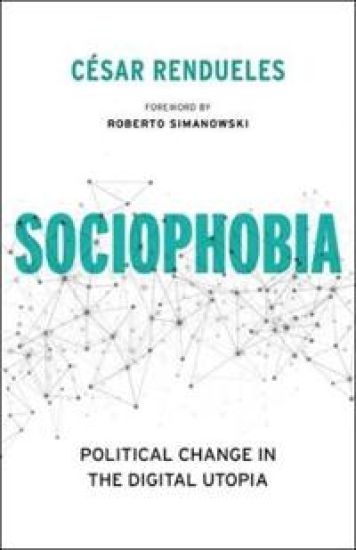
The great ideological cliche of our time, Cesar Rendueles argues in Sociophobia, is the idea that communication technologies can support positive social dynamics and improve economic and political conditions. We would like to believe that the Internet has given us the tools to overcome modernity's practical dilemmas and bring us into closer relation, but recent events show how technology has in fact driven us farther apart. Named one of the ten best books of the year by Babelia El Pais, Sociophobia looks at the root causes of neoliberal utopia's modern collapse. It begins by questioning the cyber-fetishist dogma that lulls us into thinking our passive relationship with technology plays a positive role in resolving longstanding differences. Rendueles claims that the World Wide Web has produced a diminished rather than augmented social reality. In other words, it has lowered our expectations with respect to political interventions and personal relations. In an effort to correct this trend, Rendueles embarks on an ambitious reassessment of our antagonistic political traditions to prove that post-capitalism is not only a feasible, intimate, and friendly system to strive for but also essential for moving past consumerism and political malaise.
The great ideological cliche of our time, Cesar Rendueles argues in Sociophobia, is the idea that communication technologies can support positive social dynamics and improve economic and political conditions. We would like to believe that the Internet has given us the tools to overcome modernity's practical dilemmas and bring us into closer relation, but recent events show how technology has in fact driven us farther apart. Named one of the ten best books of the year by Babelia El Pais, Sociophobia looks at the root causes of neoliberal utopia's modern collapse. It begins by questioning the cyber-fetishist dogma that lulls us into thinking our passive relationship with technology plays a positive role in resolving longstanding differences. Rendueles claims that the World Wide Web has produced a diminished rather than augmented social reality. In other words, it has lowered our expectations with respect to political interventions and personal relations. In an effort to correct this trend, Rendueles embarks on an ambitious reassessment of our antagonistic political traditions to prove that post-capitalism is not only a feasible, intimate, and friendly system to strive for but also essential for moving past consumerism and political malaise.


Intelligence services, government administrations, businesses, and a growing majority of the population are hooked on the idea that big data can reveal patterns and correlations in everyday life. Initiated by software engineers and carried out through algorithms, the mining of big data has sparked a silent revolution. But algorithmic analysis and data mining are not simply byproducts of media development or the logical consequences of computation. They are the radicalization of the Enlightenment's quest for knowledge and progress. Data Love argues that the "cold civil war" of big data is taking place not among citizens or between the citizen and government but within each of us. Roberto Simanowski elaborates on the changes data love has brought to the human condition while exploring the entanglements of those who-out of stinginess, convenience, ignorance, narcissism, or passion-contribute to the amassing of ever more data about their lives, leading to the statistical evaluation and individual profiling of their selves. Writing from a philosophical standpoint, Simanowski illustrates the social implications of technological development and retrieves the concepts, events, and cultural artifacts of past centuries to help decode the programming of our present.
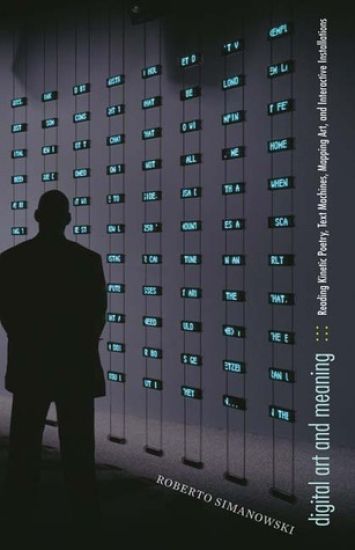
In a world increasingly dominated by the digital, the critical response to digital art generally ranges from hype to counterhype. Popular writing about specific artworks seldom goes beyond promoting a given piece and explaining how it operates, while scholars and critics remain unsure about how to interpret and evaluate them. This is where Roberto Simanowski intervenes, demonstrating how such critical work can be done. Digital Art and Meaning offers close readings of varied examples from genres of digital art such as kinetic concrete poetry, computer-generated text, interactive installation, mapping art, and information sculpture. For instance, Simanowski deciphers the complex meaning of words that not only form an image on a screen but also react to the viewer’s behavior; images that are progressively destroyed by the human gaze; text machines generating nonsense sentences out of a Kafka story; and a light show above Mexico City’s historic square, created by Internet users all over the world. Simanowski combines these illuminating explanations with a theoretical discussion that employs art philosophy and history to achieve a deeper understanding of each particular example of digital art and, ultimately, of the genre as a whole.
In a world increasingly dominated by the digital, the critical response to digital art generally ranges from hype to counterhype. Popular writing about specific artworks seldom goes beyond promoting a given piece and explaining how it operates, while scholars and critics remain unsure about how to interpret and evaluate them. This is where Roberto Simanowski intervenes, demonstrating how such critical work can be done. Digital Art and Meaning offers close readings of varied examples from genres of digital art such as kinetic concrete poetry, computer-generated text, interactive installation, mapping art, and information sculpture. For instance, Simanowski deciphers the complex meaning of words that not only form an image on a screen but also react to the viewer’s behavior; images that are progressively destroyed by the human gaze; text machines generating nonsense sentences out of a Kafka story; and a light show above Mexico City’s historic square, created by Internet users all over the world. Simanowski combines these illuminating explanations with a theoretical discussion that employs art philosophy and history to achieve a deeper understanding of each particular example of digital art and, ultimately, of the genre as a whole.