Kirjojen hintavertailu. Mukana 12 595 353 kirjaa ja 12 kauppaa.

Kirjailija

Robin Broad

Kirjat ja teokset yhdessä paikassa: 7 kirjaa, julkaisuja vuosilta 1990-2026, suosituimpien joukossa The Water Defenders: How Ordinary People Saved a Country from Corporate Greed. Vertaile teosten hintoja ja tarkista saatavuus suomalaisista kirjakaupoista.

7 kirjaa

Kirjojen julkaisuhaarukka 1990-2026.

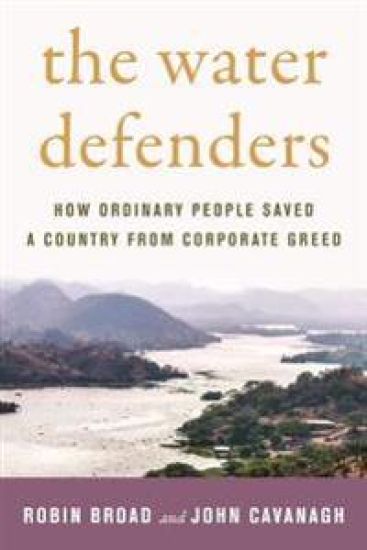
The Water Defenders: How Ordinary People Saved a Country from Corporate Greed
In their acclaimed book The Water Defenders, Robin Broad and John Cavanagh told the story of activists in San Isidro, El Salvador, who fought multinational mining corporation OceanaGold and won--protecting their drinking water and environment from irreparable harm--despite great personal danger. Now, Jon Sack's captivating graphic adaptation brings the story to new audiences and with new urgency, as environmental progress and human rights remain under assault around the world. The book is also updated to address Salvadoran dictator Nayib Bukele's ascent and the subsequent arrests of five water defenders. Initially excited by the company's promises of jobs and prosperity, farmer Vidalina Morales, brothers Marcelo and Miguel Rivera, and others soon realized that the trade-off was catastrophic contamination of El Salvador's main source of fresh water. Facing corporate machinations and violence, the ordinary people of San Isidro and surrounding communities built a transnational coalition that prevailed over powerful adversaries to score an environmental victory with worldwide repercussions. Broad and Cavanagh draw on over a decade of research, interviews, and experience as allies and experts in international development to recount the harrowing saga. A blueprint for civic bravery and local-to-global activism, as well as a rich history of Central America's political conflicts and people's fights against environmental and economic exploitation, this story will inspire anyone who feels helpless against corporate malfeasance.
Development Redefined

Development Redefined

Robin Broad; John Cavanagh

Paradigm
2008
nidottu
Rejecting the "flat worldism" of the globalists as well as the peaks and valleys of trade and aid policies over the years, Robin Broad and John Cavanagh guide us through the raging debate over the best route to development for the poorer nations of Africa, Asia, and Latin America. This book takes readers on a journey through the rise and fall of the one-size-fits-all model of development that richer nations began imposing on poorer ones three decades ago. That model-called the "Washington Consensus" by its backers and "neoliberalism" or "market fundamentalism" by its critics-placed enormous power in markets to solve the problems of the poor. The authors have stood at the epicenter of these debates from their perches in the United Nations, the U.S. government, academia, and civil society. They guide us back in time to understand why the Washington Consensus dominated for so long, and how it devastated workers, the environment, and the poor. At the same time, they chart the rise of an "alter-globalization" movement of those adversely affected by market fundamentalism. Today, this movement is putting alternatives into action across the globe, and what constitutes development is being redefined. As the authors present this dramatic confrontation of paradigms, they bring into question the entire conventional notion of "development," and offer readers a new lens through which to view the way forward for poorer nations and poorer people. This brief history of development connects an arcane world with contemporary forces of globalization, environmental degradation, and the violation of perhaps the essential human right: to be considered individually, equally, in an economically viable world and way.
Development Redefined

Development Redefined

Robin Broad; John Cavanagh

Paradigm
2008
sidottu
Rejecting the "flat worldism" of the globalists as well as the peaks and valleys of trade and aid policies over the years, Robin Broad and John Cavanagh guide us through the raging debate over the best route to development for the poorer nations of Africa, Asia, and Latin America. This book takes readers on a journey through the rise and fall of the one-size-fits-all model of development that richer nations began imposing on poorer ones three decades ago. That model-called the "Washington Consensus" by its backers and "neoliberalism" or "market fundamentalism" by its critics-placed enormous power in markets to solve the problems of the poor. The authors have stood at the epicenter of these debates from their perches in the United Nations, the U.S. government, academia, and civil society. They guide us back in time to understand why the Washington Consensus dominated for so long, and how it devastated workers, the environment, and the poor. At the same time, they chart the rise of an "alter-globalization" movement of those adversely affected by market fundamentalism. Today, this movement is putting alternatives into action across the globe, and what constitutes development is being redefined. As the authors present this dramatic confrontation of paradigms, they bring into question the entire conventional notion of "development," and offer readers a new lens through which to view the way forward for poorer nations and poorer people. This brief history of development connects an arcane world with contemporary forces of globalization, environmental degradation, and the violation of perhaps the essential human right: to be considered individually, equally, in an economically viable world and way.
Plundering Paradise

Plundering Paradise

Robin Broad; John Cavanagh; Barbara Ehrenreich

University of California Press
1994
pokkari
This gripping portrait of environmental politics chronicles the devastating destruction of the Philippine countryside and reveals how ordinary men and women are fighting back. Traveling through a land of lush rainforests, the authors have recorded the experiences of the people whose livelihoods are disappearing along with their country's natural resources. The result is an inspiring, informative account of how peasants, fishers, and other laborers have united to halt the plunder and to improve their lives. These people do not debate global warming--they know that their very lives depend on the land and oceans, so they block logging trucks, protest open-pit mining, and replant trees. In a country where nearly two-thirds of the children are impoverished, the reclaiming of natural resources is offering young people hope for a future. Plundering Paradise is essential reading for anyone interested in development, the global environment, and political life in the Third World.
Unequal Alliance

Unequal Alliance

Robin Broad

University of California Press
1990
pokkari
In this seminal work, U.S. development specialist Robin Broad chronicles the Philippine experiment with the structural adjustment model of development espoused by the World Bank and the International Monetary Fund.