

Kirjailija
Rodney Stark
Kirjat ja teokset yhdessä paikassa: 33 kirjaa, julkaisuja vuosilta 1970-2024, suosituimpien joukossa Religion, Deviance, and Social Control. Vertaile teosten hintoja ja tarkista saatavuus suomalaisista kirjakaupoista.
33 kirjaa
Kirjojen julkaisuhaarukka 1970-2024.

A shocking snapshot of the most current impulses in American religion. Rodney Stark reports the surprising findings of the 2007 Baylor Surveys of Religion, a follow up to the 2005 survey revealing most Americans believe in God or a higher power. This new volume highlights even more hot-button issues of religious life in our country. A must-read for anyone interested in Americans' religious beliefs and practices.
A critical analysis of the important role of Christianity in the history of the West argues that the Christian faith's emphasis on reason, progress, moral equality, and freedom led to technological innovation, the rise of science, open political institutions, democracy, and capitalism, paving the way to Western success. Reprint. 25,000 first printing.
Will Mormonism be the next world faith, one that will rival Catholicism, Islam, and other major religions in terms of numbers and global appeal? This was the question Rodney Stark addressed in his much-discussed and much-debated article, "The Rise of a New World Faith" (1984), one of several essays on Mormonism included in this new collection. Examining the religion's growing appeal, Rodney Stark concluded that Mormons could number 267 million members by 2080. In what would become known as "the Stark argument," Stark suggested that the Mormon Church offered contemporary sociologists and historians of religion an opportunity to observe a rare event: the birth of a new world religion. In the years following that article, Stark has become one of the foremost scholars of Mormonism and the sociology of religion. This new work, the first to collect his influential writings on the Mormon Church, includes previously published essays, revised and rewritten for this volume. His work sheds light on both the growth of Mormonism and on how and why certain religions continue to grow while others fade away. Stark examines the reasons behind the spread of Mormonism, exploring such factors as cultural continuity with the faiths from which it seeks converts, a volunteer missionary force, and birth rates. He explains why a demanding faith like Mormonism has such broad appeal in today's world and considers the importance of social networks in finding new converts. Stark's work also presents groundbreaking perspectives on larger issues in the study of religion, including the nature of revelation and the reasons for religious growth in an age of modernization and secularization.
Although many Americans assume that religious participation has declined in America, Finke and Stark present a different picture. In 1776, fewer than 1 in 5 Americans were active in church affairs. Today, church membership includes about 6 out of 10 people. But, as Finke and Stark show, not all denominations benefited. They explain how and why the early nineteenth-century churches began their descent, while two newcomer sects, the Baptists and the Methodists, gained ground. They also analyze why the Methodists then began a long, downward slide, why the Baptists continued to succeed, how the Catholic Church met the competition of ardent Protestant missionaries, and why the Catholic commitment has declined since Vatican II. The authors also explain why ecumenical movements always fail In short, Americans are not abandoning religion; they have been moving away from established denominations. A "church-sect process" is always under way, Finke and Stark argue, as successful churches lose their organizational vigor and are replaced by less worldly groups. Some observers assert that the rise in churching rates indicates increased participation, not increased belief. Finke and Stark challenge this as well. They find that those groups that have gained the greatest numbers have demanded that their followers accept traditional doctrines and otherworldliness. They argue that religious organizations can thrive only when they comfort souls and demand sacrifice. When theology becomes too logical, or too secular, it loses people.
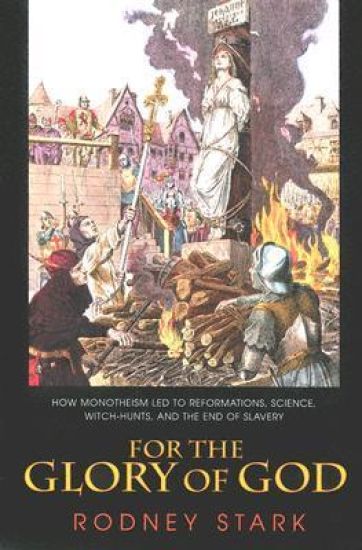
Rodney Stark's provocative new book argues that, whether we like it or not, people acting for the glory of God have formed our modern culture. Continuing his project of identifying the widespread consequences of monotheism, Stark shows that the Christian conception of God resulted--almost inevitably and for the same reasons--in the Protestant Reformation, the rise of modern science, the European witch-hunts, and the Western abolition of slavery. In the process, he explains why Christian and Islamic images of God yielded such different cultural results, leading Christians but not Muslims to foster science, burn "witches," and denounce slavery. With his usual clarity and skepticism toward the received wisdom, Stark finds the origins of these disparate phenomena within monotheistic religious organizations. Endemic in such organizations are pressures to maintain religious intensity, which lead to intense conflicts and schisms that have far-reaching social results. Along the way, Stark debunks many commonly accepted ideas. He interprets the sixteenth-century flowering of science not as a sudden revolution that burst religious barriers, but as the normal, gradual, and direct outgrowth of medieval theology. He also shows that the very ideas about God that sustained the rise of science led also to intense witch-hunting by otherwise clear-headed Europeans, including some celebrated scientists. This conception of God likewise yielded the Christian denunciation of slavery as an abomination--and some of the fiercest witch-hunters were devoted participants in successful abolitionist movements on both sides of the Atlantic. For the Glory of God is an engrossing narrative that accounts for the very different histories of the Christian and Muslim worlds. It fundamentally changes our understanding of religion's role in history and the forces behind much of what we point to as secular progress.
Though religion is for most people one of the most important aspects of their lives, social scientists and other observers of human society too often misunderstand and misrepresent the nature and role of religion in history and in daily life. From the supposed decline of religious attitudes in Western Europe and the venal motivations attributed to the Christian Crusaders to the very definition of religion, personal biases and an inadequate grasp of relevant data have led to the formulation and propagation of unsupportable views on the sacred. In Exploring the Religious Life, Rodney Stark boldly overturns much received wisdom within the social sciences about religion, drawing on a wide range of sources to reassess a diverse selection of topics in the study of religion. In his first essay, Stark addresses the carelessness with which scholars use the term religion and the conviction that the belief in divinity evolved from the practice of magic in primitive cultures.In subsequent chapters, he challenges the widespread attitude among social scientists that religion is nothing more than a mask for material realities and examines the effectiveness of religious doctrines in attracting converts and influencing individuals; uncovers the surprising prevalence of upper-class asceticism in medieval Christianity; and explores the relationship between gender, piety, and criminal activity. Divine revelation is a central aspect of many religions, and Stark next applies empirical research to the phenomenon to assess its meaning in Judaism, Christianity, Islam, and Mormonism. He then turns to the confusion between faith and practice in debates over the secularization of the developed world before investigating the validity of the classic proposition within the social sciences that religion functions to sustain the moral order. He does so, examining the correlation between criminal behavior and depth of religious belief.Stark concludes with an essay on the ingenious methods he uses to unearth data about the popularity of new religions in California and northern Europe, the decline of Christian Science in America, the spread of Christianity in the Roman world, and the execution patterns during the antiwitchcraft frenzy of Enlightenment Europe. Together, the essays that constitute Exploring the Religious Life offer an engaging introduction to Rodney Stark's provocative insights and a fearless challenge to academic perceptions about religion's place in history, society, and private life.
Western history would be unrecognizable had it not been for people who believed in One True God. There would have been wars, but no religious wars. There would have been moral codes, but no Commandments. Had the Jews been polytheists, they would today be only another barely remembered people, less important, but just as extinct as the Babylonians. Had Christians presented Jesus to the Greco-Roman world as "another" God, their faith would long since have gone the way of Mithraism. And surely Islam would never have made it out of the desert had Muhammad not removed Allah from the context of Arab paganism and proclaimed him as the only God. The three great monotheisms changed everything. With his customary clarity and vigor, Rodney Stark explains how and why monotheism has such immense power both to unite and to divide. Why and how did Jews, Christians, and Muslims missionize, and when and why did their efforts falter? Why did both Christianity and Islam suddenly become less tolerant of Jews late in the eleventh century, prompting outbursts of mass murder? Why were the Jewish massacres by Christians concentrated in the cities along the Rhine River, and why did the pogroms by Muslims take place mainly in Granada? How could the Jews persist so long as a minority faith, able to withstand intense pressures to convert? Why did they sometimes assimilate? In the final chapter, Stark also examines the American experience to show that it is possible for committed monotheists to sustain norms of civility toward one another. A sweeping social history of religion, One True God shows how the great monotheisms shaped the past and created the modern world.
Finally, social scientists have begun to attempt to understand religious behavior rather than to discredit it as irrational, ignorant, or foolish--and Rodney Stark and Roger Finke have played a major role in this new approach. Acknowledging that science cannot assess the supernatural side of religion (and therefore should not claim to do so), Stark and Finke analyze the observable, human side of faith. In clear and engaging prose, the authors combine explicit theorizing with animated discussions as they move from considering the religiousness of individuals to the dynamics of religious groups and then to the religious workings of entire societies as religious groups contend for support. The result is a comprehensive new paradigm for the social-scientific study of religion.
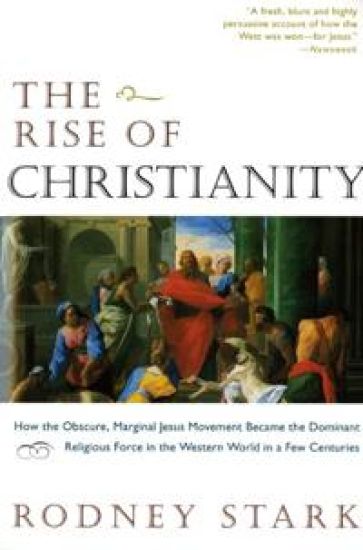
A study of the early history of Christianity reveals that it attracted members of the upper class, that many of the early converts were women and marginalized Jews, and that it helped converts achieve happier lives. Reprint. LJ. PW.

The idea that Christianity started as a clandestine movement among the poor is a widely accepted notion. Yet it is one of many myths that must be discarded if we are to understand just how a tiny messianic movement on the edge of the Roman Empire became the dominant faith of Western civilization. In a fast-paced, highly readable book that addresses beliefs as well as historical facts, Rodney Stark brings a sociologist's perspective to bear on the puzzle behind the success of early Christianity. He comes equipped not only with the logic and methods of social science but also with insights gathered firsthand into why people convert and how new religious groups recruit members. He digs deep into the historical evidence on many issues--such as the social background of converts, the mission to the Jews, the status of women in the church, the role of martyrdom--to provide a vivid and unconventional account of early Christianity. The author plots the most plausible curve of Christian growth from the year 40 to 300. By the time of Constantine, Christianity had become a considerable force, with growth patterns very similar to those of modern-day successful religious movements. An unusual number of Christian converts, for example, came from the educated, cosmopolitan classes. Because it offered a new perspective on familiar concepts and was not linked to ethnicity, Christianity had a large following among persons seeking to assimilate into the dominant culture, mainly Hellenized Jews. The oversupply of women in Christian communities--due partly to the respect and protection they received--led to intermarriages with pagans, hence more conversions, and to a high fertility rate. Stark points out, too, the role played by selflessness and faith. Amidst the epidemics, fires, and other disasters that beleaguered Greco-Roman cities, Christian communities were a stronghold of mutual aid, which resulted in a survival rate far greater than that of the pagans. In the meantime, voluntary martyrdom, especially a generation after the death of Christ, reinforced the commitment of the Christian rank and file. What Stark ultimately offers is a multifaceted portrait of early Christianity, one that appeals to practical reasoning, historical curiosity, and personal reflection.

How religious are Americans these days? How many still believe in God, in Biblical miracles, in heaven and hell? Do people pray? How much money is being given to churches, by Episcopalians, Presbyterians, Roman Catholics, Lutherans, and other groups? American Piety, the first of a three-volume study of religious commitment, answers these and a host of other questions about the contemporary religious scene. Particularly startling are the contrasts in beliefs, practices, and experiences revealed among the eleven major Christian denominations whose membership is compared.