
Kirjojen hintavertailu. Mukana 12 595 353 kirjaa ja 12 kauppaa.

Kirjailija

Roger Berkowitz

Kirjat ja teokset yhdessä paikassa: 7 kirjaa, julkaisuja vuosilta 2003-2027, suosituimpien joukossa A World We Share. Vertaile teosten hintoja ja tarkista saatavuus suomalaisista kirjakaupoista.

7 kirjaa

Kirjojen julkaisuhaarukka 2003-2027.

A World We Share

A World We Share

Roger Berkowitz

YALE UNIVERSITY PRESS
2027
sidottu
A bold rethinking of politics through Hannah Arendt’s life and thought, arguing that friendship—not truth—is the fragile but necessary foundation of democratic life A World We Share sounds the warning that politics cannot be saved by truth alone. Against a tradition that elevates truth above all else, Roger Berkowitz draws on the life and thought of Hannah Arendt to argue that a politics governed by an objective ideal of truth becomes cruel, coercive, and ultimately anti-political. Friendship—grounded in dialogue, respect, and plurality—offers a more human political bond. Hannah Arendt (1906–1975) was known to possess a “genius for friendship.” A Jew in Nazi Germany, an exile in Paris and New York, and an uncompromising critic of postwar orthodoxies, she survived and flourished through friendships that were intellectually intense, complicated, and morally demanding. Her tribe of outsiders included thinkers as disparate as Karl Jaspers, Hans Jonas, Mary McCarthy, Gershom Scholem, Heinrich Blücher, and Martin Heidegger. This book explores how these friendships shaped Arendt’s political thinking. Berkowitz weaves Arendt’s life, thought, and friendships into a powerful meditation on our present moment. In an age of mass loneliness, ideological certainty, and civic breakdown, A World We Share connects democracy not to consensus or moral purity but to our capacity to maintain relationships with others we do not agree with—and cannot fully understand. Berkowitz argues that our political crisis is actually founded in a crisis of friendship. Only by nurturing private and also public friendships can we reimagine a truly democratic politics.
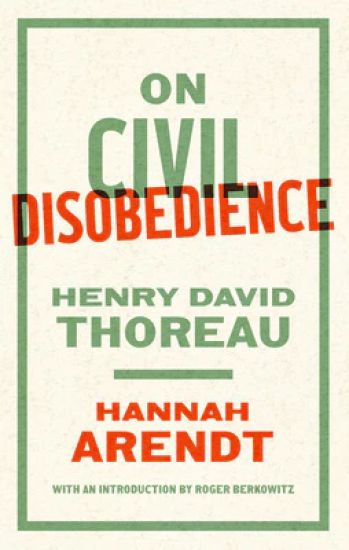
On Civil Disobedience

On Civil Disobedience

Hannah Arendt; Henry David Thoreau; Roger Berkowitz

THE LIBRARY OF AMERICA
2024
nidottu
Together for the first time, classic essays on how and when to disobey the government from two of the greatest thinkers in our literature As we grapple with how to respond to emerging threats against democracy, Library of America brings together for the first time two seminal essays about the duties of citizenship and the imperatives of conscience. In "Resistance to Civil Government" (1849), Henry David Thoreau recounts the story of a night he spent in jail for refusing to pay poll taxes, which he believed supported the Mexican American War and the expansion of slavery. His larger aim was to articulate a view of individual conscience as a force in American politics. No writer has made a more persuasive case for obedience to a "higher law." In "Civil Disobedience" (1970), Hannah Arendt offers a stern rebuttal to Thoreau. For Arendt, Thoreau stands in willful opposition to the public and collective spirit that defines civil disobedience. Only through positive collective action and the promises we make to each other in a civil society can meaningful change occur. This deluxe paperback features an introduction by Roger Berkowitz, Founder and Academic Director of the Hannah Arendt Center for Politics and Humanities and Professor of Politics, Philosophy, and Human Rights at Bard College, who reflects on the tradition of civil disobedience and the future of American politics.
The Perils of Invention - Lying, Technology, and the Human Condition
Hannah Arendt (1906-1975) is the leading thinker of politics and the humanities in the modern era and continues to draw widespread attention. No other scholar so enrages and engages citizens and scholars from all political persuasions, all the while insisting on human dignity, providing a clear voice against totalitarianism, and defending freedom with extraordinary intelligence and courage. An activist and thinker whose work resists simple categorization, Arendt writes with a stunning lucidity that resonates with intellectuals and the reading public alike. Her writing continues to delight and inspire, even as she asks us to confront the most haunting questions of our time. These twelve essays are based on talks originally given at three Hannah Arendt Center Conferences: "Human Being in an Inhuman Age," "Lying and Politics," and "Truthtelling: Democracy in an Age without Facts." The authors have diverse backgrounds--Arendt scholars, public intellectuals, novelists, journalists, and businesspeople--and include Lewis Lapham, Nicholson Baker, George Kateb, Marianne Constable, Patchen Markell, and Peg Birmingham. These essays are based on oral lectures that make Arendt's thinking as accessible as it is potent.
The Gift of Science

The Gift of Science

Roger Berkowitz

Fordham University Press
2010
pokkari
The front pages of our newspapers and the chatter on the blogs bear witness to the divorce of law from justice. Highly paid lawyers mine the law for loopholes to help Fortune 500 corporations legally evade their taxes and spoil the environment. In a world governed by the rule of law, justice, it seems, is a chimera, an abstraction, and thus a distraction from the real world struggle over political interest. Ought we, then, to abandon talk about abstract ideals of justice in favor of strategic and political arguments? In The Gift of Science, a bold, revisionist account of 300 years of jurisprudence, Roger Berkowitz argues that the idea of justice is endangered and needs to be saved. Moving from the scientific revolution to the rise of law and economics, Berkowitz tells the story of how lawyers invented a science of law to preserve law's claim to moral authority. The "gift" of science to law, however, proved bittersweet. Instead of strengthening the bond between law and justice, the subordination of law to science transformed law from an ethical order into a tool for social and economic ends. The Gift of Science is a mesmerizing and original intellectual history of law. As a genealogy of the modern divorce of law from justice, Berkowitz shows that positive law has its formative impulse not in the English works of Thomas Hobbes and John Austin, but in the German tradition of legal science stretching from Gottfried Wilhelm Leibniz to Friedrich Carl von Savigny and Rudolf von Jhering. As a contribution to jurisprudence, Berkowitz argues that positive law is best understood as a product of science and not, as usually thought, as the will of a sovereign. As a work of political theory, Berkowitz explores how the subordination of law to social science has hollowed out the ethical center of law as the institutional embodiment of justice. Finally, the book makes manifest the danger that the transformation of law itself into a product of science poses for the possibility of law, justice, and freedom in the modern age.
The Gift of Science

The Gift of Science

Roger Berkowitz

Harvard University Press
2005
sidottu
The front pages of our newspapers and the lead stories on the evening news bear witness to the divorce of law from justice. The rich and famous get away with murder; Fortune 500 corporations operate sweatshops with impunity; blue-chip energy companies that spoil the environment and sicken communities face mere fines that don't dent profits. In The Gift of Science, a bold, revisionist account of 300 years of jurisprudence, Roger Berkowitz looks beyond these headlines to explore the historical and philosophical roots of our current legal and ethical crisis.Moving from the scientific revolution to the nineteenth-century rise of legal codes, Berkowitz tells the story of how lawyers and philosophers invented legal science to preserve law's claim to moral authority. The "gift" of science, however, proved bittersweet. Instead of strengthening the bond between law and justice, the subordination of law to science transformed law from an ethical order into a tool for social and economic ends. Drawing on major figures from the traditions of law, philosophy, and history, The Gift of Science is not only a mesmerizing and original intellectual history of law; it shows how modern law remains imprisoned by a failed scientific metaphysics.
The New Legal Sea Foods Cookbook

The New Legal Sea Foods Cookbook

Roger Berkowitz; Jane Doerfer

Clarkson Potter
2003
sidottu
A seafood cookbook from the Bost-based restaurant introduces a series of innovative recipes for every kind of fish and seafood, featuring both traditional favorites as well as tasty contemporary dishes and regional specialties, including Smoked Bluefish Paté, Clam Chowder, Crabmeat with Morel Mushrooms, and Fried Grouper with Jalapeño Mayonnaise.