
Kirjailija
Roger C. Schank
Kirjat ja teokset yhdessä paikassa: 10 kirjaa, julkaisuja vuosilta 1977-2016, suosituimpien joukossa Education Outrage. Vertaile teosten hintoja ja tarkista saatavuus suomalaisista kirjakaupoista.
Mukana myös kirjoitusasut: Roger C Schank
10 kirjaa
Kirjojen julkaisuhaarukka 1977-2016.
From Roger C. Schank—one of the most highly respected thinkers, writers, and speakers in the training, learning, and e-learning community—comes a compelling book of essays that explore the myriad issues related to challenges faced by today’s instructional designers and trainers. The essays offer a much-needed perspective on what trainers do, why they do it, and how they do it. Lessons in Learning, e-Learning, and Training serves as a barometer to the issues that often perplex trainers and helps to illuminate three main points: what can and cannot be taught; how people think and learn; and what technology can really effectively provide. In addition, each essay is filled with practical guidance and includes a summary of ideas, tips and techniques, things to think about, checklists, and other job aids.
Making Minds Less Well Educated Than Our Own
Roger C. Schank
Routledge Member of the Taylor and Francis Group
2004
nidottu
In the author's words: "This book is an honest attempt to understand what it means to be educated in today's world." His argument is this: No matter how important science and technology seem to industry or government or indeed to the daily life of people, as a society we believe that those educated in literature, history, and other humanities are in some way better informed, more knowing, and somehow more worthy of the descriptor "well educated." This 19th-century conception of the educated mind weighs heavily on our notions on how we educate our young. When we focus on intellectual and scholarly issues in high school as opposed to issues, such as communications, basic psychology, or child raising, we are continuing to rely on outdated notions of the educated mind that come from elitist notions of who is to be educated and what that means. To accommodate the realities of today's world it is necessary to change these elitist notions. We need to rethink what it means to be educated and begin to focus on a new conception of the very idea of education. Students need to learn how to think, not how to accomplish tasks, such as passing standardized tests and reciting rote facts. In this engaging book, Roger C. Schank sets forth the premises of his argument, cites its foundations in the Great Books themselves, and illustrates it with examples from an experimental curriculum that has been used in graduate schools and with K-12 students. Making Minds Less Well Educated Than Our Own is essential reading for scholars and students in the learning sciences, instructional design, curriculum theory and planning, educational policy, school reform, philosophy of education, higher education, and anyone interested in what it means to be educated in today's world.
Making Minds Less Well Educated Than Our Own
Roger C. Schank
Routledge Member of the Taylor and Francis Group
2004
sidottu
In the author's words: "This book is an honest attempt to understand what it means to be educated in today's world." His argument is this: No matter how important science and technology seem to industry or government or indeed to the daily life of people, as a society we believe that those educated in literature, history, and other humanities are in some way better informed, more knowing, and somehow more worthy of the descriptor "well educated." This 19th-century conception of the educated mind weighs heavily on our notions on how we educate our young. When we focus on intellectual and scholarly issues in high school as opposed to issues, such as communications, basic psychology, or child raising, we are continuing to rely on outdated notions of the educated mind that come from elitist notions of who is to be educated and what that means. To accommodate the realities of today's world it is necessary to change these elitist notions. We need to rethink what it means to be educated and begin to focus on a new conception of the very idea of education. Students need to learn how to think, not how to accomplish tasks, such as passing standardized tests and reciting rote facts. In this engaging book, Roger C. Schank sets forth the premises of his argument, cites its foundations in the Great Books themselves, and illustrates it with examples from an experimental curriculum that has been used in graduate schools and with K-12 students. Making Minds Less Well Educated Than Our Own is essential reading for scholars and students in the learning sciences, instructional design, curriculum theory and planning, educational policy, school reform, philosophy of education, higher education, and anyone interested in what it means to be educated in today's world.
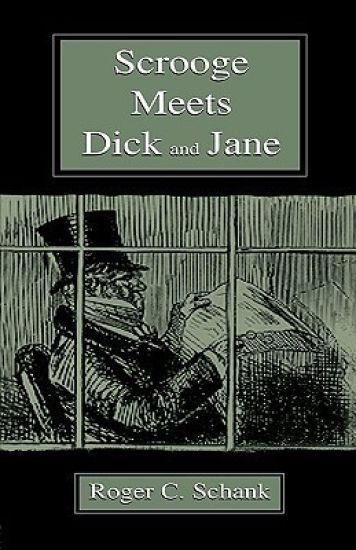
Scrooge Meets Dick and Jane
Roger C. Schank
Routledge Member of the Taylor and Francis Group
2001
nidottu
To hear politicians talk, one would think the entire purpose of school is to assess children rather than educate them. Excitement about learning doesn't seem to be on anyone's agenda. The villains are those who profit from testing mania, make the tests, coach for testing, publish the books on which the tests are based, and believe that the results matter. Children are being taught things they don't need to know and nobody seems to care. Scrooge Meets Dick and Jane is a cautionary tale of the dangers of educational testing and outmoded curriculum design. Bringing a new twist to Charles Dickens' classic story, A Christmas Carol, Scrooge is recast as the head of an educational testing service. He is faced with the ghosts of Education Past, Present, and Future as well as his former mentor, John Dewey. As he observes a horrible future, he comes to understand the harm he has done and its repercussions on the school system. His time with the ghosts and John Dewey leads him to a dramatic turnaround regarding schools and scholastic teaching. It haunts him until he decides to undo the damage he has done to children all over the world.
Roger Schank’s influential book, Dynamic Memory, described how computers could learn based upon what was known about how people learn. Since that book’s publication in 1982, Dr Schank has turned his focus from artificial intelligence to human intelligence. Dynamic Memory Revisited contains the theory of learning presented in the original book, extending it to provide principles for teaching and learning. It includes Dr Schank’s important theory of case-based reasoning and assesses the role of stories in human memory. In addition, it covers his ideas on non-conscious learning, indexing, and the cognitive structures that underlie learning by doing. Dynamic Memory Revisited is crucial reading for all who are concerned with education and school reform. It draws attention to how effective learning takes place and provides instruction for developing software that truly helps students learn.
Roger Schank's influential book, Dynamic Memory, described how computers could learn based upon what was known about how people learn. Since that book's publication in 1982, Dr Schank has turned his focus from artificial intelligence to human intelligence. Dynamic Memory Revisited contains the theory of learning presented in the original book, extending it to provide principles for teaching and learning. It includes Dr Schank's important theory of case-based reasoning and assesses the role of stories in human memory. In addition, it covers his ideas on non-conscious learning, indexing, and the cognitive structures that underlie learning by doing. Dynamic Memory Revisited is crucial reading for all who are concerned with education and school reform. It draws attention to how effective learning takes place and provides instruction for developing software that truly helps students learn.
Engines for Education
Roger C. Schank; Chip Cleary
Routledge Member of the Taylor and Francis Group
1995
nidottu
Most six-year-olds can't wait to go to school on that first day in September. It's a sign of coming of age. They get to go to school like the big kids. For an alarmingly large number of these children, however, boredom, anxiety, and fear of learning quickly set in. This happens because societies build schools that achieve much less than they promise, are frustrating for students, and generally fail to help children become adults who can think for themselves. The development of flexible, inquiring minds has rarely been the primary consideration in the design of educational systems. Making students into proper members of society has usually been of much greater concern than developing students who are creative thinkers. Today's schools are organized around yesterday's ideas, needs, and resources. The purpose of this volume is to raise consciousness about the changes needed in the educational system. It is concerned with what is wrong with the educational system and how to improve it. It presents a pragmatic view of what education could be through the use of computer technology -- technology permitting us to pursue the radical notion that children must be allowed to guide their own education because interested learners learn more. Children can and will become voracious learners if they are in charge of their own education. This does not mean letting them play video games all day, but it does mean allowing them to pursue the intellectual goals that interest them, rather than being force-fed knowledge according to someone else's schedule. The school system must face the responsibility of creating learning environments that are so much fun that children cannot wait to get up in the morning and go to school. This volume describes the progress being made at The Institute for the Learning Sciences using computers to provide motivating environments for learning -- environments that enable students to explore new worlds, and learn things by doing them. This technology will allow society to support what is one of the most important parts of a good educational system: the cultivation of individual initiative in students. This text documents the authors' work from the cognitive psychology which underlies it on through to guided tours of a number of the software learning environments they've developed. The CD ROM version of Engines for Education illustrates the types of innovative education software being developed at the Institute for the Learning Sciences at Northwestern University. In addition to providing tours of seven different ILS programs, the CD ROM itself provides an example of a new form of hypermedia system developed at ILS. Containing the complete text of the book with full-text search, the CD ROM enables readers to move fluidly between pages as they would with a traditional book; it also engages the reader through question-answer interactions with the system. Hardware Requirements: Macintosh (not a Macintosh Power PC) with 16M of RAM (13M of free RAM) and a CD ROM Drive. Software Requirements: System 7 (or later version) and Quicktime.
Inside Case-Based Reasoning
Christopher K. Riesbeck; Roger C. Schank
Lawrence Erlbaum Associates Inc
1989
sidottu
Introducing issues in dynamic memory and case-based reasoning, this comprehensive volume presents extended descriptions of four major programming efforts conducted at Yale during the past several years. Each descriptive chapter is followed by a companion chapter containing the micro program version of the information. The authors emphasize that the only true way to learn and understand any AI program is to program it yourself. To this end, the book develops a deeper and richer understanding of the content through LISP programming instructions that allow the running, modification, and extension of the micro programs developed by the authors.
Scripts, Plans, Goals, and Understanding
Roger C. Schank; Robert P. Abelson
Lawrence Erlbaum Associates Inc
1977
sidottu
First Published in 1977. In the summer of 1971, there was a workshop in an ill-defined field at the intersection of psychology, artificial intelligence, and linguistics. The fifteen participants were in various ways interested in the representation of large systems of knowledge (or beliefs) based upon an understanding process operating upon information expressed in natural language. This book reflects a convergence of interests at the intersection of psychology and artificial intelligence. What is the nature of knowledge and how is this knowledge used? These questions lie at the core of both psychology and artificial intelligence.