Kirjojen hintavertailu. Mukana 12 335 630 kirjaa ja 12 kauppaa.

Kirjailija

Roger D. Stone

Kirjat ja teokset yhdessä paikassa: 3 kirjaa, julkaisuja vuosilta 2002-2024, suosituimpien joukossa The Lives of Dillon Ripley. Vertaile teosten hintoja ja tarkista saatavuus suomalaisista kirjakaupoista.

3 kirjaa

Kirjojen julkaisuhaarukka 2002-2024.

The Mightier Hudson

The Mightier Hudson

Roger D. Stone

ROWMAN LITTLEFIELD
2024
pokkari
Against the odds, the Hudson Valley has cleaned up its act and rediscovered its soul. In this well researched and passionate treatise on the much celebrated but long abused Hudson River, author Roger D. Stone describes how protecting New York City’s drinking water supply, making innovative efforts to safeguard views and open space, and reconnecting communities with long abandoned stretches of priceless shoreline have combined to bring about a new age of spirted restoration in a region that long seemed condemned to cultural and environmental mediocrity. Stone links disparate historical, cultural, political, and environmental threads to clearly show the multiple forces that have made this turnaround happen, a vivid example of new ideas and values for a nation struggling to counter devastating economic and environmental effects of misusing the landscape. The extraordinary revival of the majestic Hudson River estuary and its surrounding areas, even in communities where hope was long in short supply, shows remarkable results when it’s done right.
The Lives of Dillon Ripley

The Lives of Dillon Ripley

Roger D. Stone

Dartmouth College Press
2017
sidottu
A Yale-educated Renaissance man, S. Dillon Ripley was a “courtly, determined, hugely ambitious, energetic, funny, and colorful ornithologist, conservationist, and cultural standard-bearer” who led the Smithsonian Institution for twenty years, during its greatest period of growth. During his watch, from 1964 to 1984, the SI added eight new museums and seven new research centers and began publication of the Smithsonian magazine. It was Ripley’s vision that transformed “the nation’s attic” from a dusty archive to a vibrant educational and cultural institution, just as he had transformed Yale’s Peabody museum before it. Prior to his career at the SI, and running parallel with it for the rest of his life, was Ripley’s work as an ornithologist, begun in New Guinea in the 1930s, continued through his PhD from Harvard in 1943, and culminating in his landmark thirty-year project documenting the bird life of India. His lifelong passion for ornithology led him to positions of leadership in worldwide nature conservation. In the midst of these endeavors he was recruited in 1944 to the Office of Strategic Services, a Yalie club at the outset that became the forerunner of the modern CIA. Posted to Ceylon, he recruited and ran agents who reported from and infiltrated Japanese-held Southeast Asia. Roger D. Stone worked with Ripley on the board of the World Wildlife Fund. He has access to the Ripley family’s archives and photos, as well as to the voluminous archives at the Smithsonian and the National Archives, and to over forty hours of transcribed interviews, conducted with Ripley at the Smithsonian.
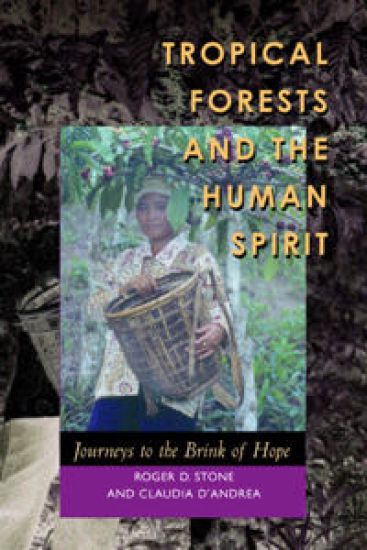
Tropical Forests and the Human Spirit

Tropical Forests and the Human Spirit

Roger D. Stone; Claudia D'Andrea

University of California Press
2002
pokkari
Tropical forests are vanishing at an alarming rate. This book, based on extensive international field research, highlights one solution for preserving this precious resource: empowering local people who depend on the forest for survival. Synthesizing a vast amount of information that has never been brought together in one place, Roger D. Stone and Claudia D'Andrea provide a clearly written and energizing tour of global efforts to empower community-based forest stewards. Along the way, they show the fundamental importance of tropical forest ecosystems and deepen our sense of urgency to save them for the benefit of billions of rural people in tropical and subtropical regions as well as for countless species of plants and animals.In their travels to research this book, the authors saw many remarkable examples of how proficient even the poorest local people can be in stabilizing and recovering formerly destitute forests. With engagingly written case studies from Thailand's Golden Triangle to Mindanao in the Philippines, from Indonesia, India, and Africa to Brazil, Mexico, and Central America, they introduce us to the communities and the individuals, the governments, the loggers, the agencies, and the local groups who vie for forest resources.Contrasting community-based efforts and traditional forest management with government and donor efforts, they discuss the many reasons why international institutions and national governments have been unable and unwilling to stem the accelerating loss of tropical forestland. This book argues that we are paying a terrible price - politically, economically, and environmentally - for allowing tropical forests to be stripped. Community-based forestry is no panacea, but this book clearly shows its effectiveness as a management technique.