Kirjojen hintavertailu. Mukana 12 152 606 kirjaa ja 12 kauppaa.

Kirjailija

Roger E. Backhouse

Kirjat ja teokset yhdessä paikassa: 16 kirjaa, julkaisuja vuosilta 1995-2026, suosituimpien joukossa Founder of Modern Economics: Paul A. Samuelson. Vertaile teosten hintoja ja tarkista saatavuus suomalaisista kirjakaupoista.

Mukana myös kirjoitusasut: Roger E Backhouse

16 kirjaa

Kirjojen julkaisuhaarukka 1995-2026.

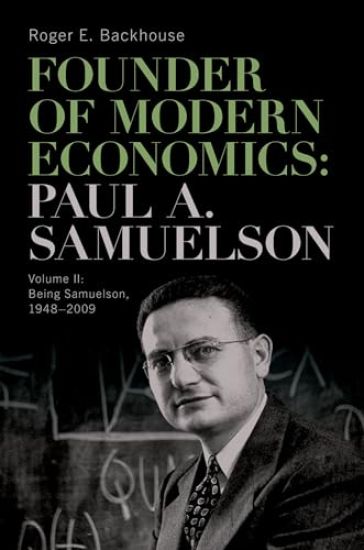
Founder of Modern Economics: Paul A. Samuelson

Founder of Modern Economics: Paul A. Samuelson

Roger E. Backhouse

OXFORD UNIVERSITY PRESS INC
2026
sidottu
Paul A. Samuelson is widely regarded as the world's leading economist in the so-called “Age of Keynes”, the three decades after WWII, acknowledged by his being the first American to win the Nobel prize in economics. Foundations of Economic Analysis was a manual on how economic theory should be done, and the nineteen editions of Economics: An Introductory Analysis provided the first exposure to economics for millions of students worldwide. Volume I of this intellectual biography told the story of someone who established himself as the most promising economist of his generation. This volume shows how he went on to dominate the subject. He was well known as a mathematical economist at a time when the use of mathematics in economics was in its infancy but, as this volume shows, he was far more than that. He wrote seminal articles in field after field, including consumer behaviour, international trade, consumer, finance, public expenditure, optimal taxation, the economics of inflation and unemployment, and many others. He had the ability to use his knowledge of mathematics to simplify economic problems, providing the concepts that other economists could use and yet he could write in a style that entertained as well as informed his readers. He helped transform of his department at the Massachusetts Institute of Technology from a relative backwater into the most influential economics department in the United States, its graduates filling influential positions in academia, central banks, and the provision of economic advice to government. He was active in trading commodities and played a significant role in the establishment of index funds. An innovative feature of this biography is that it is not confined to what he called his scientific work but covers his political economy (his analysis of current events and his policy advice) in depth. From the start of his academic career, he was in demand as an economic adviser, his most prominent role being as adviser to President John Kennedy, and he was a regular columnist for newspapers and news magazines from the Financial Times to the Washington Post and Newsweek and a range of Japanese and Korean newspapers.
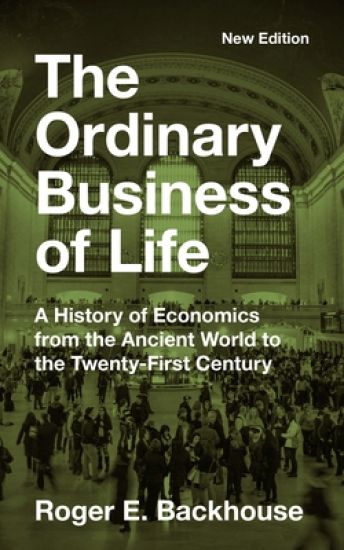
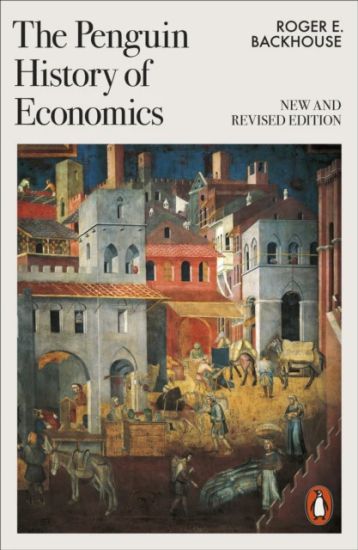
The Ordinary Business of Life: A History of Economics from the Ancient World to the Twenty-First Century - New Edition
The classic history of economic thought through the ages--now fully updated and expanded Hesiod defined the basic economic problem as one of scarce resources, a view still held by economists today. Diocletian tried to save the Roman Empire with wage and price fixes--a strategy that has not gone entirely out of style. Roger Backhouse takes readers from the ancient world to the frontiers of game theory, mechanism design, and engagements with climate science, presenting an essential history of a discipline that economist Alfred Marshall called "the study of mankind in the ordinary business of life." Backhouse introduces the many fascinating figures who have thought about money and markets down through the centuries--from philosophers and theologians to politicians and poets--and shows how today's economic ideas have their origins in antiquity. This updated edition of The Ordinary Business of Life includes a new chapter on contemporary economics and the rest of the book has been thoroughly revised.
The History of Economics

The History of Economics

Roger E. Backhouse; Keith Tribe

Agenda Publishing
2017
nidottu
As a broad introduction to the history of economic thought – based on courses the authors have taught for many years – this book provides a magisterial overview for students and teachers who have not had the opportunity to cover the development of the field of economics in its historical context. The text is presented as a series of twenty-four lectures, which can be used as the basis for self-study or for the delivery of a course. Each lecture presents an outline of aims, a select bibliography, a chronology, an overview of between 3,000 and 4,000 words, and questions for further study or reflection. Contemporary understanding of economic principles sheds little light on the manner in which past thinkers thought, so the reader is provided with the much-needed context behind the development of ideas, as well as being guided through the original writings of economists such as Smith, Jevons, Marshall, Robbins, Keynes and others. The emphasis is on the broad developing stream of economic argument from the seventeenth century to the present, seeking to emphasize a diversity that is sometimes suppressed in more conventional textbooks, which tend to organize their histories into sequences of schools of thought. Backhouse and Tribe bring their considerable insight and knowledge to bear on the text, having honed their presentation to the needs of those with no previous background in the subject, without sacrificing analysis or rigour. The book will be warmly welcomed by students and teachers alike.
The History of Economics

The History of Economics

Roger E. Backhouse; Keith Tribe

Agenda Publishing
2017
sidottu
As a broad introduction to the history of economic thought – based on courses the authors have taught for many years – this book provides a magisterial overview for students and teachers who have not had the opportunity to cover the development of the field of economics in its historical context. The text is presented as a series of twenty-four lectures, which can be used as the basis for self-study or for the delivery of a course. Each lecture presents an outline of aims, a select bibliography, a chronology, an overview of between 3,000 and 4,000 words, and questions for further study or reflection. Contemporary understanding of economic principles sheds little light on the manner in which past thinkers thought, so the reader is provided with the much-needed context behind the development of ideas, as well as being guided through the original writings of economists such as Smith, Jevons, Marshall, Robbins, Keynes and others. The emphasis is on the broad developing stream of economic argument from the seventeenth century to the present, seeking to emphasize a diversity that is sometimes suppressed in more conventional textbooks, which tend to organize their histories into sequences of schools of thought. Backhouse and Tribe bring their considerable insight and knowledge to bear on the text, having honed their presentation to the needs of those with no previous background in the subject, without sacrificing analysis or rigour. The book will be warmly welcomed by students and teachers alike.
Founder of Modern Economics: Paul A. Samuelson

Founder of Modern Economics: Paul A. Samuelson

Roger E. Backhouse

Oxford University Press Inc
2017
sidottu
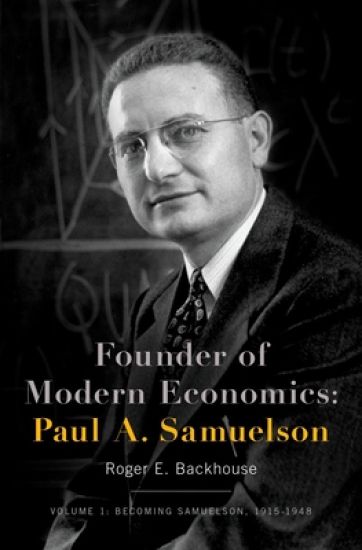
Paul Samuelson was at the heart of a revolution in economics. He was "the foremost academic economist of the 20th century," according to the New York Times, and the first American to win the Nobel Prize in Economics. His work transformed the field of economics and helped give it the theoretical and mathematic rigor that increased its influence in business and policy making. In Founder of Modern Economics, Roger E. Backhouse explores the central importance of Samuelson's personality and social networks to understanding his intellectual development. This is the first of two volumes covering Samuelson's extended and productive life and career. This volume surveys Samuelson's early years growing up in the Midwest to his experiences at the University of Chicago and Harvard University, where leading scholars in economics and other disciplines stimulated and rewarded his curiosity. His thinking was influenced by the natural sciences and he understood that a critical, scientific approach increased insights into important social and economic questions. He realized that these questions could not be answered through rhetorical debate but required rigor. His "eureka" moment came, he said, when "a good fairy whispered to me that math was a skeleton key to solve age old problems in economics." Backhouse traces Samuelson's thinking from his early days to the publication of his groundbreaking book Foundations of Economic Analysis and Economics: An Introductory Analysis, which influenced generations of students. His work set the stage for economics to become a more cohesive and coherent discipline, based on mathematical techniques that provided surprising insights into many important topics, from business cycles to wage and unemployment rates, and from how competition influences trade to how tax rates affects tax collection. Founder of Modern Economics is a profound contribution to understanding how modern economics developed and the thinking of a revolutionary thinker.
Transforming Modern Macroeconomics

Transforming Modern Macroeconomics

Roger E. Backhouse; Mauro Boianovsky

Cambridge University Press
2014
pokkari
This book tells the story of the search for disequilibrium micro-foundations for macroeconomic theory, from the disequilibrium theories of Patinkin, Clower and Leijonhufvud to recent dynamic stochastic general equilibrium models with imperfect competition. Placing this search against the background of wider developments in macroeconomics, the authors contend that this was never a single research program, but involved economists with very different aims who developed the basic ideas about quantity constraints, spillover effects and coordination failures in different ways. The authors contrast this with the equilibrium, market-clearing approach of Phelps and Lucas, arguing that equilibrium theories simply assumed away the problems that had motivated the disequilibrium literature. Although market-clearing models came to dominate macroeconomics, disequilibrium theories never went away and continue to exert an important influence on the subject. Although this book focuses on one strand in modern macroeconomics, it is crucial to understanding the origins of modern macroeconomic theory.
Transforming Modern Macroeconomics

Transforming Modern Macroeconomics

Roger E. Backhouse; Mauro Boianovsky

Cambridge University Press
2012
sidottu
This book tells the story of the search for disequilibrium micro-foundations for macroeconomic theory, from the disequilibrium theories of Patinkin, Clower and Leijonhufvud to recent dynamic stochastic general equilibrium models with imperfect competition. Placing this search against the background of wider developments in macroeconomics, the authors contend that this was never a single research program, but involved economists with very different aims who developed the basic ideas about quantity constraints, spillover effects and coordination failures in different ways. The authors contrast this with the equilibrium, market-clearing approach of Phelps and Lucas, arguing that equilibrium theories simply assumed away the problems that had motivated the disequilibrium literature. Although market-clearing models came to dominate macroeconomics, disequilibrium theories never went away and continue to exert an important influence on the subject. Although this book focuses on one strand in modern macroeconomics, it is crucial to understanding the origins of modern macroeconomic theory.
Capitalist Revolutionary

Capitalist Revolutionary

Roger E. Backhouse; Bradley W. Bateman

Harvard University Press
2011
sidottu
The Great Recession of 2008 restored John Maynard Keynes to prominence. After decades when the Keynesian revolution seemed to have been forgotten, the great British theorist was suddenly everywhere. The New York Times asked, “What would Keynes have done?” The Financial Times wrote of “the undeniable shift to Keynes.” Le Monde pronounced the economic collapse Keynes’s “revenge.” Two years later, following bank bailouts and Tea Party fundamentalism, Keynesian principles once again seemed misguided or irrelevant to a public focused on ballooning budget deficits. In this readable account, Backhouse and Bateman elaborate the misinformation and caricature that have led to Keynes’s repeated resurrection and interment since his death in 1946.Keynes’s engagement with social and moral philosophy and his membership in the Bloomsbury Group of artists and writers helped to shape his manner of theorizing. Though trained as a mathematician, he designed models based on how specific kinds of people (such as investors and consumers) actually behave—an approach that runs counter to the idealized agents favored by economists at the end of the century.Keynes wanted to create a revolution in the way the world thought about economic problems, but he was more open-minded about capitalism than is commonly believed. He saw capitalism as essential to a society’s well-being but also morally flawed, and he sought a corrective for its main defect: the failure to stabilize investment. Keynes’s nuanced views, the authors suggest, offer an alternative to the polarized rhetoric often evoked by the word “capitalism” in today’s political debates.
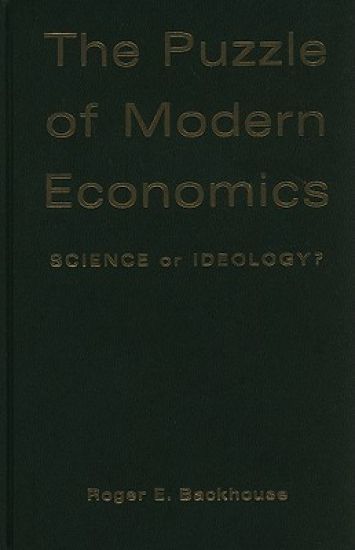
The Puzzle of Modern Economics

The Puzzle of Modern Economics

Roger E. Backhouse

Cambridge University Press
2010
pokkari
Does economics hold the key to everything or does the recent financial crisis show that it has failed? This book provides an assessment of modern economics that cuts through the confusion and controversy on this question. Case studies of the creation of new markets, the Russian transition to capitalism, globalization, and money and finance establish that economics has been very successful where problems have been well defined and where the world can be changed to fit the theory, but that it has been less successful in tackling bigger problems. The book then offers a historical perspective on how economists have, since the Second World War, tried to make their subject scientific. It explores the evolving relationship between science and ideology and investigates the place of heterodoxy and dissent within the discipline.
The Puzzle of Modern Economics

The Puzzle of Modern Economics

Roger E. Backhouse

Cambridge University Press
2010
sidottu
Does economics hold the key to everything or does the recent financial crisis show that it has failed? This book provides an assessment of modern economics that cuts through the confusion and controversy on this question. Case studies of the creation of new markets, the Russian transition to capitalism, globalization, and money and finance establish that economics has been very successful where problems have been well defined and where the world can be changed to fit the theory, but that it has been less successful in tackling bigger problems. The book then offers a historical perspective on how economists have, since the Second World War, tried to make their subject scientific. It explores the evolving relationship between science and ideology and investigates the place of heterodoxy and dissent within the discipline.
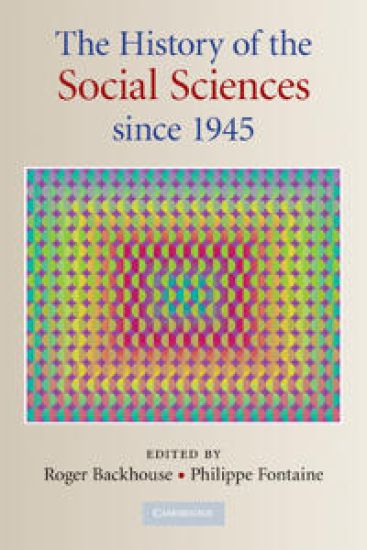
The History of the Social Sciences since 1945

The History of the Social Sciences since 1945

Roger E. Backhouse; Philippe Fontaine

Cambridge University Press
2010
sidottu
This compact volume covers the main developments in the social sciences since the Second World War. Chapters on economics, human geography, political science, psychology, social anthropology, and sociology will interest anyone wanting short, accessible histories of those disciplines, all written by experts in the relevant field; they will also make it easy for readers to make comparisons between disciplines. A final chapter proposes a blueprint for a history of the social sciences as a whole. Whereas most of the existing literature considers the social sciences in isolation from one other, this volume shows that they have much in common; for example, they have responded to common problems using overlapping methods, and cross-disciplinary activities have been widespread.
The History of the Social Sciences since 1945

The History of the Social Sciences since 1945

Roger E. Backhouse; Philippe Fontaine

Cambridge University Press
2010
pokkari
This compact volume covers the main developments in the social sciences since the Second World War. Chapters on economics, human geography, political science, psychology, social anthropology, and sociology will interest anyone wanting short, accessible histories of those disciplines, all written by experts in the relevant field; they will also make it easy for readers to make comparisons between disciplines. A final chapter proposes a blueprint for a history of the social sciences as a whole. Whereas most of the existing literature considers the social sciences in isolation from one other, this volume shows that they have much in common; for example, they have responded to common problems using overlapping methods, and cross-disciplinary activities have been widespread.
Truth and Progress in Economic Knowledge

Truth and Progress in Economic Knowledge

Roger E. Backhouse

Edward Elgar Publishing Ltd
1997
sidottu
Truth and Progress in Economic Knowledge provides a new perspective on economic methodology, specifically addressing progress in economic knowledge. This important investigation argues that economic methodology is developed through analysing economics, not through imposing a framework developed in other sciences.Roger Backhouse begins his discussion by defending economic methodology both against economists who object to it on practical grounds and post-modern critics who argue that the notion of methodology makes no sense. He then explores the concept of progress, drawing on ideas from Kuhn, the notion of pragmatism and the Popperian tradition. The discussion develops to examine theoretical economics, considering Lakatos's concept of informal mathematics, analysing replication in economics and the use of econometrics and informal empirical methods to test economic theories. The author argues that replication is not simply an econometric problem, but a problem for economics, as it involves both the nature of economic theory and the way in which economists use economic results.This new approach to economic methodology will be of special interest to academics, philosophers with an interest in economics and social sciences, and students of economic methodology.
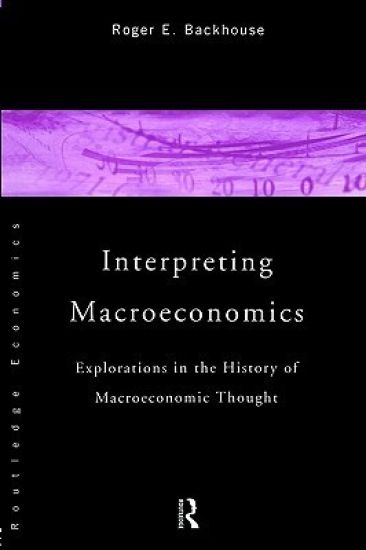
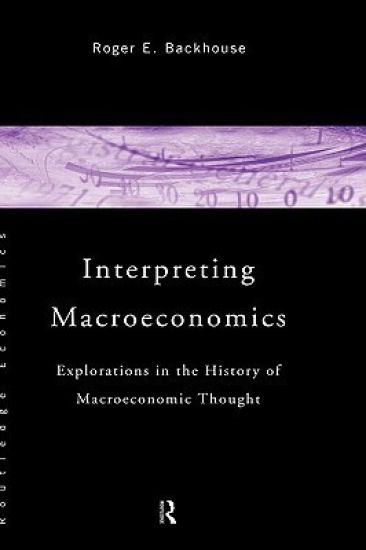
Interpreting Macroeconomics

Interpreting Macroeconomics

Roger E. Backhouse

Routledge
1996
nidottu
Interpreting Macroeconomics explores a variety of different approaches to macroeconomic thought. The book considers a number of historiographical and methodological positions, as well as analyzing various important episodes in the development of macroeconomics, before during and after the Keynesian revolution. Roger Backhouse shows that the full richness of these developments can only by brought out by approaches which blend both relativism and absolutism, and historical and rational reconstructions. Examples discussed include Hobson, Keynes and Friedman.
Interpreting Macroeconomics

Interpreting Macroeconomics

Roger E. Backhouse

Routledge
1995
sidottu
Interpreting Macroeconomics explores a variety of different approaches to macroeconomic thought. The book considers a number of historiographical and methodological positions, as well as analyzing various important episodes in the development of macroeconomics, before during and after the Keynesian revolution. Roger Backhouse shows that the full richness of these developments can only by brought out by approaches which blend both relativism and absolutism, and historical and rational reconstructions. Examples discussed include Hobson, Keynes and Friedman.