Kirjojen hintavertailu. Mukana 12 595 353 kirjaa ja 12 kauppaa.
Kirjailija
Roger E. Kasperson
Kirjat ja teokset yhdessä paikassa: 8 kirjaa, julkaisuja vuosilta 1993-2020, suosituimpien joukossa Social Contours of Risk. Vertaile teosten hintoja ja tarkista saatavuus suomalaisista kirjakaupoista.
This book aims at a better understanding of the current practice of hazard management by large corporations. In-depth studies of individual corporations provide a state-of-the-art assessment of the advances and problems inherent in industrial safety management.
This book provides one of the first systematic accounts of how corporations manage risk to workers and consumers. Careful analysis and interviewing in different corporations elicit a portrait of the myriad hazards that currently confront industry, the corporate programs and resources that have emerged since 1970 to respond to this challenge, and factors that have contributed to successes and failures. In-depth studies of the Volvo Car Corporation, Rocky Flats nuclear weapons plant, Union Carbide's Bhopal facility, and large chemical and pharmaceutical corporations provide a state-of-the-art assessment of the advances and problems inherent today in industrial safety management. Roger E. Kasperson, Jeanne X. Kasperson, and Christoph Hohenemser are senior researchers at Clark University's Center for Technology, Environment, and Development (CENTED). Roger E. Kasperson is Director of CENTED and its Hazard Assessment Group. Jeanne X. Kasperson is Research Librarian at CENTED and Senior Research Associate in Brown University's World Hunger Program. Hohenemser, a professor of physics, directs the Environment, Technology, and Society Program at Clark University. Robert W. Kates, formerly with CENTED, is Director of the Alan Shawn Feinstein World Hunger Program at Brown University. Ola Svenson, of the Department of Psychology at Lund University in Sweden, is a leading researcher in the field of risk perception and decision analysis.
The desire to understand people's influence on ecosystems has inspired scientific studies and analyses of the stress individuals and communities place on the environment, human well-being, and the tradeoffs between them. As an emerging discipline, Structural Human Ecology is devoted to unlocking the dynamic links between population, environment, social organization, and technology. The new field offers cutting-edge research in risk analysis that can be used to evaluate environmental policies and thus help citizens and societies worldwide learn how to most effectively mitigate human impacts on the biosphere. The essays in this volume were presented by leading international scholars at a 2011 symposium honoring the late Dr. Eugene Rosa, then Boeing Distinguished Professor of Environmental Sociology at WSU.
We live in a 'risk society' where the identification, distribution and management of risks, from new technology, environmental factors or other sources are crucial to our individual and social existence. In The Social Contours of Risk, Volumes I and II, two of the world's leading and most influential analysts of the social dimensions of risk bring together their most important contributions to this fundamental and wide-ranging field. Volume II centres on the analysis and management of risk in society, in international business and multinationals, and globally. The 'acceptability' of risk to an individual depends on the context, whether the larger society or in, for example, a corporate framework. Their work clarifies the structures and processes for managing risks in the private sector and the factors that produce or impede effective decisions. The authors demonstrate that corporate culture is crucial in determining risk management. They analyse the transfer of corporate risk management systems from industrial to developing countries, and how globalization is spreading and creating new kinds of risk - the combination of traditional and modern hazards presented by climate change, technology transfer and economic growth. They describe the new priorities and capacities needed to deal with these enhanced vulnerabilities around the globe.
We live in a 'risk society' where the identification, distribution and management of risks, from new technology, environmental factors or other sources are crucial to our individual and social existence. In The Social Contours of Risk, Volumes 1 and 2, two of the world's leading and most influential analysts of the social dimensions of risk bring together their most important contributions to this fundamental and wide-ranging field. Volume II centres on the analysis and management of risk in society, in international business and multinationals, and globally. The 'acceptability' of risk to an individual depends on the context, whether the larger society or in, for example, a corporate framework. Their work clarifies the structures and processes for managing risks in the private sector and the factors that produce or impede effective decisions. The authors demonstrate that corporate culture is crucial in determining risk management. They analyse the transfer of corporate risk management systems from industrial to developing countries, and how globalization is spreading and creating new kinds of risk - the combination of traditional and modern hazards presented by climate change, technology transfer and economic growth. They describe the new priorities and capacities needed to deal with these enhanced vulnerabilities around the globe.
We live in a 'risk society' where the identification, distribution and management of risks, from new technology, environmental factors or other sources are crucial to our individual and social existence. In The Social Contours of Risk, Volumes I and II, two of the world's leading and most influential analysts of the social dimensions of risk bring together their most important contributions to this fundamental and wide-ranging field. Volume I collects their fundamental work on how risks are communicated among different publics and stakeholders, including local communities, corporations and the larger society. It analyses the problems of lack of transparency and trust, and explores how even minor effects can be amplified and distorted through media and social responses, preventing effective management. The final section investigates the difficult ethical issues raised by the unequal distribution of risk depending on factors such as wealth, location and genetic inheritance - with examples from worker and public protection, facility-siting conflicts, transporting hazardous waste and widespread impacts such as climate change. Volume II centres on the analysis and management of risk in society, in international business and multinationals, and globally. The 'acceptability' of risk to an individual depends on the context, whether the larger society or in, for example, a corporate framework. Their work clarifies the structures and processes for managing risks in the private sector and the factors that produce or impede effective decisions. The authors demonstrate that corporate culture is crucial in determining risk management. They analyse the transfer of corporate risk management systems from industrial to developing countries, and how globalization is spreading and creating new kinds of risk - the combination of traditional and modern hazards presented by climate change, technology transfer and economic growth. They describe the new priorities and capacities needed to deal with these enhanced vulnerabilities around the globe.
Despite international initiatives such as the Earth Summit in 1992 and ongoing efforts to implement the Kyoto Protocol, human activities continue to register a destructive toll on the planetary environment. At root, research on global environmental risk seeks new pathways for reversing unsustainable trends, curtailing ongoing destructive activities, and creating a life-sustaining planet. This book takes stock of the distinctive challenges posed by global environmental risks, the capacity of knowledge systems to identify and characterize such risks, and the competence of human society to manage the unprecedented complexity. Particular attention trains on engaging, in ways conducive to enhancing social learning and adaptation, the large uncertainties inherent in these risks. Various chapters enlist different scales of analysis to explore the manifestation and causes of global environmental risks in all the diversity of their regional expression. Throughout, the editors and contributors accord prominence to the vulnerability of people and places to environmental degradation. Understanding vulnerability is a neglected key to assessing the nature of the risks and determining strategies for altering trajectories of threat. Global risk futures, the editors argue, are not intractable, and are still amenable to a risk-analysis enterprise that is democratic in principle, humanistic in concept, and geared to the realities that pertain to the particular societies, locales, and regions that will ultimately bear the risk.
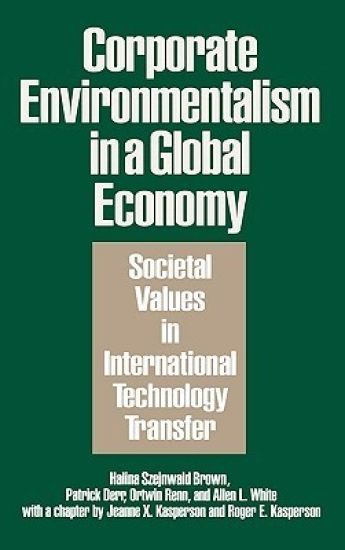
Brown and her colleagues offer an unprecedented analysis of how multinational corporations and developing countries manage, in the face of differing values, to relate as each proceeds in the interest of particular development objectives. Through three case studies involving Du Pont Agrichemical, Occidental Chemical, and Xerox and the countries of India and Thailand, the authors illustrate how the differing values of the host country and the corporation influence decisions. It offers valuable insights into the anatomy of decision-making in a highly sensitive and increasingly scrutinized segment of contemporary business.This is a particularly timely examination of multinational enterprises, of the impact of corporate cultures, sustainable development, hazard management and environmental issues seen in relationship to developing countries' values, needs, and objectives.