Kirjojen hintavertailu. Mukana 12 657 676 kirjaa ja 12 kauppaa.

Kirjailija

Roger French

Kirjat ja teokset yhdessä paikassa: 12 kirjaa, julkaisuja vuosilta 1986-2015, suosituimpien joukossa William Harvey's Natural Philosophy. Vertaile teosten hintoja ja tarkista saatavuus suomalaisista kirjakaupoista.

12 kirjaa

Kirjojen julkaisuhaarukka 1986-2015.

William Harvey's Natural Philosophy

William Harvey's Natural Philosophy

Roger French

Cambridge University Press
1994
sidottu
William Harvey’s natural philosophy was a view of the world that he had put together during his education in Cambridge and Padua. It contained ways of structuring knowledge, formulating questions and arriving at answers that directed the programme of work in which he discovered the circulation of the blood. This book, the most extensive discussion of Harvey to be published for over twenty-five years, reports extensively on the views of those who wrote for and against him. It is a study of a major change in natural philosophy and of the forces which acted for and, equally important, against change. In a period traditionally central to historians of science, it is argued here that natural philosophy and particularly Harvey’s speciality within it - anatomy - was theocentric. Harvey’s contribution was experiment; and the revolution which occurred in the seventeenth century was concerned not with science but with experiment and the status of natural knowledge.
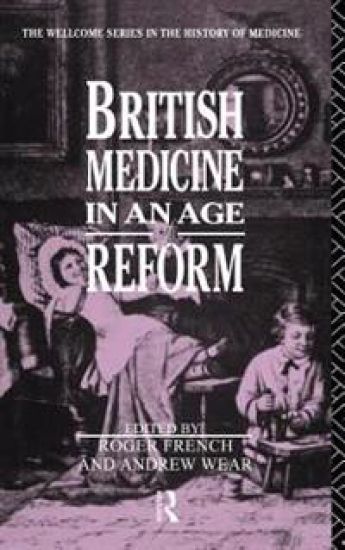
British Medicine in an Age of Reform

British Medicine in an Age of Reform

Roger French; Andrew Wear

Routledge
2015
nidottu
British Medicine in an Age of Reform, charts the nature and dynamics of the radical changes which occurred between 1780 and 1850 - a great turning point in British medicine. Medicine was reformed just as politics was being reformed. It became a recognizable profession, and at the same time there was an impetus from within to base the subject upon science. By the end of the 1850's medicine had become perceptibly `modern'. Contributions by acknowledged experts cover subjects from Apothecaries' Act of 1815 to froensic medicine, and the effect of scientific medicine on the doctor-patient relationship. Fascinating and detailed, British Medicine in an Age of Reform provides a rich source of information for students of social history, the history of medicine and science, and for those working in the medical profession.
The Great Pox

The Great Pox

Jon Arrizabalaga; John Henderson; Roger French

Yale University Press
2014
pokkari
One hundred and fifty years after the Black Death killed a third of the population of Western Europe, a new plague swept across the continent. The Great Pox—commonly known as the French disease—brought a different kind of horror: instead of killing its victims rapidly, it endured in their bodies for years, causing acute pain, disfigurement, and ultimately an agonizing death.In this new study, three experts explore the impact of the new plague and society's reaction to its challenge. Using a range of contemporary sources, from the archives of charitable and sanitary institutions that coped with the sick to the medical tracts of those who sought to cure it, they provide the first detailed account of the experience of the disease across Renaissance Italy as well as in France and Germany.The authors analyze the symptoms of the Great Pox and the identity of patients, richly documented in the records of the massive hospital for "incurables" established in early sixteenth-century Rome. They show how it challenged accepted medical theory and practice and provoked public disputations among university teachers. And at the most practical level, they reveal the plight of its victims at all levels of society, from ecclesiastical lords to the diseased poor who begged in the streets. Examining a range of contexts from princely courts and republics to university faculties, confraternities, and hospitals, the authors argue powerfully for a historical understanding of the Great Pox based on contemporary perceptions rather than a retrospective diagnosis of what later generations came to know as "syphilis."
William Harvey's Natural Philosophy

William Harvey's Natural Philosophy

Roger French

Cambridge University Press
2006
pokkari
William Harvey's natural philosophy was a view of the world that he had put together during his education in Cambridge and Padua. It contained ways of structuring knowledge, formulating questions and arriving at answers that directed the programme of work in which he discovered the circulation of the blood. This book, the most extensive discussion of Harvey to be published for over twenty-five years, reports extensively on the views of those who wrote for and against him. It is a study of a major change in natural philosophy and of the forces which acted for and, equally important, against change. In a period traditionally central to historians of science, it is argued here that natural philosophy and particularly Harvey's speciality within it - anatomy - was theocentric. Harvey's contribution was experiment; and the revolution which occurred in the seventeenth century was concerned not with science but with experiment and the status of natural knowledge.

A New World of Animals

A New World of Animals

Miguel de Asúa; Roger French

Ashgate Publishing Limited
2005
sidottu
Many Early Modern Europeans who during the sixteenth and seventeenth centuries travelled to the New World left written or pictorial records of their encounters with a surprising fauna. The story told in this book is woven out of the threads of those texts and pictures. A New World of Animals shows how the initial wonder at the new beasts gave way to a more utilitarian approach, assessing their economic and medical potential. It elucidates how shifts in European perceptions brought the animals from the realm of the fantastic into the mainstream of early modern natural history, while at the same time changing the way in which Europeans saw their own world. Indeed, the chronicles and treatises of those who in the wake of the discovery arrived in the new lands tell as much about the particular interests and mental worlds of the writers as about the 'new animals'. This book traces the amazement of the first explorers and colonizers, the chronicles of soldiers and Indians, the 'natural histories of the New World', the place of animals in the network of economic interests driving the early expansion of Europe, the views of the missionaries and those of natural philosophers and physicians. Taking the reader from the Brazilian forests to the erudite cabinets of the Old World, from Patagonia to the centres of empire, the story of the discovery of the unexpected menagerie of the New World is also an exploration of Early Modern European imagination and learning.
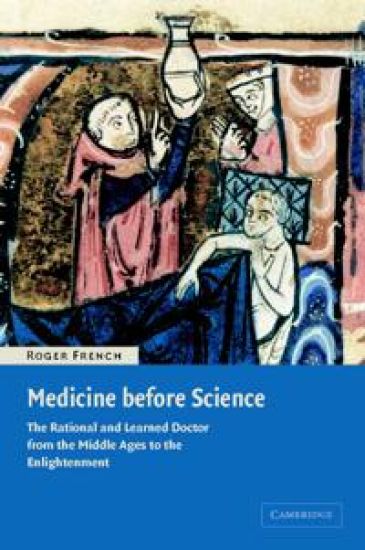
Medicine before Science

Medicine before Science

Roger French

Cambridge University Press
2003
sidottu
This book offers an introduction to the history of university-trained physicians from the middle ages to the eighteenth-century Enlightenment. These were the elite, in reputation and rewards, and they were successful. Yet we can form little idea of their clinical effectiveness, and to modern eyes their theory and practice often seems bizarre. But the historical evidence is that they were judged on other criteria, and the argument of this book is that these physicians helped to construct the expectations of society - and met them accordingly. The main focus is on the European Latin tradition of medicine, reconstructed from ancient sources and relying heavily on natural philosophy for its explanatory power. This philosophy collapsed in the 'scientific revolution', and left the learned and rational doctor in crisis. The book concludes with an examination of how this crisis was met - or avoided - in different parts of Europe during the Enlightenment.
Ancients and Moderns in the Medical Sciences
The theme of this book is the growth of the European tradition of medical theory, from the early Middle Ages until its collapse in the seventeenth century. Central to this tradition were ancient texts and the respect accorded to the ancients themselves by the moderns, the teachers and practitioners of medicine of the Middle Ages and Renaissance. The chapters examine how the ancient texts formed a resource for later medical men and how as a consequence they were sought out, translated and used. Three matters receive particular attention: the classroom culture by which the teachers perpetuated their pupil’s faith in the ancient texts; the use of learning and argumentation by which the university doctors secured their reputation; and medical astrology as a prognostic technique. The story ends when the faith that had been given to Aristotle and Galen, and which held the medical tradition together, was broken, partly by the new natural philosophy and partly by the discovery of the circulation of the blood.
Before Science

Before Science

Roger French; Andrew Cunningham

Scolar Press
1996
sidottu
The opposition of science and religion is a recent phenomenon; in the middle ages, and indeed until the middle of the nineteenth century, there was almost no conflict. In the Middle Ages the objective study of nature - the activity we now call science - was largely the province of religious men. This book looks at the origins of western science and the central role played by the Dominican and Franciscan friars. It explains why these two groups devoted so much intellectual effort to the study of physical and biological phenomena, and distinguishes 'Natural Philosophy' from 'science' as presently understood. Though the friars were recognisably 'scientific' in their approach their motives were religious - they wished to understand the mind of God and the beauty of God's nature. Even so, as this study makes clear, the roots of western science lie in the monasteries and refuges of the medieval friars - the direct forebears of the anti-scientific Popes of the age of Copernicus and Galileo.
Ancient Natural History

Ancient Natural History

Roger French

Routledge
1994
nidottu
Ancient Natural History surveys the ways in which people in the ancient world thought about nature. The writings of Aristotle, Theophrastus, Strabo, Pliny are examined, as well as the popular beliefs of their contemporaries. Roger French finds that the same natural-historical material was used to serve the purposes of both the Greek philosopher and the Christian allegorist, or of a taxonomist like Theophrastus and a collector of curiosa like Pliny. He argues convincingly that the motives of ancient writers on nature were rarely `scientific' and, indeed, that there was not really any science at all in the ancient world.This book will make fascinating reading for students, academics and anyone who is interested in the history of science, or in the ancient history of ideas.
Ancient Natural History

Ancient Natural History

Roger French

Routledge
1994
sidottu
Ancient Natural History surveys the ways in which people in the ancient world thought about nature. The writings of Aristotle, Theophrastus, Strabo, Pliny are examined, as well as the popular beliefs of their contemporaries. Roger French finds that the same natural-historical material was used to serve the purposes of both the Greek philosopher and the Christian allegorist, or of a taxonomist like Theophrastus and a collector of curiosa like Pliny. He argues convincingly that the motives of ancient writers on nature were rarely `scientific' and, indeed, that there was not really any science at all in the ancient world.This book will make fascinating reading for students, academics and anyone who is interested in the history of science, or in the ancient history of ideas.
British Medicine in an Age of Reform

British Medicine in an Age of Reform

Roger French; Andrew Wear

Routledge
1991
sidottu
British Medicine in an Age of Reform, charts the nature and dynamics of the radical changes which occurred between 1780 and 1850 - a great turning point in British medicine. Medicine was reformed just as politics was being reformed. It became a recognizable profession, and at the same time there was an impetus from within to base the subject upon science. By the end of the 1850's medicine had become perceptibly `modern'. Contributions by acknowledged experts cover subjects from Apothecaries' Act of 1815 to froensic medicine, and the effect of scientific medicine on the doctor-patient relationship. Fascinating and detailed, British Medicine in an Age of Reform provides a rich source of information for students of social history, the history of medicine and science, and for those working in the medical profession.
Science in the Early Roman Empire

Science in the Early Roman Empire

Roger French; Frank Greenaway

Barnes Noble Books-Imports, Div of Rowman Littlefield Pubs., Inc
1986
sidottu
The studies collected in this book represent the newest research being done on this important and difficult figure. If Rome is not always regarded as the most natural home for the scientific spiritóthat seeming rather to characterize Greeceóparticular problems are raised by the effort Pliny had to make to transfer his Greek sources into a Roman form and context. The papers seek to locate Pliny in his social and intellectual milieu, to survey his approach to particular sciences such as astronomy, mineralogy, botany and pharmacopoeia. Two papers consider the response to his work in the Renaissance.