Kirjailija
Roger Penrose
Kirjat ja teokset yhdessä paikassa: 37 kirjaa, julkaisuja vuosilta 1972-2025, suosituimpien joukossa Ludwig Boltzmann. Vertaile teosten hintoja ja tarkista saatavuus suomalaisista kirjakaupoista.
37 kirjaa
Kirjojen julkaisuhaarukka 1972-2025.
This book presents the life and personality, the scientific and philosophical work of Ludwig Boltzmann, one of the great scientists who marked the passage from 19th- to 20th-Century physics. His rich and tragic life, ending by suicide at the age of 62, is described in detail. A substantial part of the book is devoted to discussing his scientific and philosophical ideas and placing them in the context of the second half of the 19th century. The fact that Boltzmann was the man who did most to establish that there is a microscopic, atomic structure underlying macroscopic bodies is documented, as is Boltzmann's influence on modern physics, especially through the work of Planck on light quanta and of Einstein on Brownian motion. Boltzmann was the centre of a scientific upheaval, and he has been proved right on many crucial issues. He anticipated Kuhn's theory of scientific revolutions and proposed a theory of knowledge based on Darwin. His basic results, when properly understood, can also be stated as mathematical theorems. Some of these have been proved: others are still at the level of likely but unproven conjectures. The main text of this biography is written almost entirely without equations. Mathematical appendices deepen knowledge of some technical aspects of the subject.
Professor Sir Roger Penrose's work, spanning fifty years of science, with over five thousand pages and more than three hundred papers, has been collected together for the first time and arranged chronologically over six volumes, each with an introduction from the author. Where relevant, individual papers also come with specific introductions or notes. This sixth volume describes an actual experiment to measure the length of time that a quantum superposition might last (developing the Diósi-Penrose proposal). It also discusses the significant progress made in relation to incorporating the 'googly' information for a gravitational field into the structure of a curved twistor space. Penrose also covers such things as the geometry of light rays in relation to twistor-space structures, the utility of complex numbers in drawing three-dimensional shapes, and the geometrical representation of different types of musical scales. The turn of the millennium was also an opportunity to reflect on progress in many areas up until that point.
Professor Sir Roger Penrose's work, spanning fifty years of science, with over five thousand pages and more than three hundred papers, has been collected together for the first time and arranged chronologically over six volumes, each with an introduction from the author. Where relevant, individual papers also come with specific introductions or notes. Among the new developments that occurred during this period was the introduction of a particular notion of 'quasi-local mass-momentum and angular momentum', the topic of Penrose's Royal Society paper. Many encouraging results were initially obtained but, later, difficulties began to emerge and remain today. Also, an extensive paper (with Eastwood and Wells) gives a thorough account of the relation between twistor cohomology and massless fields. This volume witnesses Penrose's increasing conviction that the puzzling issue of quantum measurement could only be resolved by the appropriate unification of quantum mechanics with general relativity, where that union must involve an actual change in the rules of quantum mechanics as well as in space-time structure. Penrose's first incursions into a possible relation between consciousness and quantum state reduction are also covered here.
Professor Sir Roger Penrose's work, spanning fifty years of science, with over five thousand pages and more than three hundred papers, has been collected together for the first time and arranged chronologically over six volumes, each with an introduction from the author. Where relevant, individual papers also come with specific introductions or notes. Developing ideas sketched in the first volume, twistor theory is now applied to genuine issues of physics, and there are the beginnings of twistor diagram theory (an analogue of Feynman Diagrams). This collection includes joint papers with Stephen Hawking, and uncovers certain properties of black holes. The idea of cosmic censorship is also first proposed. Along completely different lines, the first methods of aperiodic tiling for the Euclidean plane that come to be known as Penrose tiles are described. This volume also contains Penrose's three prize-winning essays for the Gravity Foundation (two second places with both Ezra Newman and Steven Hawking, and a solo first place for 'The Non-linear graviton').
Professor Sir Roger Penrose's work, spanning fifty years of science, with over five thousand pages and more than three hundred papers, has been collected together for the first time and arranged chronologically over six volumes, each with an introduction from the author. Where relevant, individual papers also come with specific introductions or notes. Publication of The Emperor's New Mind (OUP 1989) had caused considerable debate and Penrose's responses are included in this volume. Arising from this came the idea that large-scale quantum coherence might exist within the conscious brain, and actual conscious experience would be associated with a reduction of the quantum state. Within this collection, Penrose also proposes that a twistor might usefully be regarded as a source (or 'charge') for a massless field of spin 3/2, suggesting that the twistor space for a Ricci-flat space-time might actually be the space of such possible sources. Towards the end of the volume, Penrose begins to develop a quite different approach to incorporating full general relativity into twistor theory. This period also sees the origin of the Diósi-Penrose proposal.
Fashion, Faith, and Fantasy in the New Physics of the Universe
Roger Penrose
PRINCETON UNIVERSITY PRESS
2024
pokkari
Nobel Prize–winning physicist Roger Penrose questions some of the most fashionable ideas in physics today, including string theoryWhat can fashionable ideas, blind faith, or pure fantasy possibly have to do with the scientific quest to understand the universe? Surely, theoretical physicists are immune to mere trends, dogmatic beliefs, or flights of fancy? In fact, acclaimed physicist and bestselling author Roger Penrose argues that researchers working at the extreme frontiers of physics are just as susceptible to these forces as anyone else. In this provocative book, he argues that fashion, faith, and fantasy, while sometimes productive and even essential in physics, may be leading today's researchers astray in three of the field's most important areas—string theory, quantum mechanics, and cosmology.Arguing that string theory has veered away from physical reality by positing six extra hidden dimensions, Penrose cautions that the fashionable nature of a theory can cloud our judgment of its plausibility. In the case of quantum mechanics, its stunning success in explaining the atomic universe has led to an uncritical faith that it must also apply to reasonably massive objects, and Penrose responds by suggesting possible changes in quantum theory. Turning to cosmology, he argues that most of the current fantastical ideas about the origins of the universe cannot be true, but that an even wilder reality may lie behind them. Finally, Penrose describes how fashion, faith, and fantasy have ironically also shaped his own work, from twistor theory, a possible alternative to string theory that is beginning to acquire a fashionable status, to "conformal cyclic cosmology," an idea so fantastic that it could be called "conformal crazy cosmology."The result is an important critique of some of the most significant developments in physics today from one of its most eminent figures.
Artificial Intelligence Versus Natural Intelligence
Roger Penrose; Emanuele Severino; Fabio Scardigli; Ines Testoni; Giuseppe Vitiello; Giacomo Mauro D'Ariano; Federico Faggin
Springer Nature Switzerland AG
2023
nidottu
This book centers around a dialogue between Roger Penrose and Emanuele Severino about one of most intriguing topics of our times, the comparison of artificial intelligence and natural intelligence, as well as its extension to the notions of human and machine consciousness.Additional insightful essays by Mauro D'Ariano, Federico Faggin, Ines Testoni, Giuseppe Vitiello and an introduction of Fabio Scardigli complete the book and illuminate different aspects of the debate. Although from completely different points of view, all the authors seem to converge on the idea that it is almost impossible to have real "intelligence" without a form of "consciousness". In fact, consciousness, often conceived as an enigmatic "mirror" of reality (but is it really a mirror?), is a phenomenon under intense investigation by science and technology, particularly in recent decades. Where does this phenomenon originate from (in humans, and perhaps alsoin animals)? Is it reproducible on some "device"? Do we have a theory of consciousness today? Will we arrive to build thinking or conscious machines, as machine learning, or cognitive computing, seem to promise? These questions and other related issues are discussed in the pages of this work, which provides stimulating reading to both specialists and general readers.The Chapter "Hard Problem and Free Will: An Information-Theoretical Approach" is available open access under a Creative Commons Attribution 4.0 International License via link.springer.com.
Complex Analysis is the powerful fusion of the complex numbers (involving the 'imaginary' square root of -1) with ordinary calculus, resulting in a tool that has been of central importance to science for more than 200 years. This book brings this majestic and powerful subject to life by consistently using geometry (not calculation) as the means of explanation. The 501 diagrams of the original edition embodied geometrical arguments that (for the first time) replaced the long and often opaque computations of the standard approach, in force for the previous 200 years, providing direct, intuitive, visual access to the underlying mathematical reality. This new 25th Anniversary Edition introduces brand-new captions that fully explain the geometrical reasoning, making it possible to read the work in an entirely new way—as a highbrow comic book!
Artificial Intelligence Versus Natural Intelligence
Roger Penrose; Emanuele Severino; Fabio Scardigli; Ines Testoni; Giuseppe Vitiello; Giacomo Mauro D'Ariano; Federico Faggin
Springer Nature Switzerland AG
2022
sidottu
This book centers around a dialogue between Roger Penrose and Emanuele Severino about one of most intriguing topics of our times, the comparison of artificial intelligence and natural intelligence, as well as its extension to the notions of human and machine consciousness.Additional insightful essays by Mauro D'Ariano, Federico Faggin, Ines Testoni, Giuseppe Vitiello and an introduction of Fabio Scardigli complete the book and illuminate different aspects of the debate. Although from completely different points of view, all the authors seem to converge on the idea that it is almost impossible to have real "intelligence" without a form of "consciousness". In fact, consciousness, often conceived as an enigmatic "mirror" of reality (but is it really a mirror?), is a phenomenon under intense investigation by science and technology, particularly in recent decades. Where does this phenomenon originate from (in humans, and perhaps alsoin animals)? Is it reproducible on some "device"? Do we have a theory of consciousness today? Will we arrive to build thinking or conscious machines, as machine learning, or cognitive computing, seem to promise? These questions and other related issues are discussed in the pages of this work, which provides stimulating reading to both specialists and general readers.The Chapter "Hard Problem and Free Will: An Information-Theoretical Approach" is available open access under a Creative Commons Attribution 4.0 International License via link.springer.com.
Fashion, Faith, and Fantasy in the New Physics of the Universe
Roger Penrose
Princeton University Press
2017
pokkari
What can fashionable ideas, blind faith, or pure fantasy possibly have to do with the scientific quest to understand the universe? Surely, theoretical physicists are immune to mere trends, dogmatic beliefs, or flights of fancy? In fact, acclaimed physicist and bestselling author Roger Penrose argues that researchers working at the extreme frontiers of physics are just as susceptible to these forces as anyone else. In this provocative book, he argues that fashion, faith, and fantasy, while sometimes productive and even essential in physics, may be leading today's researchers astray in three of the field's most important areas--string theory, quantum mechanics, and cosmology. Arguing that string theory has veered away from physical reality by positing six extra hidden dimensions, Penrose cautions that the fashionable nature of a theory can cloud our judgment of its plausibility. In the case of quantum mechanics, its stunning success in explaining the atomic universe has led to an uncritical faith that it must also apply to reasonably massive objects, and Penrose responds by suggesting possible changes in quantum theory. Turning to cosmology, he argues that most of the current fantastical ideas about the origins of the universe cannot be true, but that an even wilder reality may lie behind them. Finally, Penrose describes how fashion, faith, and fantasy have ironically also shaped his own work, from twistor theory, a possible alternative to string theory that is beginning to acquire a fashionable status, to "conformal cyclic cosmology," an idea so fantastic that it could be called "conformal crazy cosmology." The result is an important critique of some of the most significant developments in physics today from one of its most eminent figures.
The concept of symmetry has widespread manifestations and many diverse applications--from architecture to mathematics to science. Yet, as twentieth-century physics has revealed, symmetry has a special, central role in nature, one that is occasionally and enigmatically violated. Fearful Symmetry brings the incredible discoveries of the juxtaposition of symmetry and asymmetry in contemporary physics within everyone's grasp. A. Zee, a distinguished physicist and skillful expositor, tells the exciting story of how contemporary theoretical physicists are following Einstein in their search for the beauty and simplicity of Nature. Animated by a sense of reverence and whimsy, Fearful Symmetry describes the majestic sweep and accomplishments of twentieth-century physics--one of the greatest chapters in the intellectual history of humankind.
Fashion, Faith, and Fantasy in the New Physics of the Universe
Roger Penrose
PRINCETON UNIVERSITY PRESS
2016
sidottu
What can fashionable ideas, blind faith, or pure fantasy possibly have to do with the scientific quest to understand the universe? Surely, theoretical physicists are immune to mere trends, dogmatic beliefs, or flights of fancy? In fact, acclaimed physicist and bestselling author Roger Penrose argues that researchers working at the extreme frontiers of physics are just as susceptible to these forces as anyone else. In this provocative book, he argues that fashion, faith, and fantasy, while sometimes productive and even essential in physics, may be leading today's researchers astray in three of the field's most important areas--string theory, quantum mechanics, and cosmology. Arguing that string theory has veered away from physical reality by positing six extra hidden dimensions, Penrose cautions that the fashionable nature of a theory can cloud our judgment of its plausibility. In the case of quantum mechanics, its stunning success in explaining the atomic universe has led to an uncritical faith that it must also apply to reasonably massive objects, and Penrose responds by suggesting possible changes in quantum theory. Turning to cosmology, he argues that most of the current fantastical ideas about the origins of the universe cannot be true, but that an even wilder reality may lie behind them. Finally, Penrose describes how fashion, faith, and fantasy have ironically also shaped his own work, from twistor theory, a possible alternative to string theory that is beginning to acquire a fashionable status, to "conformal cyclic cosmology," an idea so fantastic that it could be called "conformal crazy cosmology." The result is an important critique of some of the most significant developments in physics today from one of its most eminent figures.
For many decades, the proponents of `artificial intelligence' have maintained that computers will soon be able to do everything that a human can do. In his bestselling work of popular science, Sir Roger Penrose takes us on a fascinating tour through the basic principles of physics, cosmology, mathematics, and philosophy to show that human thinking can never be emulated by a machine. Oxford Landmark Science books are 'must-read' classics of modern science writing which have crystallized big ideas, and shaped the way we think.
Crystal Cave: The Ultimate Geometry Colouring Book
Roger Penrose; Haifa Khawaja
Wooden Books
2015
pokkari
This incredible 96-page collection contains every single one of the world famous Altair Design patterns and brings together new designs by Roger Burrows, Prof Roger Penrose, Haifa Khawaja and John Martineau. What do you see? Colour it in!
Einstein said that the most incomprehensible thing about the universe is that it is comprehensible. But was he right? Can the quantum theory of fields and Einstein's general theory of relativity, the two most accurate and successful theories in all of physics, be united into a single quantum theory of gravity? Can quantum and cosmos ever be combined? In The Nature of Space and Time, two of the world's most famous physicists--Stephen Hawking (A Brief History of Time) and Roger Penrose (The Road to Reality)--debate these questions. The authors outline how their positions have further diverged on a number of key issues, including the spatial geometry of the universe, inflationary versus cyclic theories of the cosmos, and the black-hole information-loss paradox. Though much progress has been made, Hawking and Penrose stress that physicists still have further to go in their quest for a quantum theory of gravity.
This annual anthology brings together the year's finest mathematics writing from around the world. Featuring promising new voices alongside some of the foremost names in the field, The Best Writing on Mathematics 2013 makes available to a wide audience many articles not easily found anywhere else--and you don't need to be a mathematician to enjoy them. These writings offer surprising insights into the nature, meaning, and practice of mathematics today. They delve into the history, philosophy, teaching, and everyday occurrences of math, and take readers behind the scenes of today's hottest mathematical debates. Here Philip Davis offers a panoramic view of mathematics in contemporary society; Terence Tao discusses aspects of universal mathematical laws in complex systems; Ian Stewart explains how in mathematics everything arises out of nothing; Erin Maloney and Sian Beilock consider the mathematical anxiety experienced by many students and suggest effective remedies; Elie Ayache argues that exchange prices reached in open market transactions transcend the common notion of probability; and much, much more. In addition to presenting the year's most memorable writings on mathematics, this must-have anthology includes a foreword by esteemed mathematical physicist Roger Penrose and an introduction by the editor, Mircea Pitici. This book belongs on the shelf of anyone interested in where math has taken us--and where it is headed.
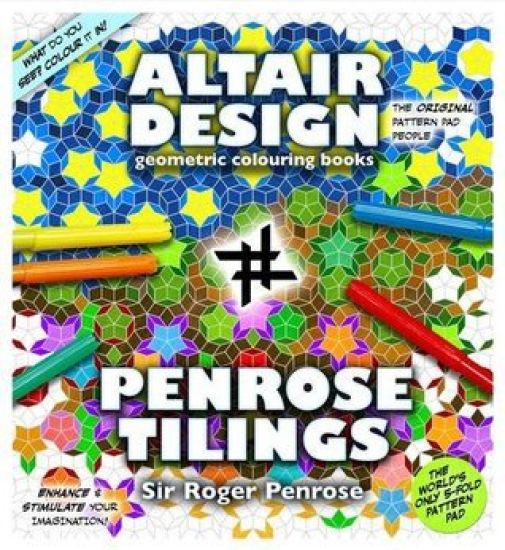
The one and only Penrose colouring book