

Kirjailija
Rolf Pfeifer
Kirjat ja teokset yhdessä paikassa: 5 kirjaa, julkaisuja vuosilta 2006-2025, suosituimpien joukossa Ich fahre einen Skoda. Vertaile teosten hintoja ja tarkista saatavuus suomalaisista kirjakaupoista.
5 kirjaa
Kirjojen julkaisuhaarukka 2006-2025.

The Playful Machine
Ralf Der; Georg Martius; Rolf Pfeifer
Springer-Verlag Berlin and Heidelberg GmbH Co. K
2016
nidottu
Autonomous robots may become our closest companions in the near future. While the technology for physically building such machines is already available today, a problem lies in the generation of the behavior for such complex machines. Nature proposes a solution: young children and higher animals learn to master their complex brain-body systems by playing. Can this be an option for robots? How can a machine be playful? The book provides answers by developing a general principle---homeokinesis, the dynamical symbiosis between brain, body, and environment---that is shown to drive robots to self- determined, individual development in a playful and obviously embodiment- related way: a dog-like robot starts playing with a barrier, eventually jumping or climbing over it; a snakebot develops coiling and jumping modes; humanoids develop climbing behaviors when fallen into a pit, or engage in wrestling-like scenarios when encountering an opponent. The book also develops guided self-organization, a new method that helps to make the playful machines fit for fulfilling tasks in the real world.The book provides two levels of presentation. Students and scientific researchers interested in the field of robotics, self-organization and dynamical systems theory may be satisfied by the in-depth mathematical analysis of the principle, the bootstrapping scenarios, and the emerging behaviors. But the book additionally comes with a robotics simulator inviting also the non- scientific reader to simply enjoy the fabulous world of playful machines by performing the numerous experiments.

The Playful Machine
Ralf Der; Georg Martius; Rolf Pfeifer
Springer-Verlag Berlin and Heidelberg GmbH Co. K
2012
sidottu
Autonomous robots may become our closest companions in the near future. While the technology for physically building such machines is already available today, a problem lies in the generation of the behavior for such complex machines. Nature proposes a solution: young children and higher animals learn to master their complex brain-body systems by playing. Can this be an option for robots? How can a machine be playful? The book provides answers by developing a general principle---homeokinesis, the dynamical symbiosis between brain, body, and environment---that is shown to drive robots to self- determined, individual development in a playful and obviously embodiment- related way: a dog-like robot starts playing with a barrier, eventually jumping or climbing over it; a snakebot develops coiling and jumping modes; humanoids develop climbing behaviors when fallen into a pit, or engage in wrestling-like scenarios when encountering an opponent. The book also develops guided self-organization, a new method that helps to make the playful machines fit for fulfilling tasks in the real world.The book provides two levels of presentation. Students and scientific researchers interested in the field of robotics, self-organization and dynamical systems theory may be satisfied by the in-depth mathematical analysis of the principle, the bootstrapping scenarios, and the emerging behaviors. But the book additionally comes with a robotics simulator inviting also the non- scientific reader to simply enjoy the fabulous world of playful machines by performing the numerous experiments.

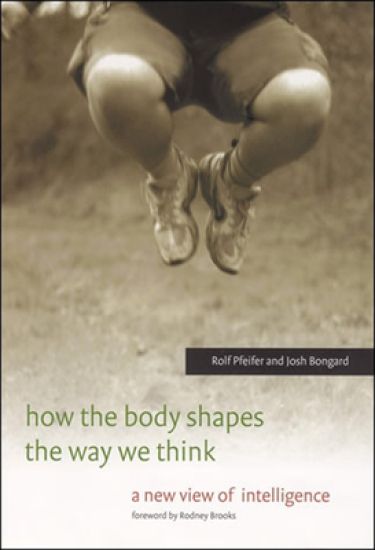
An exploration of embodied intelligence and its implications points toward a theory of intelligence in general; with case studies of intelligent systems in ubiquitous computing, business and management, human memory, and robotics.How could the body influence our thinking when it seems obvious that the brain controls the body? In How the Body Shapes the Way We Think, Rolf Pfeifer and Josh Bongard demonstrate that thought is not independent of the body but is tightly constrained, and at the same time enabled, by it. They argue that the kinds of thoughts we are capable of have their foundation in our embodiment—in our morphology and the material properties of our bodies.This crucial notion of embodiment underlies fundamental changes in the field of artificial intelligence over the past two decades, and Pfeifer and Bongard use the basic methodology of artificial intelligence—"understanding by building"—to describe their insights. If we understand how to design and build intelligent systems, they reason, we will better understand intelligence in general. In accessible, nontechnical language, and using many examples, they introduce the basic concepts by building on recent developments in robotics, biology, neuroscience, and psychology to outline a possible theory of intelligence. They illustrate applications of such a theory in ubiquitous computing, business and management, and the psychology of human memory. Embodied intelligence, as described by Pfeifer and Bongard, has important implications for our understanding of both natural and artificial intelligence.