Kirjojen hintavertailu. Mukana 12 390 323 kirjaa ja 12 kauppaa.

Kirjailija

Ron C. Mittelhammer

Kirjat ja teokset yhdessä paikassa: 4 kirjaa, julkaisuja vuosilta 2011-2015, suosituimpien joukossa Mathematical Statistics for Economics and Business. Vertaile teosten hintoja ja tarkista saatavuus suomalaisista kirjakaupoista.

4 kirjaa

Kirjojen julkaisuhaarukka 2011-2015.

Mathematical Statistics for Economics and Business

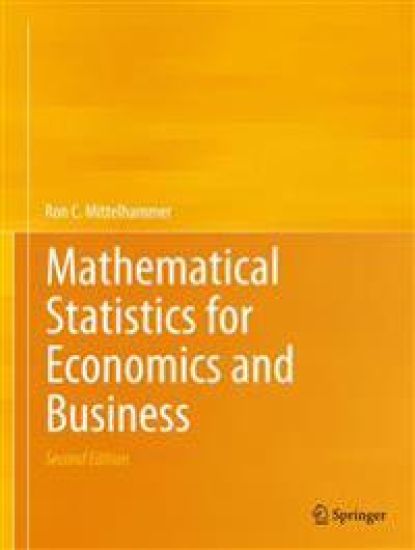
Mathematical Statistics for Economics and Business

Ron C. Mittelhammer

Springer-Verlag New York Inc.
2015
nidottu
Mathematical Statistics for Economics and Business, Second Edition, provides a comprehensive introduction to the principles of mathematical statistics which underpin statistical analyses in the fields of economics, business, and econometrics. The selection of topics in this textbook is designed to provide students with a conceptual foundation that will facilitate a substantial understanding of statistical applications in these subjects. This new edition has been updated throughout and now also includes a downloadable Student Answer Manual containing detailed solutions to half of the over 300 end-of-chapter problems. After introducing the concepts of probability, random variables, and probability density functions, the author develops the key concepts of mathematical statistics, most notably: expectation, sampling, asymptotics, and the main families of distributions. The latter half of the book is then devoted to the theories of estimation and hypothesis testing withassociated examples and problems that indicate their wide applicability in economics and business. Features of the new edition include: a reorganization of topic flow and presentation to facilitate reading and understanding; inclusion of additional topics of relevance to statistics and econometric applications; a more streamlined and simple-to-understand notation for multiple integration and multiple summation over general sets or vector arguments; updated examples; new end-of-chapter problems; a solution manual for students; a comprehensive answer manual for instructors; and a theorem and definition map.This book has evolved from numerous graduate courses in mathematical statistics and econometrics taught by the author, and will be ideal for students beginning graduate study as well as for advanced undergraduates.
Mathematical Statistics for Economics and Business

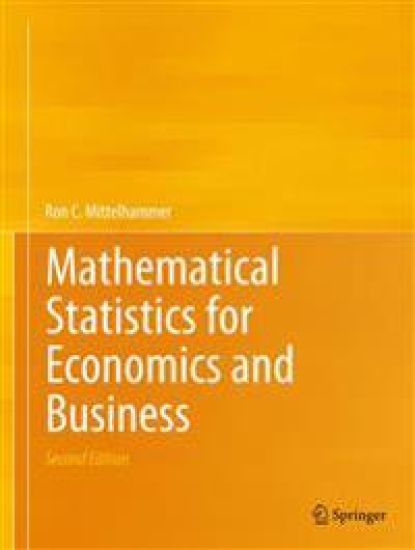
Mathematical Statistics for Economics and Business

Ron C. Mittelhammer

Springer-Verlag New York Inc.
2013
sidottu
Mathematical Statistics for Economics and Business, Second Edition, provides a comprehensive introduction to the principles of mathematical statistics which underpin statistical analyses in the fields of economics, business, and econometrics. The selection of topics in this textbook is designed to provide students with a conceptual foundation that will facilitate a substantial understanding of statistical applications in these subjects. This new edition has been updated throughout and now also includes a downloadable Student Answer Manual containing detailed solutions to half of the over 300 end-of-chapter problems. After introducing the concepts of probability, random variables, and probability density functions, the author develops the key concepts of mathematical statistics, most notably: expectation, sampling, asymptotics, and the main families of distributions. The latter half of the book is then devoted to the theories of estimation and hypothesis testing withassociated examples and problems that indicate their wide applicability in economics and business. Features of the new edition include: a reorganization of topic flow and presentation to facilitate reading and understanding; inclusion of additional topics of relevance to statistics and econometric applications; a more streamlined and simple-to-understand notation for multiple integration and multiple summation over general sets or vector arguments; updated examples; new end-of-chapter problems; a solution manual for students; a comprehensive answer manual for instructors; and a theorem and definition map.This book has evolved from numerous graduate courses in mathematical statistics and econometrics taught by the author, and will be ideal for students beginning graduate study as well as for advanced undergraduates.
An Information Theoretic Approach to Econometrics

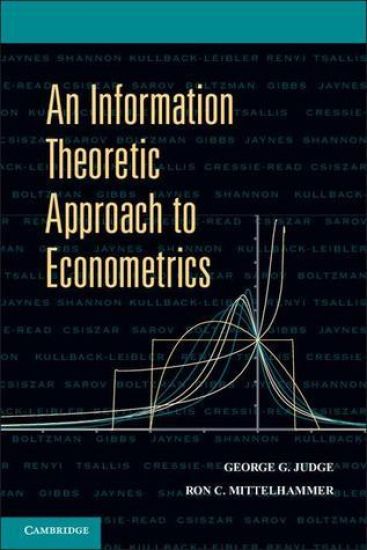
An Information Theoretic Approach to Econometrics

George G. Judge; Ron C. Mittelhammer

Cambridge University Press
2011
pokkari
This book is intended to provide the reader with a firm conceptual and empirical understanding of basic information-theoretic econometric models and methods. Because most data are observational, practitioners work with indirect noisy observations and ill-posed econometric models in the form of stochastic inverse problems. Consequently, traditional econometric methods in many cases are not applicable for answering many of the quantitative questions that analysts wish to ask. After initial chapters deal with parametric and semiparametric linear probability models, the focus turns to solving nonparametric stochastic inverse problems. In succeeding chapters, a family of power divergence measure-likelihood functions are introduced for a range of traditional and nontraditional econometric-model problems. Finally, within either an empirical maximum likelihood or loss context, Ron C. Mittelhammer and George G. Judge suggest a basis for choosing a member of the divergence family.
An Information Theoretic Approach to Econometrics

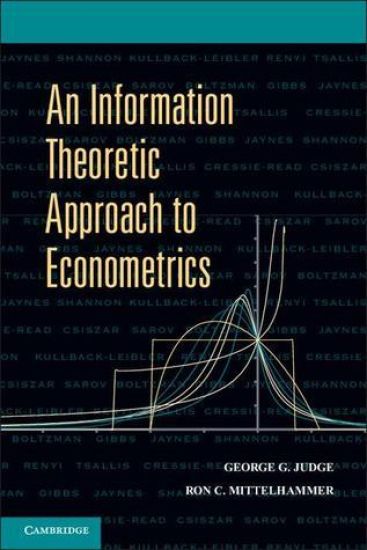
An Information Theoretic Approach to Econometrics

George G. Judge; Ron C. Mittelhammer

Cambridge University Press
2011
sidottu
This book is intended to provide the reader with a firm conceptual and empirical understanding of basic information-theoretic econometric models and methods. Because most data are observational, practitioners work with indirect noisy observations and ill-posed econometric models in the form of stochastic inverse problems. Consequently, traditional econometric methods in many cases are not applicable for answering many of the quantitative questions that analysts wish to ask. After initial chapters deal with parametric and semiparametric linear probability models, the focus turns to solving nonparametric stochastic inverse problems. In succeeding chapters, a family of power divergence measure-likelihood functions are introduced for a range of traditional and nontraditional econometric-model problems. Finally, within either an empirical maximum likelihood or loss context, Ron C. Mittelhammer and George G. Judge suggest a basis for choosing a member of the divergence family.